Genome sequence of cluster A6 bacteriophage Lilbunny, isolated using Mycobacterium smegmatis mc2155
Kyla Radke, Harry M. Peless, Hayzen H. Chamberlain, Shule M. Aggabao, Russell T. Ridd, David C. Amsbury, James R. Cannon, Tate G. Fisher, Payson C. Danielson, Matthew N. Jackson, Hyunbi Hwang, Jacob D. Scott, Elisa A. Correa Lazaro, Atalie B. Bogh, Jayden S. Longhurst

TL;DR
This paper reports the genome sequence of a new bacteriophage, Lilbunny, isolated from rabbit fecal compost and infecting Mycobacterium smegmatis.
Contribution
The study provides the first genome sequence of a cluster A6 bacteriophage isolated from rabbit fecal compost.
Findings
Lilbunny's genome is 50,789 bp and contains 95 open reading frames.
Approximately 52.6% of the open reading frames encode proteins with predicted functions.
The genome includes three tRNA genes.
Abstract
Bacteriophage Lilbunny is a siphovirus infecting Mycobacterium smegmatis strain mc2155. It was isolated from compost of rabbit fecal matter. The genome of Lilbunny belongs to the A6 subcluster and is 50,789 bp, containing 95 open reading frames, 52.6% of which encode proteins with predicted functions, and three tRNA genes.
Genes, proteins, chemicals, diseases, species, mutations and cell lines named across the full text — each resolved to its canonical identifier and authoritative record.
Click any figure to enlarge with its caption.
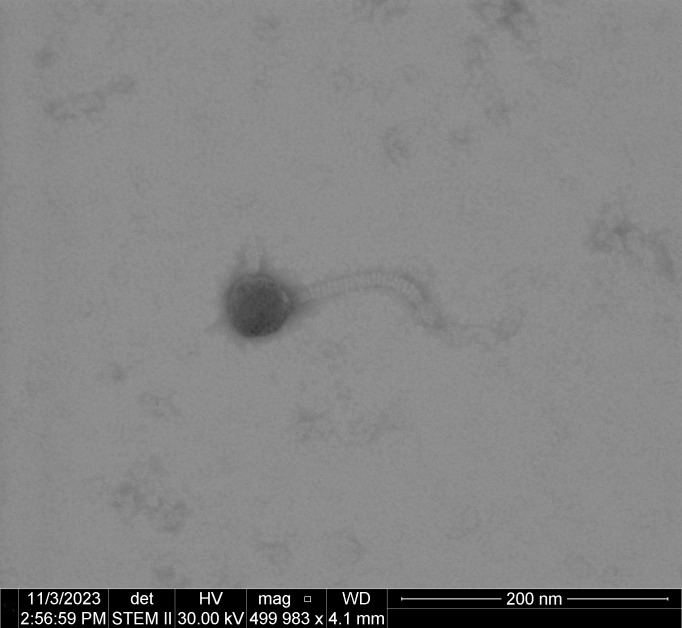 Fig 1
Fig 1Peer Reviews
No public reviews on file for this paper yet. If you reviewed it on a platform where reviews are public (OpenReview, ICLR, NeurIPS, ICML), you can paste yours below so the community can read it here.
Videos
No videos yet. Explain this paper in a talk, walkthrough, or lecture? Add one.
Taxonomy
TopicsBacteriophages and microbial interactions · Genomics and Phylogenetic Studies · RNA and protein synthesis mechanisms
ANNOUNCEMENT
The Lilbunny phage was isolated from ~100 g of rabbit feces compost in Provo, Utah, on 1 October 2023. Phages were isolated by shaking in 7H9 liquid medium, then 0.2 micron-filtering and triplicate M. smegmatis mc^2^155 plaque assays (37°C incubation for 48 hours). Plaques were clear with a ~2 mm diameter. Negative-stained transmission electron microscopy (2% uranyl-acetate) revealed a virion with siphovirus morphology and a length of ~200 nm (Fig. 1).
Negative-stained transmission electron micrograph of the 200 nm Lilbunny phage (500,000× magnification, 30 kV accelerating voltage, Tecnai TF-20).
High-titer lysate was sent to CD Genomics, where 0.5 µg DNA was extracted using the phage DNA isolation kit (Norgen) protocol prior to DNA sequencing. NEBNext Ultra DNA Library Prep Kit for Illumina (NEB, USA) following manufacturer’s recommendations and indices were used. DNA samples were sonicated to 350 bp, then end-polished, A-tailed, and ligated with the full-length adaptor for sequencing. The product was purified (AMPure XP system) and quantified with an Agilent 2100 Bioanalyzer and qPCR. In addition, 2.74 million 150 bp paired-end reads were generated using Illumina NovaSeq X PE150. TrimGalore was applied with a minimum length of 20 bases and minimum phred score of 20 (1), then de novo assembly of the 1.4 million reads using CONSED 2.9 (2) with Unicycler version 0.5.0 (3), resulting in a 50,739 base-pair genome (4,051× coverage) with 61.5% G + C content. The phage sequence, assigned to the Gladiatorvirus genus, has a 10-base 3´ sticky overhang sequence (CGGTCGGTAA; phagesdb.org) and was assigned to subcluster A6 using BLAST. Plaque morphology and similarity with other members of this cluster suggest that this phage has a temperate life cycle.
Annotation of the genome sequence used DNA Master v.5.0.2 (4), Glimmer v.3.0 (5), and GeneMark v.2.5 (6), and refined using Phamerator (7) and Starterator (https://phagesdb.org/). HHPRED (8) and BLASTP (9) searches confirmed annotations. We identified 95 protein-coding genes and three tRNA genes for aspartic acid, tryptophan, and glutamine, which were determined by Aragorn (10) and tRNAscan-SE (11). We identified open reading frames that putatively encode a holin, a DnaB-like helicase, and a metallophosphatase.
The reference list from the paper itself. Each links out to its DOI / PubMed record.
- 1Git Hub. Felix Krueger/Trim Galore: a wrapper around Cutadapt and Fast QC to consistently apply adapter and quality trimming to Fast Q files, with extra functionality for RRBS data. Git Hub. Available from: https://github.com/Felix Krueger/Trim Galore
- 2Gordon D, Green P. 2013. Consed: a graphical editor for next-generation sequencing. Bioinformatics 29:2936–2937. doi:10.1093/bioinformatics/btt 51523995391 PMC 3810858 · doi ↗ · pubmed ↗
- 3Wick RR, Judd LM, Gorrie CL, Holt KE. 2017. Unicycler: resolving bacterial genome assemblies from short and long sequencing reads. P Lo S Comput Biol 13:e 1005595. doi:10.1371/journal.pcbi.100559528594827 PMC 5481147 · doi ↗ · pubmed ↗
- 4Pope WH, Jacobs-Sera D. 2018. Annotation of bacteriophage genome sequences using DNA master: an overview. Methods Mol Biol 1681:217–229. doi:10.1007/978-1-4939-7343-9_1629134598 · doi ↗ · pubmed ↗
- 5Delcher AL, Bratke KA, Powers EC, Salzberg SL. 2007. Identifying bacterial genes and endosymbiont DNA with glimmer. Bioinformatics 23:673–679. doi:10.1093/bioinformatics/btm 00917237039 PMC 2387122 · doi ↗ · pubmed ↗
- 6Besemer J, Borodovsky M. 2005. Gene Mark: web software for gene finding in prokaryotes, eukaryotes and viruses. Nucleic Acids Res 33:W 451–W 454. doi:10.1093/nar/gki 48715980510 PMC 1160247 · doi ↗ · pubmed ↗
- 7Cresawn SG, Bogel M, Day N, Jacobs-Sera D, Hendrix RW, Hatfull GF. 2011. Phamerator: a bioinformatic tool for comparative bacteriophage genomics. BMC Bioinformatics 12:2105–12 doi:10.1186/1471-2105-12-395PMC 323361221991981 · doi ↗ · pubmed ↗
- 8Söding J, Biegert A, Lupas AN. 2005. The H Hpred interactive server for protein homology detection and structure prediction. Nucleic Acids Res 33:W 244–W 248. doi:10.1093/nar/gki 40815980461 PMC 1160169 · doi ↗ · pubmed ↗