Recovery of 26 metagenome-assembled genomes from the phycosphere of the marine diatom Skeletonema tropicum
Tian Xia, Jiayi Yang, Songze Chen, Huiquan Li, Shuaishuai Xu, Kangli Guo, Shengwei Hou

TL;DR
Scientists recovered 26 high-quality genomes from the marine diatom Skeletonema tropicum's surrounding microbiota, which can help study their interactions.
Contribution
The study presents 26 high-quality metagenome-assembled genomes from the phycosphere of Skeletonema tropicum.
Findings
Most MAGs were highly complete (>90%) with minimal contamination (<5%).
The MAGs can serve as reference genomes for studying interactions between Skeletonema and its phycosphere microbiota.
Abstract
Metagenome-assembled genomes (MAGs) were recovered from the phycosphere of marine diatom Skeletonema tropicum, which has been long-term maintained in artificial seawater. Most MAGs were found to be highly complete (>90%) with minimum contaminations (<5%), which could serve as reference genomes to investigate the interactions between Skeletonema and their phycosphere microbiota.
Genes, proteins, chemicals, diseases, species, mutations and cell lines named across the full text — each resolved to its canonical identifier and authoritative record.
Click any figure to enlarge with its caption.
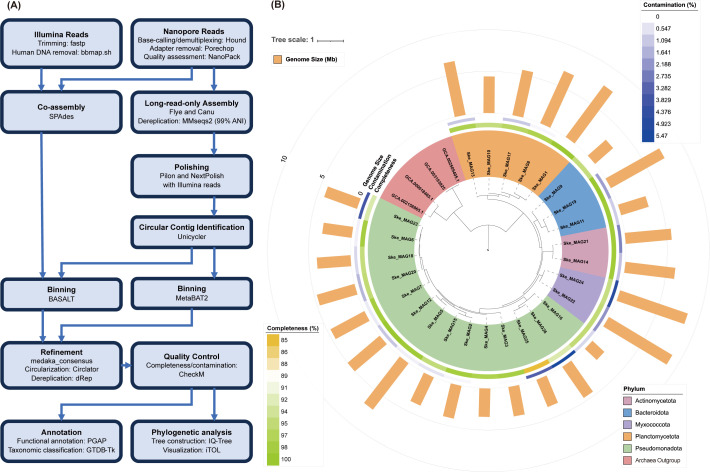 Fig 1
Fig 1| MAG name | Length (Mb) | Completeness (%) | Contamination (%) | N50 (Mb) | Contig numbers | NCBI GenBank accessions |
|---|---|---|---|---|---|---|
| Ske_MAG1 | 7.70 | 99.93 | 0 | 0.57 | 28 |
|
| Ske_MAG2 | 4.03 | 98.8 | 0.2 | 1.00 | 16 |
|
| Ske_MAG3 | 3.58 | 98.32 | 0.16 | 3.58 | 1 |
|
| Ske_MAG4 | 3.41 | 97.61 | 0 | 0.57 | 13 |
|
| Ske_MAG5 | 7.03 | 99.31 | 0.32 | 0.31 | 37 |
|
| Ske_MAG6 | 3.57 | 98.51 | 0.32 | 3.21 | 3 |
|
| Ske_MAG7 | 4.61 | 98.7 | 0.4 | 0.28 | 19 |
|
| Ske_MAG8 | 6.89 | 97.63 | 0.19 | 0.24 | 48 |
|
| Ske_MAG9 | 2.88 | 95.46 | 0 | 1.67 | 6 |
|
| Ske_MAG10 | 4.39 | 95.45 | 0 | 0.12 | 52 |
|
| Ske_MAG11 | 3.45 | 99.34 | 0.99 | 1.02 | 6 |
|
| Ske_MAG12 | 5.04 | 100 | 1.19 | 1.37 | 16 |
|
| Ske_MAG13 | 6.59 | 97.73 | 1.14 | 6.59 | 1 |
|
| Ske_MAG14 | 6.03 | 99.15 | 1.28 | 0.14 | 76 |
|
| Ske_MAG15 | 3.75 | 95.59 | 0.6 | 0.05 | 135 |
|
| Ske_MAG16 | 1.95 | 95.64 | 0.78 | 0.04 | 95 |
|
| Ske_MAG17 | 5.57 | 96.67 | 1.11 | 0.42 | 22 |
|
| Ske_MAG18 | 4.06 | 95.41 | 0.81 | 0.13 | 56 |
|
| Ske_MAG19 | 7.39 | 100 | 2.02 | 0.18 | 88 |
|
| Ske_MAG20 | 4.70 | 95.76 | 1.52 | 0.23 | 37 |
|
| Ske_MAG21 | 5.54 | 99.15 | 2.56 | 0.87 | 15 |
|
| Ske_MAG22 | 8.87 | 95.65 | 2.28 | 0.36 | 53 |
|
| Ske_MAG23 | 4.18 | 93.36 | 3.78 | 0.06 | 199 |
|
| Ske_MAG24 | 8.58 | 95.16 | 4.7 | 0.17 | 83 |
|
| Ske_MAG25 | 3.54 | 85.47 | 3.35 | 0.01 | 693 |
|
| Ske_MAG26 | 4.53 | 93.28 | 5.47 | 0.01 | 525 |
|
- —National Natural Science Foundation of Chinahttp://dx.doi.org/10.13039/501100001809
- —Science, Technology and Innovation Commission of Shenzhen Municipalityhttp://dx.doi.org/10.13039/501100010877
Peer Reviews
No public reviews on file for this paper yet. If you reviewed it on a platform where reviews are public (OpenReview, ICLR, NeurIPS, ICML), you can paste yours below so the community can read it here.
Videos
No videos yet. Explain this paper in a talk, walkthrough, or lecture? Add one.
Taxonomy
TopicsMicrobial Community Ecology and Physiology · Genomics and Phylogenetic Studies · Diatoms and Algae Research
ANNOUNCEMENT
Diatom-bacteria interactions have developed over 200 million years (1), forming complex relationships that facilitate nutrient exchange and biogeochemical cycling. These interactions are predominantly mutualistic, where bacteria obtain organic matter from diatoms, while diatoms benefit from essential nutrients like vitamins and remineralized nitrogen supplied by bacteria (1–3). Understanding the metabolic capacity of phycosphere microbiota and their interactions with host phytoplankton is vital for understanding the growth dynamics of marine phytoplankton and their contribution to global biogeochemical cycles.
Here, we report the recovery of 24 high-quality and two medium-quality metagenome-assembled genomes (MAGs) (4) from the hybrid metagenomic sequencing of a laboratory-maintained long-term culture of the marine diatom Skeletonema tropicum. This diatom was initially collected from the Pearl River Estuary in 2013 and has been maintained in non-axenic artificial seawater supplemented with f/2 medium at 20°C under 12:12 hour light/dark cycles. DNA was extracted and sequenced by Illumina and QitanTech Nanopore to obtain shotgun and long reads. The detailed information on DNA extraction, library preparation, and sequencing can be found in Guo et al. (5).
As shown in Fig. 1A, Illumina reads were first trimmed using fastp v0.19.5 (6). Human genome contaminations were removed using bbmap.sh (minid = 0.95, maxindel = 3, bwr = 0.16, bw = 12, quickmatch, fast) (http://sourceforge.net/projects/bbmap). Nanopore reads were base-called and demultiplexed using Hound v1.1 (Qitan Technology Co.). Adapters were removed using Porechop v0.2.4 (7), and the sequence quality was assessed using NanoPack v1.25.0 (8). Nanopore and Illumina reads were co-assembled by SPAdes v3.15.5 (-k 21,33,55,77,99,127) (9). Besides, the Nanopore reads were assembled by Flye v2.9 (10) and Canu v2.2 (11) and dereplicated by MMseqs2 (12) at 99% average nucleotide identity (ANI). The dereplicated contigs were then polished using Pilon v1.24 (13) and NextPolish v1.4.0 (14) with Illumina reads, and Unicycler v0.4.8 (15) was used to identify and clean circular contigs from the polished assemblies. MetaBAT2 v2.12.1 (16) was used for metagenomic binning based on coverage derived from Nanopore read mapping using minimap2 v2.22 (17). BASALT (18) was also used for binning based on the coverage of Illumina and Nanopore reads, and medaka_consensus (https://github.com/nanoporetech/medaka) was used to make consensus MAGs. MAGs were further circularized by Circlator (19) and dereplicated into unique MAGs using dRep v3.4.0 (-comp 50 -con 10) (20) at 98% ANI.
The computational workflow (A) and maximum likelihood phylogenetic tree (B) of the 26 MAGs recovered from the phycosphere of S. tropicum. Software versions can be found in the main text. Four archaea genomes (two MGI and two MGII) were used as the outgroup to root this phylogenomic tree. Shading colors represent the affiliated phyla of these MAGs. Detailed MAG genomic size, completeness, contamination, N50, and contig number information can be found in Table 1.
In total, 132 million clean short reads (39.74 Gbp) and 1.76 million clean long reads (4.6 Gbp raw data) were generated by Illumina and Nanopore sequencing, respectively (5). Twenty-six MAGs were recovered from the hybrid sequencing and metagenomic binning (Table 1). The completeness and contamination of these MAGs were estimated using CheckM v.1.2.1 (21), and taxonomy was classified using GTDB-Tk v2.1.1 (22) with the database GTDB v214. The 26 MAGs are affiliated with five bacterial phyla. A maximum likelihood phylogenetic tree was constructed using IQ-Tree v1.6.12 (-m LG+R10 -B 1000 -bnni -T AUTO -mem 500G) (23) and visualized using the iTOL Web server (https://itol.embl.de, Fig. 1B). Genomic annotation was done using PGAP (24). All tools described above were run with default parameters unless otherwise noted. The availability of these MAGs may facilitate studies of diatom-bacterial interactions in the ocean.
The reference list from the paper itself. Each links out to its DOI / PubMed record.
- 1Di Costanzo F, Di Dato V, Romano G. 2023. Diatom-bacteria interactions in the marine environment: complexity, heterogeneity, and potential for biotechnological applications. Microorganisms 11:12. doi:10.3390/microorganisms 11122967 PMC 1074584738138111 · doi ↗ · pubmed ↗
- 2Stock W, Blommaert L, De Troch M, Mangelinckx S, Willems A, Vyverman W, Sabbe K. 2019. Host specificity in diatom-bacteria interactions alleviates antagonistic effects. FEMS Microbiol Ecol 95:fiz 171. doi:10.1093/femsec/fiz 17131647551 · doi ↗ · pubmed ↗
- 3Amin SA, Parker MS, Armbrust EV. 2012. Interactions between diatoms and bacteria. Microbiol Mol Biol Rev 76:667–684. doi:10.1128/MMBR.00007-1222933565 PMC 3429620 · doi ↗ · pubmed ↗
- 4Bowers RM, Kyrpides NC, Stepanauskas R, Harmon-Smith M, Doud D, Reddy TBK, Schulz F, Jarett J, Rivers AR, Eloe-Fadrosh EA, et al.. 2017. Minimum information about a single amplified genome (MISAG) and a metagenome-assembled genome (MIMAG) of bacteria and archaea. Nat Biotechnol 35:725–731. doi:10.1038/nbt.389328787424 PMC 6436528 · doi ↗ · pubmed ↗
- 5Guo K, Xu S, Liu Y, Chen Z, Hou S. 2023. Complete genome sequence of a cognatishimia activa strain assembled from the phycosphere of the marine diatom skeletonema tropicum. Microbiol Resour Announc 12:e 0116422. doi:10.1128/mra.01164-2236598233 PMC 9872673 · doi ↗ · pubmed ↗
- 6Chen S. 2023. Ultrafast one-pass FASTQ data preprocessing, quality control, and deduplication using fastp. Imeta 2:e 107. doi:10.1002/imt 2.10738868435 PMC 10989850 · doi ↗ · pubmed ↗
- 7Wick R. 2017. Porechop: adapter trimmer for Oxford Nanopore reads. Available from: https://github.com/rrwick/Porechop/
- 8De Coster W, Rademakers R. 2023. Nano Pack 2: population-scale evaluation of long-read sequencing data. Bioinformatics 39:btad 311. doi:10.1093/bioinformatics/btad 31137171891 PMC 10196664 · doi ↗ · pubmed ↗