Draft genome sequences of five glacial fungi from Styx Glacier, Antarctica
Ji Seon Kim, Chang Wan Seo, Young Woon Lim

TL;DR
This paper presents draft genomes of four fungi from Antarctica's Styx Glacier, revealing how they adapt to extreme environments and their possible uses in biotechnology.
Contribution
The study provides new draft genomes of glacial fungi, offering insights into their adaptation and biotechnological potential.
Findings
Four high-quality draft genomes of fungi from Styx Glacier were generated.
The genomes reveal evolutionary adaptations to extreme glacial environments.
Potential biotechnological applications of these fungi were identified.
Abstract
We generated four high-quality draft genomes of fungi isolated from Styx Glacier, Antarctica. The genome announcement of these fungal strains offers insights into their evolution and adaptation to extreme glacial environments, as well as their potential biotechnological applications.
Genes, proteins, chemicals, diseases, species, mutations and cell lines named across the full text — each resolved to its canonical identifier and authoritative record.
Click any figure to enlarge with its caption.
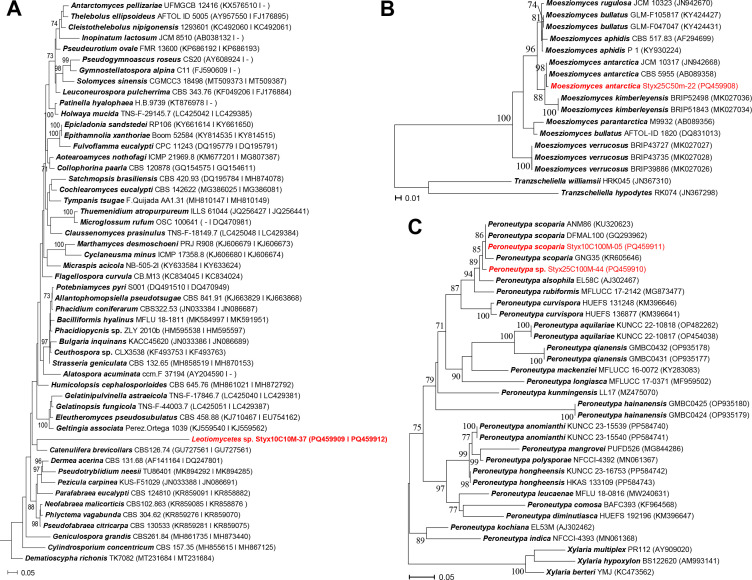 Fig 1
Fig 1| Strain no. | Styx10C10M-37 | Styx25C50M-22 | Styx10C100M-05 | Styx25C100M-44 | |
|---|---|---|---|---|---|
|
|
|
| |||
| Tryptone soy broth/10°C | Nutrient broth/25°C | Tryptone soy broth/10°C | Potato dextrose broth/25°C | ||
|
| GenBank accession no. | ITS: |
|
| ITS: |
| BioSample ID |
|
|
|
| |
| Assembly ID |
|
|
|
| |
| BioProject ID |
|
|
|
| |
|
| SRA accession no. |
|
|
|
|
| Total bases (bp) | 5,829,209,436 | 5,919,985,200 | 4,800,517,406 | 5,339,958,564 | |
| No. of reads | 38,604,036 | 39,205,200 | 31,791,506 | 35,363,964 | |
|
| SRA accession no. |
|
|
|
|
| Total bases (bp) | 4,714,916,066 | 5,531,211,399 | 5,973,422,600 | 12,559,060,800 | |
| No. of reads | 2,403,038 | 549,979 | 252,618 | 2,186,363 | |
| 3,247 | 22,456 | 44,087 | 33,005 | ||
|
| Assembler type | NextDenovo | Flye | Flye | NextDenovo |
| Contig no. | 3 | 34 | 15 | 13 | |
| Genome size (bp) | 26,888,994 | 18,515,233 | 47,265,203 | 47,860,354 | |
| Nanopore coverage (×) | 102.74 | 279 | 96 | 301.38 | |
| NovaSeq coverage (×) | 99 | 299 | 91 | 99 | |
| GC content (%) | 47.78 | 60.78 | 50.27 | 49.56 | |
| 2 | 7 | 4 | 4 | ||
| 6,884,066 | 747,440 | 5,744,238 | 5,591,736 | ||
- —Korea Polar Research Institutehttp://dx.doi.org/10.13039/501100004230
- —Korea Institute of Marine Science and Technology promotionhttp://dx.doi.org/10.13039/501100011705
- —Korea Institute of Marine Science and Technology promotionhttp://dx.doi.org/10.13039/501100011705
Peer Reviews
No public reviews on file for this paper yet. If you reviewed it on a platform where reviews are public (OpenReview, ICLR, NeurIPS, ICML), you can paste yours below so the community can read it here.
Videos
No videos yet. Explain this paper in a talk, walkthrough, or lecture? Add one.
Taxonomy
TopicsPolar Research and Ecology · Protist diversity and phylogeny · Microbial Community Ecology and Physiology
ANNOUNCEMENT
Glaciers entrap various ancient elements, such as organic/inorganic particles and gases (1–3), and there have been some reports of entrapped microbes with potential for resuscitation (2, 4, 5). In 2023, we isolated historical fungal strains from glacial cores sampled from the Styx glacier, Antarctica (−73.851667, 163.687000) through collaboration with the Division of Glacier and Earth Sciences of the Korea Polar Research Institute (6). Four strains were selected based on the need for further taxonomic and ecological characterization (e.g., unique traits or understudied taxonomic groups) (see Table 1 for detailed strain information).
For taxonomic identification, genomic DNA extraction, PCR amplification, and sequencing were performed following the methods described in previous studies (7). Primer sets ITS1/ITS4 (8) and LR0R/LR5 (9) were used for amplifying ITS and nrLSU regions, respectively, with the same primer sets utilized for both PCR and sequencing. Sequences were manually edited using Geneious Prime version 2024.0.7 (https://www.geneious.com) and then deposited in GenBank (Table 1). Sequences were aligned with reference sequences using MAFFT with the L-INS-i option (10), and a phylogenetic tree was constructed with RAxML employing the GTR + GAMMA model and 1,000 bootstrap replicates (11). Taxonomic identification was finalized based on the phylogenetic trees (Fig. 1).
Maximum likelihood phylogenetic trees for the identification of four glacial fungal strains, highlighting those in color. (A) Phylogenetic tree of the Leotiomycetes lineage based on ITS and LSU for identifying Leotiomycetes sp. (Styx10C10M-37). (B) ITS-based phylogenetic tree of the genus Moesziomyces for identifying Moesziomyces antarcticus (Styx25C50M-22). (C) ITS-based phylogenetic tree of the genus Peroneutypa lineage for identifying Peroneutypa scoparia (Styx10C100M-05) and Peroneutypa sp. (Styx25C100M-44). Each branch leaf shows the species name followed by the strain number. GenBank accession numbers for the strains are shown in panel A with ITS and LSU in parentheses, and in panels B and C, only the ITS number is provided.
For genome sequencing, strains for high-molecular-weight (HMW) DNA extraction were grown in 150 mL potato dextrose broth (Difco, USA) at 25°C with shaking at 150 rpm. Mycelia were dehydrated using a vacuum pump (GAST, USA), and HMW DNA was extracted with the Promega Wizard high-molecular-weight (HMW) extraction kit (Madison, WI) or a modified CTAB protocol. Genomic DNA was sequenced using a combination of NovaSeq 6000 and Oxford Nanopore Technologies (ONT) platforms. For long-read sequencing, library preparation and sequencing were conducted at the National Instrumentation Center for Environmental Management, Seoul National University (Republic of Korea). Libraries were constructed using the Ligation Sequencing Kit (SQK-LSK-109; ONT, UK) without shearing. Small DNA fragments were removed with a Circulomics Short Read Eliminator kit, and sequencing was performed on a PromethION 24 with an R9.4.1 flow cell and MinKNOW 21.11.7. Long-read sequence data were filtered and base-called with Guppy version 6.5.7 (https://community.nanoporetech.com). Raw reads were trimmed using Porechop version 0.2.4 (https://github.com/rrwick/Porechop). For short-read polishing, library preparation and sequencing were conducted at Macrogen (Republic of Korea). The library was constructed using the TruSeq Nano DNA kit, followed by sequencing on the Illumina NovaSeq 6000 platform with paired-end 2 × 151 bp reads. Raw reads were trimmed with fastp version 0.23.2 (12) using default settings and assembled using NextDenovo version 2.5.2 (13) or Flye version 2.9.2 (14). The assembled reads were polished with four rounds each of Racon version 1.5.0 (15) and Hapo-G version 1.3.1 (16). Assembly quality and completeness statistics, including N50 and L50, were obtained using QUAST version 5.2.0 (17). Tapestry version 1.0.0 was used to visualize sequencing depth uniformity, contiguity, and telomere completeness, with telomere “CTGGTG” (18). Contig selection was performed via Tapestry version 1.0.0. Data from the final assemblies are summarized in Table 1.
The reference list from the paper itself. Each links out to its DOI / PubMed record.
- 1Cuffey KM, Paterson WSB. 2010. The physics of glaciers. Academic Press.
- 2Abyzov SS, Hoover RB, Imura S, Mitskevich IN, Naganuma T, Poglazova MN, Ivanov MV. 2004. Use of different methods for discovery of ice-entrapped microorganisms in ancient layers of the Antarctic glacier. Adv Space Res 33:1222–1230. doi:10.1016/j.asr.2003.08.033 · doi ↗
- 3La Farge C, Williams KH, England JH. 2013. Regeneration of little ice age bryophytes emerging from a polar glacier with implications of totipotency in extreme environments. Proc Natl Acad Sci USA 110:9839–9844. doi:10.1073/pnas.130419911023716658 PMC 3683725 · doi ↗ · pubmed ↗
- 4Zhong Z-P, Tian F, Roux S, Gazitúa MC, Solonenko NE, Li Y-F, Davis ME, Van Etten JL, Mosley-Thompson E, Rich VI, Sullivan MB, Thompson LG. 2021. Glacier ice archives nearly 15,000-year-old microbes and phages. Microbiome 9:160. doi:10.1186/s 40168-021-01106-w 34281625 PMC 8290583 · doi ↗ · pubmed ↗
- 5de Menezes GCA, Porto BA, Amorim SS, Zani CL, de Almeida Alves TM, Junior PAS, Murta SMF, Simões JC, Cota BB, Rosa CA, Rosa LH. 2020. Fungi in glacial ice of Antarctica: diversity, distribution and bioprospecting of bioactive compounds. Extremophiles 24:367–376. doi:10.1007/s 00792-020-01161-532157393 · doi ↗ · pubmed ↗
- 6Han Y, Jun SJ, Miyahara M, Lee HG, Ahn J, Chung JW, Hur SD, Hong SB. 2015. Shallow ice-core drilling on Styx glacier, northern Victoria Land, Antarctica in the 2014-2015 summer. JGSK 51:343. doi:10.14770/jgsk.2015.51.3.343 · doi ↗
- 7Kim JS, Cho Y, Park KH, Park JH, Kim M, Kim CS, Lim YW. 2022. Taxonomic study of Collybiopsis (Omphalotaceae, Agaricales) in the Republic of Korea with seven new species. Myco Keys 88:79–108. doi:10.3897/mycokeys.88.7926635585931 PMC 9005495 · doi ↗ · pubmed ↗
- 8White TJ, Bruns T, Lee S, Taylor J. 1990. Amplification and direct sequencing of fungal ribosomal RNA genes for phylogenetics. PCR protocols: a guide to methods and applications. PCR Protocols 18:315–322. doi:10.1016/B 978-0-12-372180-8.50042-1 · doi ↗