Draft genomes of five putative biosurfactant-producing Serratia sp. isolates from Laguna de Bay, Philippines
Nacita B. Lantican, Glaezel Angelique T. Barredo, Albert R. Rosana, Ann Clarisse S.V. Siababa, Andrew D. Montecillo

TL;DR
This paper presents draft genomes of five Serratia sp. bacteria from Laguna de Bay, Philippines, which may produce biosurfactants.
Contribution
The study provides new draft genome sequences of Serratia sp. isolates with potential biosurfactant production capabilities.
Findings
Five Serratia sp. isolates from different bays of Laguna de Bay were sequenced.
Genome lengths ranged from 5,175,553 to 5,214,031 base pairs.
Abstract
Here, we report on the draft genomes of five putative biosurfactant-producing isolates of Serratia sp. from the East, West, and South bays of Laguna de Bay, Philippines. The contigs ranged from 20 to 21, and the genome lengths ranged from 5,175,553 to 5,214,031 bp.
Genes, proteins, chemicals, diseases, species, mutations and cell lines named across the full text — each resolved to its canonical identifier and authoritative record.
Click any figure to enlarge with its caption.
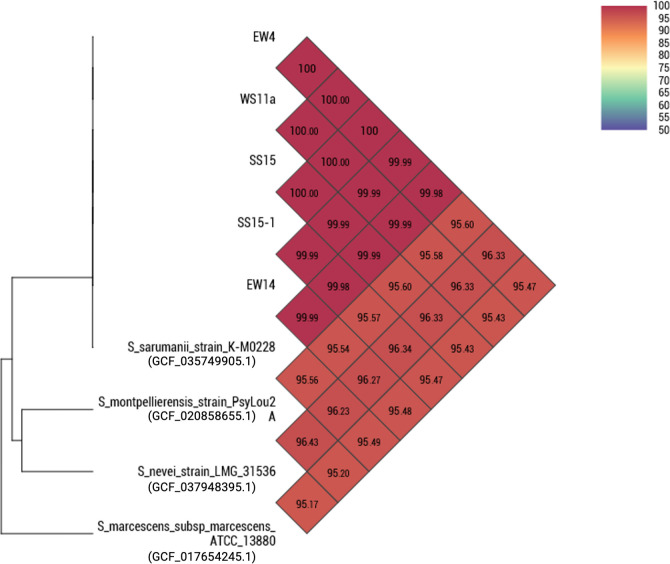 Fig 1
Fig 1| Isolate code | Location and sample type | Whole-genome sequence accession | SRA accession number | Genome size (bp) | Gc | Filtered reads used in the assembly | Mean depth | Contigs | N50 | Predicted total | BUSCO | Nearest genome match |
|---|---|---|---|---|---|---|---|---|---|---|---|---|
| EW14 | East Bay—water |
| | 5,175,553 | 60 | 48,466,944 | 1,414 | 21 | 2,618,309 | 4,920; 4,832; 4,806 | 95.2 | |
| EW4 | East Bay—water |
| | 5,214,031 | 60 | 41,897,142 | 1,213 | 20 | 2,886,712 | 4,982; 4,892; 4,866 | 95.2 | |
| SS15 | South Bay—sediment |
| | 5,213,867 | 60 | 48,884,526 | 1,416 | 20 | 2,886,724 | 4,980; 4,892; 4,866 | 95.2 | |
| SS15-1 | South Bay—sediment |
| | 5,213,181 | 60 | 45,959,424 | 1,331 | 21 | 2,886,712 | 4,978; 4,890; 4,864 | 95.2 | |
| WS11a | West Bay—sediment |
| | 5,213,854 | 60 | 47,766,626 | 1,383 | 20 | 2,886,712 | 4,980; 4,892, 4,866 | 95.2 |
- —University of the Philippineshttp://dx.doi.org/10.13039/501100007421
Peer Reviews
No public reviews on file for this paper yet. If you reviewed it on a platform where reviews are public (OpenReview, ICLR, NeurIPS, ICML), you can paste yours below so the community can read it here.
Videos
No videos yet. Explain this paper in a talk, walkthrough, or lecture? Add one.
Taxonomy
TopicsGenomics and Phylogenetic Studies · Microbial Community Ecology and Physiology · Enzyme Production and Characterization
ANNOUNCEMENT
Laguna de Bay is the largest inland wetland lake in the Philippines located around Metro Manila and extends to the province of Rizal and Laguna. It is extensively being used for fishing, source of food, and for irrigation. The extent of pollution is, however, very high with diverse sources of pollutants from household, agriculture, and industry; hence, it is expected to have high concentrations of hydrocarbons (1). The presence of biosurfactant-producing microorganisms would be an important factor in bioremediating such polluted bodies of water.
Five putative biosurfactant-producing bacterial strains were isolated from sediments and water samples from various sites (East, West, and South bays) in Laguna de Bay (14.3935° N, 121.1939° E) (2) following the method of Shoeb et al. (3). Briefly, for each sample, 1 g of sediment or 1 mL of lake water samples was diluted 10-fold using maximum recovery diluent (0.85% NaCl and 0.15% peptone). Dilutions were plated on nutrient agar plates and incubated at 30°C for 24 to 48 h. Single-colony isolates were subcultured on the same medium until axenic cultures were obtained and confirmed microscopically. Cell pellets were sent to Macrogen, Inc., South Korea for 16S rRNA gene and whole-genome sequencing. Sample preparation and DNA extraction were performed following the standard procedures of Macrogen Identification Services. The boiling method using Instagene matrix was used to extract the total DNA, followed by PCR amplification and sequencing. For whole-genome sequencing, TruSeq DNA Nano Library Preparation Kit (Illumina, San Diego, CA) and 2 × 150 bp cycle were used in Illumina NovaSeq 6000 (Illumina, San Diego, CA).
Paired-end raw reads were assessed and trimmed using fastp v.0.23.4 (4) with default parameters. De novo assembly was done in Unicycler v.0.5.1 (5) with default parameters, and assembly quality was assessed using QUAST v4.6 (6). Contigs with less than 500 bp length were discarded. The draft genome sequences were annotated using the National Center for Biotechnology Information (NCBI) Prokaryotic Genome Annotation Pipeline (PGAP) (7), and taxonomic placement of the isolates was established using the Microbial Genomes Atlas tool (8) by 16S SSU rRNA classification based on RDP 16S rRNA training set No. 19 07/2023 and RDP Naive Bayesian rRNA Classifier Version 2.14 and by calculating the average nucleotide identity (ANI) in comparison to entries in the NCBI TypeMat database (release 2024-08). Assembly completeness was determined in BUSCO v.5.8.0 (9) with bacteria_odb10 lineage data set. Default parameters were used with all tools, unless otherwise specified. GenBank and SRA accession numbers, sequencing, assembly, and annotation information for each isolate were summarized in Table 1. Digital DNA–DNA hybridization (dDDH) values (formula 2) were calculated against the nearest genome match using the recommended settings in GGDC 4.0 (10). Pairwise ANI and GGDC were calculated in OrthoANI v.0.93.10 (11). The nearest matching species for all genomes is Serratia sarumanii (99.9% ANI, 100% dDDH) (Fig. 1).
Pairwise average nucleotide identity (ANI) analysis of pucbitative biosurfactant-producing Serratia sp. isolates from Laguna de Bay and select reference Serratia genomes.
The reference list from the paper itself. Each links out to its DOI / PubMed record.
- 1Comiso JC, Espaldon MVQ, Faustino-Eslava DV. 2024. Rediscovering Laguna de Bay: A Vital Natural Resource in Crisis. University of the Philippines Press.
- 2Siababa AC. 2022. Characterization and Genome Sequence Analysis of Biosurfactant-Producing Bacteria from Laguna de Bay, Philippines [Unpublished master's thesis], University of the Philippines Los Baños, Philippines
- 3Shoeb E, Ahmed N, Akhter J, Badar U, Siddiqui K, Ansari FA, Waqar M, Imtiaz S, Akhtar N, Shaikh Q ul A, Baig R, Butt S, Khan S, Khan S, Hussain S, Ahmed B, Ansari MA. 2015. Screening and characterization of biosurfactant-producing bacteria isolatedfrom the Arabian Sea coast of Karachi. Turk J Biol 39:210–216. doi:10.3906/biy-1405-63 · doi ↗
- 4Chen S, Zhou Y, Chen Y, Gu J. 2018. Fastp: an ultra-fast all-in-one FASTQ preprocessor. Bioinformatics 34:i 884–i 890. doi:10.1093/bioinformatics/bty 56030423086 PMC 6129281 · doi ↗ · pubmed ↗
- 5Wick RR, Judd LM, Gorrie CL, Holt KE. 2017. Unicycler: resolving bacterial genome assemblies from short and long sequencing reads. P Lo S Comput Biol 13:e 1005595. doi:10.1371/journal.pcbi.100559528594827 PMC 5481147 · doi ↗ · pubmed ↗
- 6Gurevich A, Saveliev V, Vyahhi N, Tesler G. 2013. QUAST: quality assessment tool for genome assemblies. Bioinformatics 29:1072–1075. doi:10.1093/bioinformatics/btt 08623422339 PMC 3624806 · doi ↗ · pubmed ↗
- 7Tatusova T, Di Cuccio M, Badretdin A, Chetvernin V, Nawrocki EP, Zaslavsky L, Lomsadze A, Pruitt KD, Borodovsky M, Ostell J. 2016. NCBI prokaryotic genome annotation pipeline. Nucleic Acids Res 44:6614–6624. doi:10.1093/nar/gkw 56927342282 PMC 5001611 · doi ↗ · pubmed ↗
- 8Rodriguez-R LM, Gunturu S, Harvey WT, Rosselló-Mora R, Tiedje JM, Cole JR, Konstantinidis KT. 2018. The microbial genomes atlas (Mi GA) webserver: taxonomic and gene diversity analysis of archaea and bacteria at the whole genome level. Nucleic Acids Res 46:W 282–W 288. doi:10.1093/nar/gky 46729905870 PMC 6031002 · doi ↗ · pubmed ↗