Fully resolved genome assembly of a Macrococcus bovicus isolated from a human skin infection
Javier E. Fernandez, Alexandra Collaud, Géraldine Jost, Vincent Perreten, Nadia Liassine

TL;DR
This paper presents the first complete genome of Macrococcus bovicus from a human skin infection, combining Nanopore and Illumina sequencing.
Contribution
The study provides the first fully resolved genome of M. bovicus isolated from a human source.
Findings
The genome includes a 2,082,488-bp chromosome and three plasmids.
Phage-related sequences were identified in the genome.
Abstract
The complete circular genome of Macrococcus bovicus LI0213 isolated from a human skin lesion was obtained using a hybrid assembly of Nanopore and Illumina reads. The genome consisting of a 2,082,488-bp chromosome and three plasmids, contains phage-related sequences and represents the first fully resolved genome of M. bovicus from human origin.
Genes, proteins, chemicals, diseases, species, mutations and cell lines named across the full text — each resolved to its canonical identifier and authoritative record.
Click any figure to enlarge with its caption.
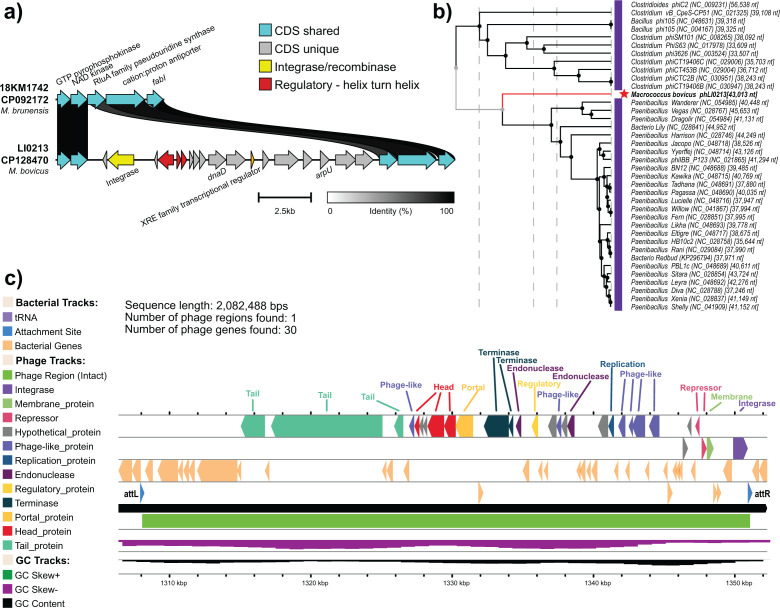 Fig 1
Fig 1| Parameters | Genomic features |
|---|---|
| Genome | Size in bp and GenBank acc. no. |
| Chromosome | 2,082,488 ( |
| Plasmids | |
| pLI0213a (75 CDS) | 66,682 ( |
| pLI0213b (5 CDS) | 4,933 ( |
| pLI0213c (4 CDS) | 2,933 ( |
| GC content (%) | 44.5 |
| Illumina statistics | |
| Read length | 151 |
| Number of reads (paired, 2X) | 5,425,163 |
| Mean depth | 705X |
| ONT statistics | |
| N50 (bp) | 25.68 |
| Mean read length (bp) | 8,449 |
| Number of reads | 30,604 |
| Total bases | 258,575,387 |
| Coverage | 123X |
| Total number of | |
| CDSs | 2,183 |
| rRNAs | 16 |
| tRNAs | 62 |
| ncRNAs | 4 |
| Pseudogenes | 14 |
| CRISPR arrays | 1 |
| Integrated elements | Size in bp and position |
| Prophage phLI0213 (64 CDSs) | 42,841 (490,469–532,976) |
| PICILI0213 (18 CDSs) | 13,944 (80,737–94,681) |
- —Institute of Veterinary Bacteriology, University of Bernhttp://dx.doi.org/10.13039/100017545
Peer Reviews
No public reviews on file for this paper yet. If you reviewed it on a platform where reviews are public (OpenReview, ICLR, NeurIPS, ICML), you can paste yours below so the community can read it here.
Videos
No videos yet. Explain this paper in a talk, walkthrough, or lecture? Add one.
Taxonomy
TopicsGenomics and Phylogenetic Studies · Plant Pathogenic Bacteria Studies · Bacteriophages and microbial interactions
ANNOUNCEMENT
Members of the Macrococcus genus are skin flora inhabitants of mammals and are rarely associated with infections (1). Macrococcus bovicus was originally detected in cattle and horses (2), and an association with infection has not yet been reported. The only M. bovicus genome available in the NCBI database is the incomplete draft of the type strain ATCC 51825^T^ (accession number: NZ_SCWF00000000.1) (3). We present the complete circular genome of a human infection-associated M. bovicus.
M. bovicus LI0213 was isolated in May 2019 in Switzerland from an erythematous lesion on the back of a 47-year-old female outpatient. The infected skin material was collected using an eSwab (Copan), which was streaked on Colombia blood agar (CBA) and chocolate blood agar with PolyVitex (bioMérieux) and subsequently incubated at 37°C for 72 hours. Cultures revealed >50 colonies of M. bovicus, which were identified by 16S rRNA gene Sanger sequencing as this bacterium did not belong to the MALDI-TOF MS Bruker MBT 7854 MSP Library. LI0213 was cryopreserved in our collections.
Genomic DNA was extracted from a lawn of colonies grown on CBA at 37°C overnight using the QIAGEN DNeasy Blood & Tissue Kit and purified with CleanNGS magnetic beads (CleanNA). DNA was sequenced using the Nextera DNA Flex Library Prep Kit with IDT Illumina DNA/RNA UD Indexes on an Illumina NovaSeq 6000 system (2 × 150-bp paired-end) (NGS Platform, University of Bern) and with the MinION MK1b device on a R9.4.1 SpotON flow cell using the 1D ligation kit (SQK-LSK109) (Oxford Nanopore Technology, ONT). ONT reads were basecalled using Guppy v4.4.1 (4). Raw Illumina reads were quality-controlled, filtered, and trimmed using Prinseq v0.6 (5). The number of reads and coverage were calculated with NanoStat v1.6.0 (6) for ONT and with fastp v0.24.0 (7) and samtools v1.21 for Illumina (8) (Table 1). The LI0213 genome was hybrid-assembled, circularized, and rotated to DnaA using Unicycler v0.4.8 (5). The resulting genome was annotated using PGAP v6.5. Default parameters were used for all software.
The assembly of LI0213 consisted of a circular chromosome and three circular plasmids. Species identification of M. bovicus was confirmed by an orthologous average nucleotide identity (ANI) value of 98.26% obtained between the genomes of LI0213 and ATCC 51825^T^ (NZ_SCWF00000000.1) using OrthoANIu v0.6.0 (http://www.ezbiocloud.net/tools/ani) (4). GC content, number of predicted protein-coding sequences, pseudogenes, RNA-encoding genes, and CRISPR array are provided in Table 1.
An intact prophage and a putative phage inducible chromosomal island (PICI) were identified in the chromosome of LI0213 (Table 1) (Fig. 1). The PICI_LI0213_ was identified by manual comparison to related strains (Fig. 1A); it remained undetectable by specialized tools (9). The prophage phLI0213 was flanked with attachment sites (att), as identified by PHASTEST (score of 130) (https://phastest.ca) (10) and PhageBoost (11) (Fig. 1C). The tBLASTx-based proteomic tree generated with ViPTree v4.0 (12) placed phLI0213 next to a cluster of Paenibacillus spp. phages (Fig. 1B). Virfam (http://biodev.extra.cea.fr/virfam) classified phLI0213 among phages possessing a type 1 neck structural organization and belonging to cluster 2 (Fig. 1C), which is strictly composed of siphophages that infect Firmicutes (13).
Graphical representation of Macrococcus bovicus LI0213 putative prophage phLI0213 and PICILI0213. a) PICILI0213 was identified by manual pairwise comparison of gene clusters of LI0213 and Macrococcus brunensis strain 18KM1742. b) Zoomed view of the Virus Proteomic Tree (ViPTree server v4.0 (12)) showing prophage phLI0213 and the closest related phages. Bacterial host, phage name, GenBank accession number, and size are shown as tip labels. c) Graphical representation of phLI0213 as depicted by PHASTEST (10) with attachment sites attL/attR: CCCTCCCAGGACGCTA.
The reference list from the paper itself. Each links out to its DOI / PubMed record.
- 1Schwendener S, Perreten V. 2022. The bla and mec families of beta-lactam resistance genes in the genera Macrococcus, Mammaliicoccus and Staphylococcus: an in-depth analysis with emphasis on Macrococcus. J Antimicrob Chemother 77:1796–1827. doi:10.1093/jac/dkac 10735445249 · doi ↗ · pubmed ↗
- 2Kloos WE, Ballard DN, George CG, Webster JA, Hubner RJ, Ludwig W, Schleifer KH, Fiedler F, Schubert K. 1998. Delimiting the genus Staphylococcus through description of Macrococcus caseolyticus gen. nov., comb. nov. and Macrococcus equipercicus sp. nov., and Macrococcus bovicus sp. nov. and Macrococcus carouselicus sp. nov. Int J Syst Bacteriol:859–877. doi:10.1099/00207713-48-3-8599734040 · doi ↗ · pubmed ↗
- 3Mazhar S, Altermann E, Hill C, Mc Auliffe O. 2019. Draft genome sequences of the type strains of six Macrococcus species. Microbiol Resour Announc 8:e 00344-19. doi:10.1128/MRA.00344-1931072882 PMC 6509531 · doi ↗ · pubmed ↗
- 4Yoon SH, Ha SM, Lim J, Kwon S, Chun J. 2017. A large-scale evaluation of algorithms to calculate average nucleotide identity. Antonie Van Leeuwenhoek 110:1281–1286. doi:10.1007/s 10482-017-0844-428204908 · doi ↗ · pubmed ↗
- 5Wick RR, Judd LM, Gorrie CL, Holt KE. 2017. Unicycler: resolving bacterial genome assemblies from short and long sequencing reads. P Lo S Comput Biol 13:e 1005595. doi:10.1371/journal.pcbi.100559528594827 PMC 5481147 · doi ↗ · pubmed ↗
- 6De Coster W, D’Hert S, Schultz DT, Cruts M, Van Broeckhoven C. 2018. Nano Pack: visualizing and processing long-read sequencing data. Bioinformatics 34:2666–2669. doi:10.1093/bioinformatics/bty 14929547981 PMC 6061794 · doi ↗ · pubmed ↗
- 7Chen S. 2023. Ultrafast one-pass FASTQ data preprocessing, quality control, and deduplication using fastp. Imeta 2:e 107. doi:10.1002/imt 2.10738868435 PMC 10989850 · doi ↗ · pubmed ↗
- 8Danecek P, Bonfield JK, Liddle J, Marshall J, Ohan V, Pollard MO, Whitwham A, Keane T, Mc Carthy SA, Davies RM, Li H. 2021. Twelve years of SA Mtools and BC Ftools. Gigascience 10:giab 008. doi:10.1093/gigascience/giab 00833590861 PMC 7931819 · doi ↗ · pubmed ↗