Complete coding sequence of the Lumpy skin disease virus collected from cattle in Central Java, Indonesia, 2022
Hendra Wibawa, Lestari, Toan Hong, Zaza Fahmia, Sri Handayani Irianingsih, Herdiyanto Mulyawan, Megaria Ardiani, Rochmadiyanto, Farida Camallia Zenal, Syafrison Idris, Gemma Clark

TL;DR
This paper presents the full genetic sequence of a Lumpy skin disease virus from cattle in Indonesia in 2022.
Contribution
The study provides a new complete coding sequence of LSDV from Central Java, Indonesia.
Findings
The virus sequence is closely related to LSDV strains in clade 2.5.
Clade 2.5 has been previously reported in East and Southeast Asia from 2019 to 2021.
Abstract
We reported the complete coding sequence of a Lumpy skin disease virus (LSDV) isolated from cattle in Central Java, Indonesia, in 2022. The nucleotide sequence of the virus was most closely related to LSDV strains belonging to clade 2.5, which has been reported in East and Southeast Asia from 2019 to 2021.
Genes, proteins, chemicals, diseases, species, mutations and cell lines named across the full text — each resolved to its canonical identifier and authoritative record.
Click any figure to enlarge with its caption.
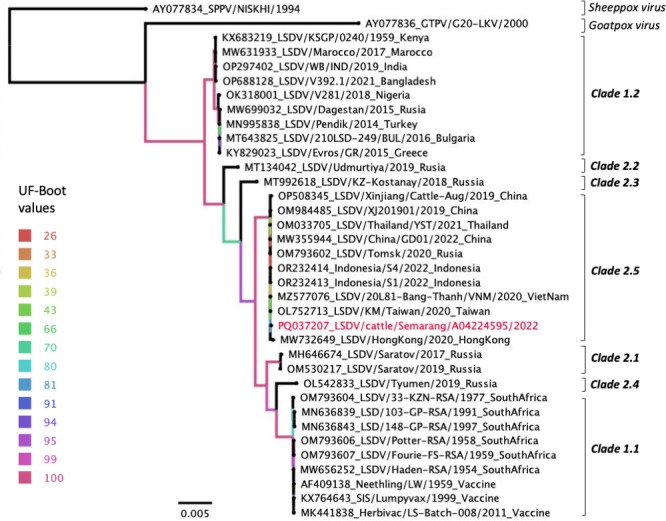 Fig 1
Fig 1| Homology | 99.998% | 99.997% | 99.999% | 99.997% | 99.997% | 99.998% |
| Nucleotide difference | 3 | 4 | 2 | 4 | 4 | 3 |
Peer Reviews
No public reviews on file for this paper yet. If you reviewed it on a platform where reviews are public (OpenReview, ICLR, NeurIPS, ICML), you can paste yours below so the community can read it here.
Videos
No videos yet. Explain this paper in a talk, walkthrough, or lecture? Add one.
Taxonomy
TopicsPoxvirus research and outbreaks · Bacteriophages and microbial interactions · Herpesvirus Infections and Treatments
ANNOUNCEMENT
Lumpy Skin Disease (LSD), caused by the Lumpy Skin Disease virus (LSDV), results in significant economic losses to livestock producers. LSDV is a double-strand DNA virus that belongs to the genus Capripoxvirus within the family Poxviridae and primarily affects cattle. The first LSD outbreak in Indonesia was reported in February 2022 in Riau Province on Sumatera Island (1). By August 2022, the disease had spread to Central Java, the second-largest cattle population in Indonesia. In October 2022, during LSD outbreak in Semarang, Central Java Province, we collected skin nodules (3–4 nodules) from three sick cattle. Samples were transferred in viral transport medium containing antibiotics and stored at −80°C before they were tested. DNA was extracted from pooled skin samples using Purelink Viral RNA/DNA Mini Kit (Invitrogen, Life Technologies) according to the manufacturer’s instructions. A high viral load of LSDV (Ct value = 15.6) was detected by real-time reverse transcription-PCR (rRT-PCR) using SensiFAST Probe Lo-ROX Kit (Bioline, Meridian Bioscience) using primers and probe as previously described (2).
Whole genome sequencing was performed using Oxford NanoPore Technologies (ONT). Genomic DNA was purified using DNA Clean & Concentrator-5 Kit (Zymo Research, USA). About 5 ng of DNA was used for library preparation using the Rapid Barcoding Kit (SQK-RBK004, ONT). The library was sequenced using a MinION SpotON R9.41 FLO-MIN106D flow cell (ONT) for 24 h. Base calling was processed in real-time with MinKNOW Software (v.22.03.05). Base-called reads were concatenated into a single FASTQ file and the adapter sequences were removed using Porechop v0.2.4 (3) with default parameters. NanoStat, a package from NanoPack software suite (4), was used to create a statistical summary from nanopore reads. A total of 273,429 reads were generated with read length N50 of 826. Of these, 247,374 reads were retained after adapter trimming. For genome assembly, trimmed FASTQ files were mapped against the reference genome of LSDV/Thailand/YST/2021 (Accession No. OM033705) using Minimap2 v2.17 (5) and the output (SAM file) was imported to UGENE v50.0 (6) to obtain a consensus sequence. Prokka v.1.14.6 was used for genome annotation (7) using the curated genome of LSDV/Thailand/YST/2021 (8). For phylogenetic analysis, multiple sequence alignment of the obtained genome with 34 virus genomes representing all LSDV clades found in Africa, Europe, the Middle East and Asia (9) was performed using MAFFT v.7.490 (10), followed by maximum likelihood tree reconstruction using IQTREE v.2.2.0 (11).
The complete coding sequence of LSDV (LSDV/Semarang/A04224595/2022) was successfully obtained from skin nodules of cattle with LSD symptoms during the disease outbreak in Central Java Province in October 2022. The genome has 150,689 bp length with 25.9% GC content with the average sequencing depth was 139.9×. The genome was 99.99% identical (2–4 nucleic acid differences) to 4 LSDV strains detected in China, Taiwan, Vietnam, and Thailand between 2019 and 2021 and to 2 LSDV strains from the index case of LSDV in cattle in Riau Province, Indonesia in 2022 ([Table 1](#T1 T1)). Our phylogenetic tree analysis showed that all the Indonesian LSD viruses are clustered in clade 2.5 (Fig. 1).
Phylogenetic relationship was inferred by using the maximum-likelihood method based on the complete coding sequence of Lumpy skin disease virus (LSDV) using best-fit K3Pu + F + I + G4 substitution model according to the Bayesian Information Criterion (BIC). The LSDV/ Semarang/A04224595/2022 virus is highlighted (red). The colour of branch indicates the branch support based on 1,000 replicates of ultrafast bootstrap (UF-Boot) approximation (12). Scale bar indicates nucleotide substitutions per site.
The reference list from the paper itself. Each links out to its DOI / PubMed record.
- 1Sendow I, Meki IK, Dharmayanti N, Hoerudin H, Ratnawati A, Settypalli TBK, Ahmed HO, Nuradji H, Saepulloh M, Adji RS, Fairusya N, Sari F, Anindita K, Cattoli G, Lamien CE. 2024. Molecular characterization of recombinant LSDV isolates from 2022 outbreak in Indonesia through phylogenetic networks and whole-genome SNP-based analysis. BMC Genomics 25:240. doi:10.1186/s 12864-024-10169-638438878 PMC 10913250 · doi ↗ · pubmed ↗
- 2Babiuk S, Bowden TR, Parkyn G, Dalman B, Manning L, Neufeld J, Embury-Hyatt C, Copps J, Boyle DB. 2008. Quantification of lumpy skin disease virus following experimental infection in cattle. Transbound Emerg Dis 55:299–307. doi:10.1111/j.1865-1682.2008.01024.x 18503511 · doi ↗ · pubmed ↗
- 3Wick RR, Judd LM, Gorrie CL, Holt KE. 2017. Completing bacterial genome assemblies with multiplex Min ION sequencing. Microb Genom 3:e 000132. doi:10.1099/mgen.0.00013229177090 PMC 5695209 · doi ↗ · pubmed ↗
- 4De Coster W, D’Hert S, Schultz DT, Cruts M, Van Broeckhoven C. 2018. Nano Pack: visualizing and processing long-read sequencing data. Bioinformatics 34:2666–2669. doi:10.1093/bioinformatics/bty 14929547981 PMC 6061794 · doi ↗ · pubmed ↗
- 5Li H. 2018. Minimap 2: pairwise alignment for nucleotide sequences. Bioinformatics 34:3094–3100. doi:10.1093/bioinformatics/bty 19129750242 PMC 6137996 · doi ↗ · pubmed ↗
- 6Okonechnikov K, Golosova O, Fursov M, the UGENE team. 2012. Unipro UGENE: a unified bioinformatics toolkit. Bioinformatics 28:1166–1167. doi:10.1093/bioinformatics/bts 09122368248 · doi ↗ · pubmed ↗
- 7Seemann T. 2014. Prokka: rapid prokaryotic genome annotation. Bioinformatics 30:2068–2069. doi:10.1093/bioinformatics/btu 15324642063 · doi ↗ · pubmed ↗
- 8Suwankitwat N, Songkasupa T, Boonpornprasert P, Sripipattanakul P, Theerawatanasirikul S, Deemagarn T, Suwannaboon M, Arjkumpa O, Buamithup N, Hongsawat A, Jindajang S, Nipaeng N, Aunpomma D, Molee L, Puangjinda K, Lohlamoh W, Nuansrichay B, Narawongsanont R, Arunvipas P, Lekcharoensuk P. 2022. Rapid spread and genetic characterisation of a recently emerged recombinant Lumpy skin disease virus in Thailand. Vet Sci 9:542. doi:10.3390/vetsci 910054236288155 PMC 9609959 · doi ↗ · pubmed ↗