Genome sequences of G. rubripertincta bacteriophages Eddiemania and UBSmoodge isolated in Las Vegas, Nevada
Maren M. Mandel, Victoria L. Dudek, Ethan D. Handelman, Ryal Tilleth, Kendra W. Kimberley, Chelsey C. McKenna, James R. Theoret, Earl J. Yoon, Erin J. Windsor

TL;DR
This paper reports the genome sequences of two new bacteriophages, Eddiemania and UBSmoodge, isolated from a specific bacterial species in Las Vegas.
Contribution
The study provides novel genome sequences and morphological data for two newly discovered bacteriophages.
Findings
Eddiemania has a 61,427 bp genome with a siphovirus morphology and 92 predicted genes.
UBSmoodge has a circularly permuted 92,786 bp genome with a myovirus morphology and 130 predicted genes.
Abstract
Eddiemania and UBSmoodge are bacteriophages isolated on Gordonia rubripertincta NRRL B-16540. Eddiemania has a 3′ sticky overhang, a 61,427 bp genome predicted to encode 92 putative genes, and a siphovirus virion morphology. The UBSmoodge genome was identified as a circularly permuted, 92,786 bp long genome predicted to encode 130 putative genes and having a myovirus virion morphology.
Genes, proteins, chemicals, diseases, species, mutations and cell lines named across the full text — each resolved to its canonical identifier and authoritative record.
Click any figure to enlarge with its caption.
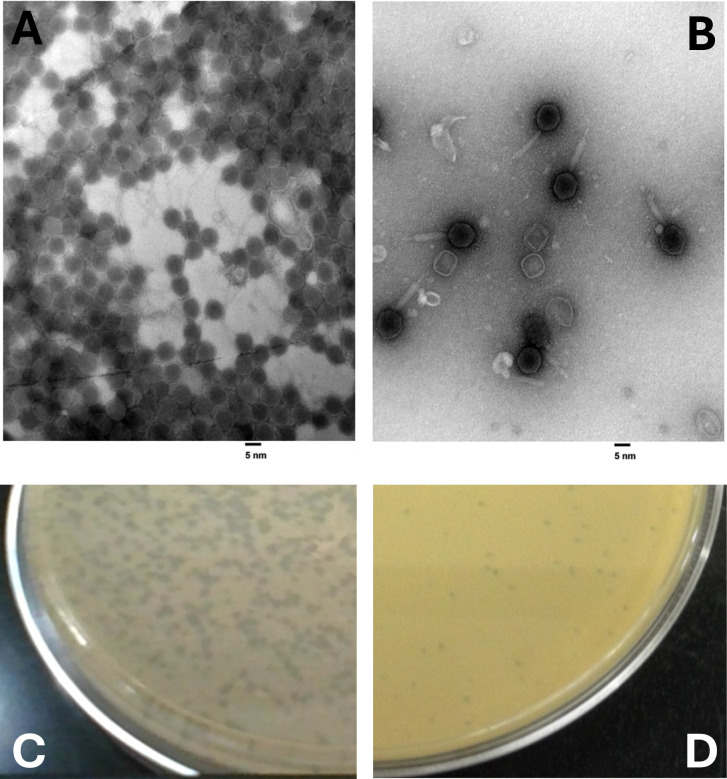 Fig 1
Fig 1| Phage | GenBank accession number | SRA | GPS coordinates | Isolation | Cluster | Genome length | GC content (%) | Genome end type | Sequencing coverage | Number of reads | Putative genes | Related phages |
|---|---|---|---|---|---|---|---|---|---|---|---|---|
| Eddiemania |
|
| 36.11021 N, 115.2384 W | Direct | DJ | 61,427 | 51.6 | 3′ Sticky overhang -CGCCGCTCT | 723 | 313,409 | 92 | Burly DJ ( |
| UBSmoodge |
|
| 36.233 N, 115.083 W | Enriched | DQ | 92,786 | 60.2 | Circularly permuted | 167 | 109,568 | 130 | FlyingTortilla DQ ( |
Peer Reviews
No public reviews on file for this paper yet. If you reviewed it on a platform where reviews are public (OpenReview, ICLR, NeurIPS, ICML), you can paste yours below so the community can read it here.
Videos
No videos yet. Explain this paper in a talk, walkthrough, or lecture? Add one.
Taxonomy
TopicsBacteriophages and microbial interactions · Genomics and Phylogenetic Studies · Plant Virus Research Studies
ANNOUNCEMENT
Bacteriophages Eddiemania and UBSmoodge were isolated from soil and characterized by the College of Southern Nevada through the Science Education Alliance-Phage Hunters Advancing Genomics and Evolutionary Science (SEA-PHAGES) program (1). The host bacterium, Gordonia rubripertincta, has potential uses in bioremediation, grows well in the laboratory at 30°C, and is stored long term at −20°C (2). Eddiemania was collected at a park in Las Vegas and came from direct isolation. UBSmoodge was collected in a neighborhood in Las Vegas and came from an enriched sample. Protocols for the isolation, purification, and DNA extraction of bacteriophages came from the SEA-PHAGES Phages Discovery Manual (3). Soil samples were incubated in PYCa media with amphotericin B at 30°C and shaken at 250 rpm for 1 hour. The supernatant was filtered through a 0.22 µM filter. For direct isolation, the supernatant was used directly for plaque assays. For enriched isolation, the 10 mL of supernatant was added to 500 µL of host bacterium and incubated at 30°C for 3 days while on the rocker at 220 rpm. The sample was filtered through a 0.22 µm filter prior to the plaque assay. After completing three rounds of purification and one round of amplification, DNA was extracted from high-titer lysates using the Norgen phage DNA isolation kit with five rounds of freeze/thaw (4 minute freeze in a dry-ice ethanol bath and a 1 minute thaw). Bacteriophages were sequenced at the Pittsburgh Bacteriophage Institute using an Illumina MiSeq instrument. Sequencing libraries were created from extracted genomic DNA using the New England Biolabs Ultra II Library kit v.3, 150-base single-end reads according to the manufacturer’s instructions. Raw reads were uploaded to Newbler v.2.9 (454 Life Sciences, Roche) using default settings to produce continuous reads (4). Reads were analyzed with Consed v.2.9 using default settings to produce a single contig, which was evaluated for accuracy and completeness by looking for gaps and low-consensus areas (http://bozeman.mbt.washington.edu/consed/consed.html (4). Bacteriophage genomic termini were identified using the Pileup Analysis Using Starts and Ends workflow in Galaxy (https://cpt.tamu.edu/) (4). Concentrated purified lysate was spotted on a copper grid, stained with Uranyless acetate, and sent to Northern Arizona University for electron microscope imaging (3).
Annotations were completed using the following programs: DNA Master v.2.53.6 (http://cobamide2.bio.pitt.edu/computer.htm), Starterator v.1.2 (https://github.com/SEA-PHAGES/starterator), Phamerator (https://phamerator.org/) (5), PhagesDB BLAST (https://phagesdb.org/blast/) (1), National Center for Biotechnology Information (NCBI) BLAST (databases: BLASTtn Standard Core Nucleotide and BLASTp Standard Non-redundant) (6), PECAAN (7), GeneMark v.2.5p (8), Glimmer v.3.02 (9), Aragorn v.1.1 and v.1.2.38 (10), HHPRED (databases: PDB, NCBI-CD, PFam-A, and SCOPe) (11), tRNAscan-SE v.2.0 (12), and DeepTMHMM v.1.0.24 (13) using the default parameters found in the SEA-PHAGES bioinformatics guide (14).
Eddiemania, with siphovirus morphology (Fig. 1A), had 92 genes identified, 24 of which were assigned putative functions. UBSmoodge, with myovirus morphology (Fig. 1B), had 130 genes, 36 of which had putative functions assigned. UBSmoodge has four genes in its reverse reading frame and a gap of 1,178 bp when switching from its reverse reading frame to its forward reading frame. These four reverse genes and a 1000 + bp gap are characteristic of the most closely related bacteriophages (Table 1).
Transmission electron micrographs of bacteriophages Eddiemania (A) and UBSmoodge (B) reveal morphologies characteristic of the siphovirus and myovirus morphology, respectively. Negative staining with Uranyless acetate. Magnification: ×40,000. (C) Plaques of Eddiemania measuring 1–2 mm in diameter. (D) Plaques of UBSmoodge measuring 0.5–1.0 mm in diameter.
The reference list from the paper itself. Each links out to its DOI / PubMed record.
- 1Russell DA, Hatfull GF. 2017. Phages DB: the actinobacteriophage database. Bioinformatics 33:784–786. doi:10.1093/bioinformatics/btw 71128365761 PMC 5860397 · doi ↗ · pubmed ↗
- 2Frantsuzova E, Bogun A, Solomentsev V, Vetrova A, Streletskii R, Solyanikova I, Delegan Y. 2023. Whole genome analysis and assessment of the metabolic potential of Gordonia rubripertincta strain 112, a degrader of aromatic and aliphatic compounds. Biology (Basel) 12:721. doi:10.3390/biology 1205072137237534 PMC 10215345 · doi ↗ · pubmed ↗
- 3Poxleitner M, Pope W, Jacobs-Sera D, Sivanathan V, Hatfull G. 2018. Phage discovery guide. Howard Hughes Medical Institute, Chevy Chase, MD.
- 4Russell DA. 2018. Sequencing, assembling, and finishing complete bacteriophage genomes. Methods Mol Biol 1681:109–125. doi:10.1007/978-1-4939-7343-9_929134591 · doi ↗ · pubmed ↗
- 5Cresawn SG, Bogel M, Day N, Jacobs-Sera D, Hendrix RW, Hatfull GF. 2011. Phamerator: a bioinformatic tool for comparative bacteriophage genomics. BMC Bioinformatics 12:2105–12 doi:10.1186/1471-2105-12-395PMC 323361221991981 · doi ↗ · pubmed ↗
- 6Altschul SF, Gish W, Miller W, Myers EW, Lipman DJ. 1990. Basic local alignment search tool. J Mol Biol 215:403–410. doi:10.1016/S 0022-2836(05)80360-22231712 · doi ↗ · pubmed ↗
- 7Rinehart CA, Gaffney B, Wood JD, Smith J. 2016. PECAAN, a phage evidence collection and annotation network. Available from: https://discover.kbrinsgd.org/login
- 8Besemer J, Borodovsky M. 2005. Gene Mark: web software for gene finding in prokaryotes, eukaryotes and viruses. Nucleic Acids Res 33:W 451–W 454. doi:10.1093/nar/gki 48715980510 PMC 1160247 · doi ↗ · pubmed ↗