Draft genome sequence of Streptomyces sp. Sce081 isolated from the nest of wasp Sceliphron destillatorium (Illiger, 1807)
Sofiia Pytel-Huta, Anna Kachor, Andriy Zatushevsky, Markiyan Samborskyy, Yuriy Rebets

TL;DR
This paper presents the draft genome sequence of a Streptomyces strain with antifungal properties, isolated from a wasp nest.
Contribution
The novel contribution is the draft genome sequence of Streptomyces sp. Sce081, isolated from a wasp nest and showing antifungal activity.
Findings
Streptomyces sp. Sce081 was isolated from the nest of wasp Sceliphron destillatorium.
The strain exhibits notable antifungal activity.
The draft genome sequence and analysis are reported.
Abstract
Actinobacteria are often involved in ecological interactions with insects. Streptomyces sp. Sce081 with notable antifungal activity was isolated from the nest of wasp Sceliphron destillatorium (Illiger, 1807). Here, we report the draft sequence and analysis of the Streptomyces sp. Sce081 genome.
Genes, proteins, chemicals, diseases, species, mutations and cell lines named across the full text — each resolved to its canonical identifier and authoritative record.
Click any figure to enlarge with its caption.
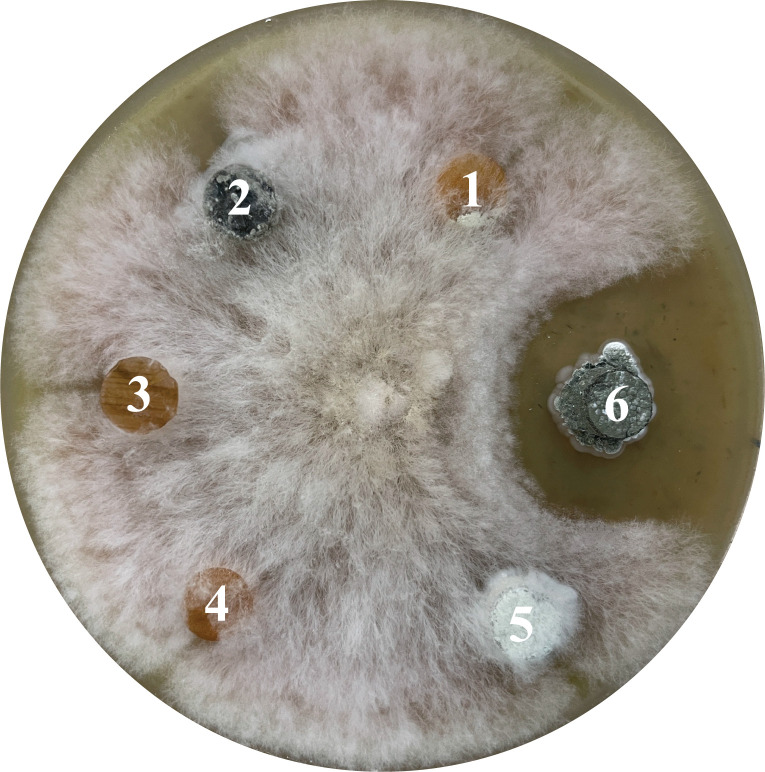 Fig 1
Fig 1- —Bundesministerium für Bildung und Forschung (BMBF)
Peer Reviews
No public reviews on file for this paper yet. If you reviewed it on a platform where reviews are public (OpenReview, ICLR, NeurIPS, ICML), you can paste yours below so the community can read it here.
Videos
No videos yet. Explain this paper in a talk, walkthrough, or lecture? Add one.
Taxonomy
TopicsGenomics and Phylogenetic Studies · Insect symbiosis and bacterial influences · Plant and Fungal Interactions Research
ANNOUNCEMENT
Insect-associated actinomycetes are a promising source of new bioactive compounds. For instance, sceliphrolactam (1), dentigerumycin (2), and selvamicin (3) isolated from such actinomycetes are proposed to play an important role in the host insects' biology. Strain Streptomyces sp. Sce081 was isolated from the nest material of mud-dauber wasp Sceliphron destillatorium (Illiger, 1807). These wasps lay their eggs into nests which are built from mud and clay and filled with paralyzed spiders. The conditions inside the nest are favorable for fungi; however, nests are typically clean of fungal contamination. This antifungal activity may result from bacteria associated with wasps or nest material.
The nest was collected from the attic of the house in Velyki Hrybovychi, Lviv region, Ukraine (Global Positioning System coordinates: N 49°54'38.7" E 24°02'16.7"). The nest was identified by visual peculiarities to belong to Sceliphron destillatorium wasp. The Sce081 isolate was obtained by dilution plating (10^−2^) of an aqueous suspension of a ground nest on HVA medium (4) and incubated at 30°C for 30 days. The used approach was not selective for actinobacteria, and the isolate Sce081 was chosen based on its morphological properties. The isolate exhibited antifungal activity when tested by agar plaque diffusion assay (Fig. 1). For genomic DNA extraction, Sce081 was cultured on MS-agar medium (5) at 30°C for 72 hours. Genomic DNA was extracted using the NucleoSpin Microbial DNA kit (Macherey-Nagel, Germany) following the manufacturer’s instructions. The Sce081 isolate was identified by Sanger sequencing of the 16S rRNA gene using universal primers 27F and 1492R (6). The obtained sequence (PQ427446) alignment to the NCBI refseq rRNA database using BLAST v2.15.0 (7) resulted in the closest match (100% identity) to be Streptomyces prasinus NBRC 13479 (NR_041230). The library preparation for the Illumina Novaseq 6000 system was performed using a TruSeq DNA PCR-Free Kit and sequenced in a 2 × 150 bp paired-end configuration. The reads QC was performed using FastQC (8). The genome coverage was x319. The adapters were trimmed with fastq_miseq_trimmer v.t19, and the data were assembled with Newbler v3.0 (F. Hoffmann-La Roche AG, Switzerland) using default parameters. The assembly yielded 114 contigs, with a total length of 7,933,994 bp, an N_50_ value of 127,902 bp, and an L_50_ value of 21. The Sce081 genome has a G+C content of 72.22%. A total of 6,540 protein-coding genes, 68 tRNA and 2 rRNA genes, 3 non-coding RNAs, and 211 pseudogenes were predicted using the NCBI Prokaryotic Genome Annotation Pipeline v6.7 (9).
Plaque diffusion antifungal activity test of actinobacteria isolates: (1) – Sce080; (2) – Sce079; (3) – Sce078; (4) – Sce083; (5) – Sce082; (6) – Sce081. Strains were cultured on MS agar for 7 days at 30 ° C. Plaques were cut off and placed on fungal test culture. Plates incubated for 5 days at 30 ° C.
The genome analysis with antiSMASH v7.1.0 (10) predicted 34 regions encoding secondary metabolite biosynthetic gene clusters (BGC) with some being fragments of large clusters incorrectly assembled due to the repetitive nature of the corresponding sequences. The observed antifungal activity of the strain could be at least partially attributed to the presence of the polycyclic tetramine macrolactams BGC which is a very well-known antifungal metabolite efficiently produced in laboratory conditions (BGC0001043) (11). However, the majority of BGCs predicted within the genome of Streptomyces sp. Sce081 are coding for potentially new natural products, giving a promise for new biologically active compound discovery.
The reference list from the paper itself. Each links out to its DOI / PubMed record.
- 1Oh DC, Poulsen M, Currie CR, Clardy J. 2011. Sceliphrolactam, a polyene macrocyclic lactam from a wasp-associated Streptomyces sp. Org Lett 13:752–755. doi:10.1021/ol 102991 d 21247188 PMC 3037738 · doi ↗ · pubmed ↗
- 2Oh D-C, Poulsen M, Currie CR, Clardy J. 2009. Dentigerumycin: a bacterial mediator of an ant-fungus symbiosis. Nat Chem Biol 5:391–393. doi:10.1038/nchembio.15919330011 PMC 2748230 · doi ↗ · pubmed ↗
- 3Van Arnam EB, Ruzzini AC, Sit CS, Horn H, Pinto-Tomás AA, Currie CR, Clardy J. 2016. Selvamicin, an atypical antifungal polyene from two alternative genomic contexts. Proc Natl Acad Sci U S A 113:12940–12945. doi:10.1073/pnas.161328511327803316 PMC 5135293 · doi ↗ · pubmed ↗
- 4Zhang J, Zhang L. 2011. Improvement of an isolation medium for actinomycetes. Mod Appl Sci 5:124–127. doi:10.5539/mas.v 5n 2p 124 · doi ↗
- 5Kieser B, Buttner M, Charter K, Hopwood B. 2000. Practical Streptomyces genetics. John Innes Foundation, Norwich.
- 6Heuer H, Krsek M, Baker P, Smalla K, Wellington EM. 1997. Analysis of actinomycete communities by specific amplification of genes encoding 16S r RNA and gel-electrophoretic separation in denaturing gradients. Appl Environ Microbiol 63:3233–3241. doi:10.1128/aem.63.8.3233-3241.19979251210 PMC 168621 · doi ↗ · pubmed ↗
- 7Altschul SF, Gish W, Miller W, Myers EW, Lipman DJ. 1990. Basic local alignment search tool. J Mol Biol 215:403–410. doi:10.1016/S 0022-2836(05)80360-22231712 · doi ↗ · pubmed ↗
- 8Brown J, Pirrung M, Mc Cue LA. 2017. FQC dashboard: integrates Fast QC results into a web-based, interactive, and extensible FASTQ quality control tool. Bioinformatics 33:3137–3139. doi:10.1093/bioinformatics/btx 37328605449 PMC 5870778 · doi ↗ · pubmed ↗