Draft genome analysis of a serum-resistant and fourth-generation cephalosporin (cefepime)-resistant Acinetobacter baumannii strain TDU5 isolated from Dhaka, Bangladesh
Spencer Mark Mondol, Mohammed Aziz Hossain, Fahim Kabir Monjurul Haque

TL;DR
This paper presents the draft genome of a drug-resistant Acinetobacter baumannii strain from Bangladesh, highlighting its resistance to cefepime and serum.
Contribution
The study provides a detailed genomic analysis of a serum- and cefepime-resistant A. baumannii strain from Bangladesh.
Findings
The genome size was 3,586,480 bp with 3,429 coding sequences.
The strain harbored multiple antimicrobial resistance genes including blaPER-7, blaADC-52, and blaOXA-91.
The isolate was found to be serum-resistant and pathogenic.
Abstract
We report the draft genome of a cefepime-resistant A. baumannii TDU5, isolated from Turag river water in Bangladesh. The strain was serum-resistant and pathogenic. The genome size was 3,586,480 bp with 3,429 coding sequences (CDS). The isolate harbored multiple antimicrobial resistance genes including blaPER-7, blaADC-52, and blaOXA-91.
Genes, proteins, chemicals, diseases, species, mutations and cell lines named across the full text — each resolved to its canonical identifier and authoritative record.
Click any figure to enlarge with its caption.
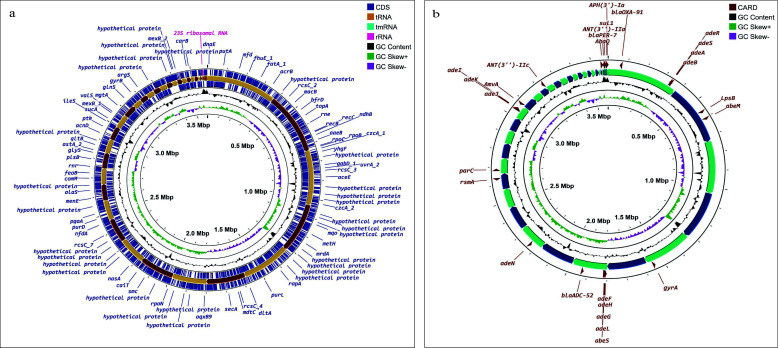 Fig 1
Fig 1| General features | |
|---|---|
| Completeness of genome | 100 |
| Coarse consistency | 99.3 |
| Fine consistency | 98.5 |
| Contigs | 53 |
| GC Content | 38.91 |
| Genome length (bp) | 3,586,480 |
| CDS | 3,429 |
| CDS ratio | 0.9560906 |
| Hypothetical CDS | 748 |
| N50 value | 213009 |
| L50 value | 6 |
| RNA | Three rRNA, 35 tRNA, and one tmRNA |
| MLST | 234 |
| Accession |
|
Peer Reviews
No public reviews on file for this paper yet. If you reviewed it on a platform where reviews are public (OpenReview, ICLR, NeurIPS, ICML), you can paste yours below so the community can read it here.
Videos
No videos yet. Explain this paper in a talk, walkthrough, or lecture? Add one.
Taxonomy
TopicsAntibiotic Resistance in Bacteria · Antimicrobial Resistance in Staphylococcus · Genomics and Phylogenetic Studies
ANNOUNCEMENT
Acinetobacter baumannii (A. baumannii) is an opportunistic pathogen associated with severe nosocomial infections, particularly in immunocompromised patients (1, 2). Its ability to evade host immune defenses, including resistance to complement-mediated serum killing, contributes significantly to its pathogenicity. The emergence of resistance to fourth-generation cephalosporins, such as cefepime, further exacerbates the global threat posed by this pathogen, limiting therapeutic options and complicating treatment outcomes (3).
In this study, we have isolated a cefepime-resistant strain of A. baumannii from Turag River water near Dhaka Uddan (23.76285 N; 90.33825 E), Bangladesh. A water sample was collected and transported to the lab in sterile 50-mL Falcon conical tubes. The sample was diluted tenfold by mixing 1 mL of the sample with 9 mL of 0.9% sterile saline (NaCl). Afterward, 100 µL of the diluted samples was spread onto Leeds Acinetobacter Agar plate. Isolated single colonies were sub-cultured in nutrient broth. Testing of antimicrobial susceptibility to cefepime was carried out using the disk diffusion procedure following the Kirby Bauer method (4). A serum resistance assay was performed following a described protocol (5). Genomic DNA extraction was carried out using the Genomic DNA Purification Kit for gram-negative bacteria (New England Biolabs, UK), following the manufacturer’s protocol (NEB#T3010). Whole-genome sequencing was conducted on the Illumina platform using the Illumina Miniseq sequencing system at the Bangladesh Council of Scientific and Industrial Research (BCSIR). Paired-end sequencing libraries were prepared using the Nextera XT DNA Library Prep Kit, with an average insert size of 150 bp. The raw FASTQ files were quality-checked using FastQC (v0.11) (6) and trimmed with Trimmomatic (v0.39) (7). The trimming parameters were set to retain reads with a minimum average quality score of 30 and a minimum length of 50 base pairs. High-quality reads were assembled de novo using SPAdes (v3.15.4) (8) and annotated with Prokka (9) and RAST (10). The genome was visualized using Proksee (11), and isolate identification was performed with the KmerFinder tool (12). MLST typing was carried out using the MLST 2.0 tool (13). Antibiotic resistance genes (ARGs) were investigated through the CARD (14) server using default parameters. The virulence factor genes (VFGs) and pathogenicity were determined using the VFDB (15) and PathogenFinder (v1.1) (16) tool using default parameters.
The isolate was found to be resistant to cefepime and exhibited serum resistance as well. A total of 181.1M reads were obtained from Illumina sequencing. The draft genome assembly of TDU5 comprises 3,586,480 base pairs, with detailed features presented in Table 1. The genome map is depicted in Fig. 1a. The cefepime-resistant A. baumannii strain TDU5 contains blaPER-7, blaADC-52, and blaOXA-91 genes, which are known to be responsible for conferring resistance to different beta-lactam antibiotics including cephalosporins (Fig. 1b). Also, mutations in gyrA (S81L) and parC (V104I and D105E) genes were also detected. Several virulence factor genes, notably basA, basB, bauA, bauB, entE, lpsB, lpxA, lpxC, lpxD, ompA, and plcD, were detected. Also, the csu operon (csuABCDE) and pga operon (pgaABCD) were found. Along with that, the pbpG gene was detected to have a predicted role in serum resistance. The strain was detected to have 86.3% probability of being a human pathogen having 624 matched pathogenic families. This study shed light on uncovering the genomic characteristics of a pathogenic A. baumannii strain isolated from an environmental source, which underscored the importance of the implementation of the “One Health” approach in Bangladesh.
Genomic characterization of Acinetobacter baumannii strain TDU5. (a) Circular genome map depicting the organization of coding sequences (CDS), tRNA, rRNA, tmRNA, GC content, and GC skew across the genome. (b) Genome mapping highlighting antimicrobial resistance (AMR) genes identified in strain TDU5. CARD-identified AMR determinants, including resistance gene clusters, are displayed with their respective locations on the genome.
The reference list from the paper itself. Each links out to its DOI / PubMed record.
- 1Howard A, O’Donoghue M, Feeney A, Sleator RD. 2012. Acinetobacter baumannii: an emerging opportunistic pathogen. Virulence 3:243–250. doi:10.4161/viru.1970022546906 PMC 3442836 · doi ↗ · pubmed ↗
- 2Islam I, Mubashshira B, Mondol SM, Saha O, Rahman MS, Khan A Amiruzzaman Rahaman M. 2024. Epidemiological pattern and genomic insights into multidrug-resistant ST 491 Acinetobacter baumannii BD 20 isolated from an infected wound in Bangladesh: concerning co-occurrence of three classes of beta lactamase genes. J Glob Antimicrob Resist 38:327–331. doi:10.1016/j.jgar.2024.07.00939059552 · doi ↗ · pubmed ↗
- 3De Oliveira DMP, Forde BM, Kidd TJ, Harris PNA, Schembri MA, Beatson SA, Paterson DL, Walker MJ. 2020. Antimicrobial resistance in ESKAPE pathogens. Clin Microbiol Rev 33:e 00181-19. doi:10.1128/CMR.00181-1932404435 PMC 7227449 · doi ↗ · pubmed ↗
- 4Hudzicki J. 2012. Kirby-Bauer disk diffusion susceptibility test protocol author information. Am Soc Microbiol
- 5Nandanwar N, Janssen T, Kühl M, Ahmed N, Ewers C, Wieler LH. 2014. Extraintestinal pathogenic Escherichia coli (Ex PEC) of human and avian origin belonging to sequence type complex 95 (STC 95) portray indistinguishable virulence features. Int J Med Microbiol 304:835–842. doi:10.1016/j.ijmm.2014.06.00925037925 · doi ↗ · pubmed ↗
- 6Ward CM, To TH, Pederson SM. 2020. Ngs Reports: a bioconductor package for managing Fast QC reports and other NGS related log files. Bioinformatics 36:2587–2588. doi:10.1093/bioinformatics/btz 93731841127 · doi ↗ · pubmed ↗
- 7Bolger AM, Lohse M, Usadel B. 2014. Trimmomatic: A flexible trimmer for Illumina sequence data. Bioinformatics 30:2114–2120. doi:10.1093/bioinformatics/btu 17024695404 PMC 4103590 · doi ↗ · pubmed ↗
- 8Bankevich A, Nurk S, Antipov D, Gurevich AA, Dvorkin M, Kulikov AS, Lesin VM, Nikolenko SI, Pham S, Prjibelski AD, Pyshkin AV, Sirotkin AV, Vyahhi N, Tesler G, Alekseyev MA, Pevzner PA. 2012. SP Ades: a new genome assembly algorithm and its applications to single-cell sequencing. J Comput Biol 19:455–477. doi:10.1089/cmb.2012.002122506599 PMC 3342519 · doi ↗ · pubmed ↗