Draft genome sequence of Solimonas sp. strain SE-A11 isolated from the rhizosphere of feral Brassica napus in South Korea
Jihoon Kim, Kyong-Hee Nam, Jun-Woo Lee, Seong-Jun Chun

TL;DR
This paper presents the draft genome of a new Solimonas bacterium found in the roots of wild Brassica napus plants in South Korea.
Contribution
This is the first genome of the genus Solimonas isolated from a plant rhizosphere.
Findings
The genome size is 4,937,440 bp with a G + C content of 66.5%.
The genome contains 281 predicted subsystems.
Abstract
The draft genome of Solimonas sp. strain SE-A11 bacterium isolated from the rhizosphere of feral Brassica napus in South Korea, represents the first isolate of the genus Solimonas obtained from a plant rhizosphere. The strain has a genome size of 4,937,440 bp, a G + C content of 66.5%, and 281 predicted subsystems.
Genes, proteins, chemicals, diseases, species, mutations and cell lines named across the full text — each resolved to its canonical identifier and authoritative record.
Click any figure to enlarge with its caption.
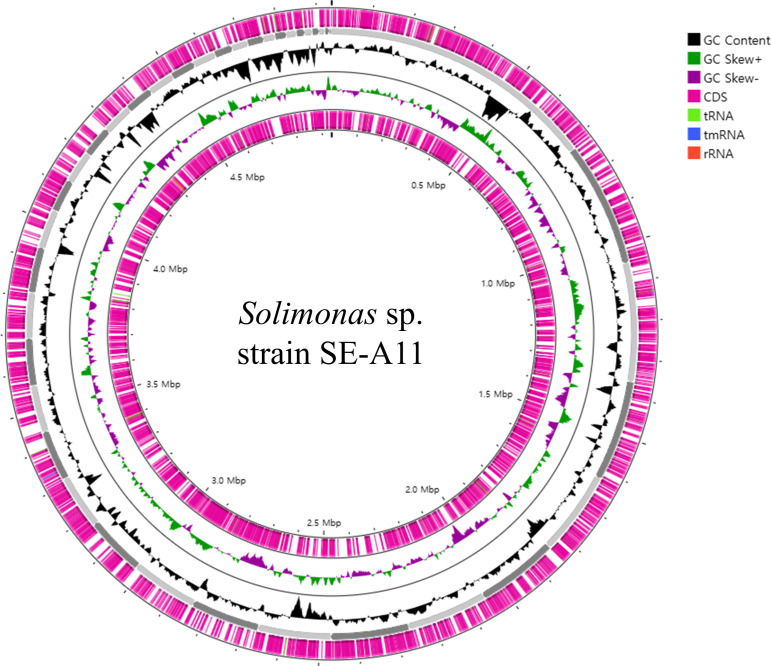 Fig 1
Fig 1Peer Reviews
No public reviews on file for this paper yet. If you reviewed it on a platform where reviews are public (OpenReview, ICLR, NeurIPS, ICML), you can paste yours below so the community can read it here.
Videos
No videos yet. Explain this paper in a talk, walkthrough, or lecture? Add one.
Taxonomy
TopicsPlant Disease Resistance and Genetics · Genomics and Phylogenetic Studies · Plant Pathogens and Fungal Diseases
ANNOUNCEMENT
Feral Brassica napus, or rapeseed, thrives in natural environments, making its rhizosphere a crucial area for studying ecological interactions between plants and soil microorganisms (1, 2). B. napus is also a representative crop that has been widely developed and cultivated as a genetically modified (GM) crop, with instances of environmental leakage being reported (3). The isolation of Solimonas sp. from the lateral root of feral B. napus presents significant potential for its use as a bioindicator species in environmental risk assessments of the rhizosphere of genetically modified B. napus, establishing it as a key species for evaluating the ecological stability of rhizospheres influenced by genetically modified crops. This strain is the first Solimonas species (family Nevskiaceae) isolated from a plant rhizosphere, despite the genus having seven previously described species (4). Genome sequencing data can provide crucial insights into the fundamental molecular and evolutionary characteristics of this strain. Here, we report a draft genome sequence of Solimonas sp. strain SE-A11.
During environmental risk assessments of feral B. napus conducted in Naju, South Korea (35°00′3.16″N, 126°42′7.58″E) (1), bacterial strains were isolated from the lateral root using Reasoner’s 2A Agar (R2A) (Difco, MI, USA) at room temperature. The lateral roots were placed in distilled water (DW) and shaken, then serially diluted with sterilized distilled water (pH 7.0) and spread on plates. Single colonies were subcultured onto fresh R2A agar plates and incubated under identical conditions. The isolates were routinely maintained by transferring them onto new R2A plates every 10–14 days. The genomic DNA was extracted directly from plate colonies using a FastDNA SPIN Kit for Soil according to the manufacturer’s instructions (MP Biomedicals, OH, USA). The concentration and quality of extracted DNA were evaluated using a Nanodrop 2000 spectrophotometer (Thermo Scientific, DE, USA). The extracted gDNA was then used for amplification of the 16S rRNA gene and library construction. PCR was performed using the universal 16S primers 27F and 1492R (5). PCR amplification was performed under the following conditions: initial denaturation at 95°C for 5 min; 30 cycles of 95°C for 1.5 min, 55°C for 1 min, and 72°C for 1.5 min; followed by a final extension at 72°C for 10 min. Then, BLAST analysis showed 98.6% similarity to S. fluminis strain HR-BB (GenBank accession number NR179743.1) based on the 16S rRNA gene sequence (NCBI BLAST rRNA_typestrains/16S_ribosomal_RNA, 09.25.2024) (6). The library for whole-genome sequencing was constructed using the TruSeq Nano DNA LT Library Prep Kit (Illumina, San Diego, CA, USA), following the manufacturer’s regular protocol (insert size 350 bp), then sequenced using the HiSeq Rapid SBS Kit v2-HS with the HiSeq X platform (Illumina). After sequencing, 14,956,918 reads were produced, and total bases are 2,258,494,618. Quality control was performed using FastQC (https://www.bioinformatics.babraham.ac.uk/projects/fastqc) (7). De novo assembly was performed using SPAdes v3.10.1 to assemble the trimmed paired-end reads into contigs (8). Contigs shorter than 500 bp were eliminated. The CG view server constructed a circular genomic map from the resultant genome (https://cgview.ca/) (9). Annotation was performed using the RAST server (http://rast.nmpdr.org) (10). The isolate has been deposited in both the Korean Culture Center of Microorganisms (KCCM 43467) and the Japan Collection of Microorganisms (JCM 36557).
The genome consists of 42 contigs, totaling 4,937,440 bp, with an N50 value of 203.8 kb and a high G + C content of 66.5% (Fig. 1). The genome coverage was 149×, indicating a high level of sequencing depth and reliability in the genome assembly. A total of 4,525 protein-coding genes and 55 RNA genes were predicted, with the genes classified into 281 subsystems.
Genome map of Solimonas sp. strain SE-A11 built using CGView server (https://proksee.ca/ accessed on 25 September 2024). Genomic features are represented from the outer to the inner circle, circle 1—illustrates Prokka annotated forward and coding sequences (CDS) with tRNA, rRNA, and tmRNA; circle 2—represents the GC content; circle 3—displays the GC skew (G-C) / (G + C).
The reference list from the paper itself. Each links out to its DOI / PubMed record.
- 1Chun S-J, Cui Y, Yoo S-H, Lee JR. 2022. Organic connection of holobiont components and the essential roles of core microbes in the holobiont formation of feral Brassica napus Front Microbiol 13:920759. doi:10.3389/fmicb.2022.92075935875588 PMC 9305074 · doi ↗ · pubmed ↗
- 2Chun S-J. 2022. Microbiome dataset of eukaryotic and fungal communities in the bulk soil and root of wild Brassica napus in South Korea. Data Brief 43:108457. doi:10.1016/j.dib.2022.10845735864876 PMC 9294038 · doi ↗ · pubmed ↗
- 3Lim HS, Choi W, Jung YJ, Yoon A-M, Noh D, Lee JH, Kim CM, Lee JR. 2024. Long-term monitoring and management of genetically modified canola in natural environments: a 15-year study. Appl Sci (Basel) 14:8333. doi:10.3390/app 14188333 · doi ↗
- 4Liu X, Lai Q, Sun F, Du Y, Gai Y, Li G, Shao Z. 2021. Solimonas marina sp. nov., isolated from deep seawater of the Pacific Ocean. Int J Syst Evol Microbiol 71:004528. doi:10.1099/ijsem.0.00452833253084 · doi ↗ · pubmed ↗
- 5Frank JA, Reich CI, Sharma S, Weisbaum JS, Wilson BA, Olsen GJ. 2008. Critical evaluation of two primers commonly used for amplification of bacterial 16S r RNA genes. Appl Environ Microbiol 74:2461–2470. doi:10.1128/AEM.02272-0718296538 PMC 2293150 · doi ↗ · pubmed ↗
- 6Zhang Z, Schwartz S, Wagner L, Miller W. 2000. A greedy algorithm for aligning DNA sequences. J Comput Biol 7:203–214. doi:10.1089/1066527005008147810890397 · doi ↗ · pubmed ↗
- 7Andrews S. 2010. Fast QC: a quality control tool for high throughput sequence data. Cambridge, United Kingdom.
- 8Bankevich A, Nurk S, Antipov D, Gurevich AA, Dvorkin M, Kulikov AS, Lesin VM, Nikolenko SI, Pham S, Prjibelski AD, Pyshkin AV, Sirotkin AV, Vyahhi N, Tesler G, Alekseyev MA, Pevzner PA. 2012. SP Ades: a new genome assembly algorithm and its applications to single-cell sequencing. J Comput Biol 19:455–477. doi:10.1089/cmb.2012.002122506599 PMC 3342519 · doi ↗ · pubmed ↗