Characterization of a novel HIV-1 second-generation circulating recombinant form (CRF144_07C) in Ganzhou, China
Xiaoyi Zhang, Hongmin Cao, Yating Chen, Chaoxian Lian, Ting Zeng, Junjie Liu, Junzhi Su, Qian Gao, Fengxiu Zhu, Yuning Zhang, Dandan Huang, Yanheng Zhou, Xin Chen

Abstract
Genes, proteins, chemicals, diseases, species, mutations and cell lines named across the full text — each resolved to its canonical identifier and authoritative record.
Click any figure to enlarge with its caption.
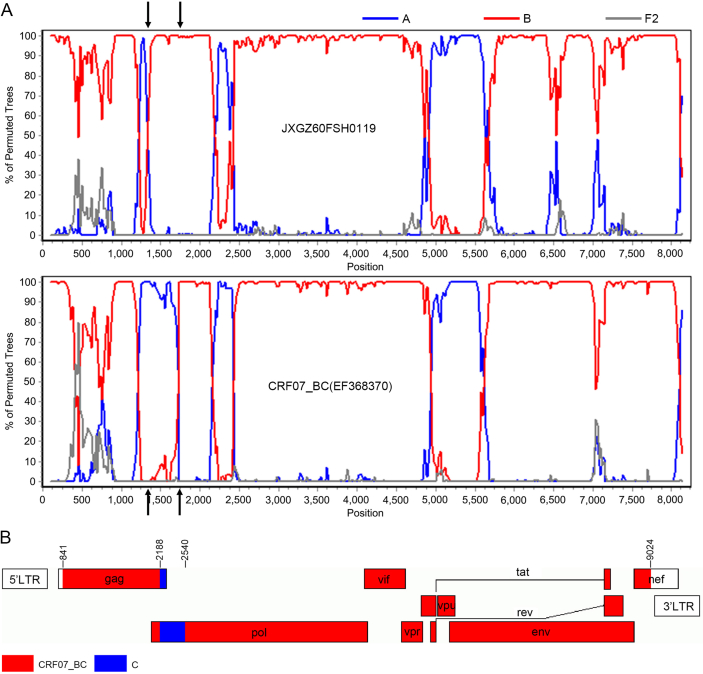 Figure 1
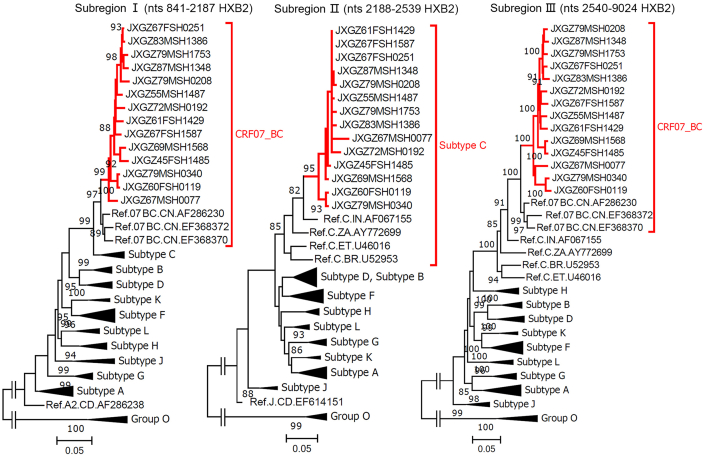 Figure 2
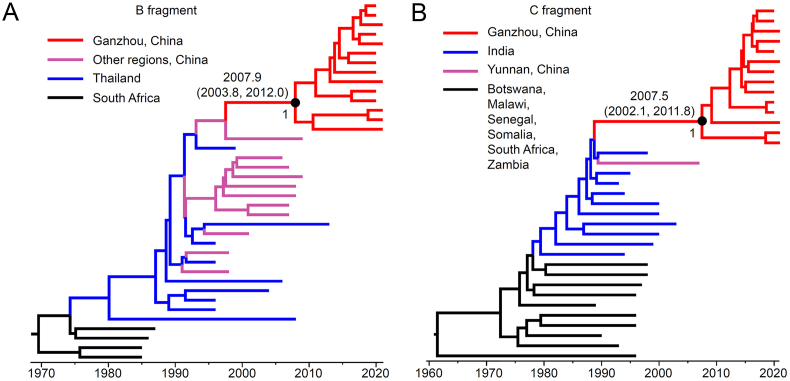 Figure 3
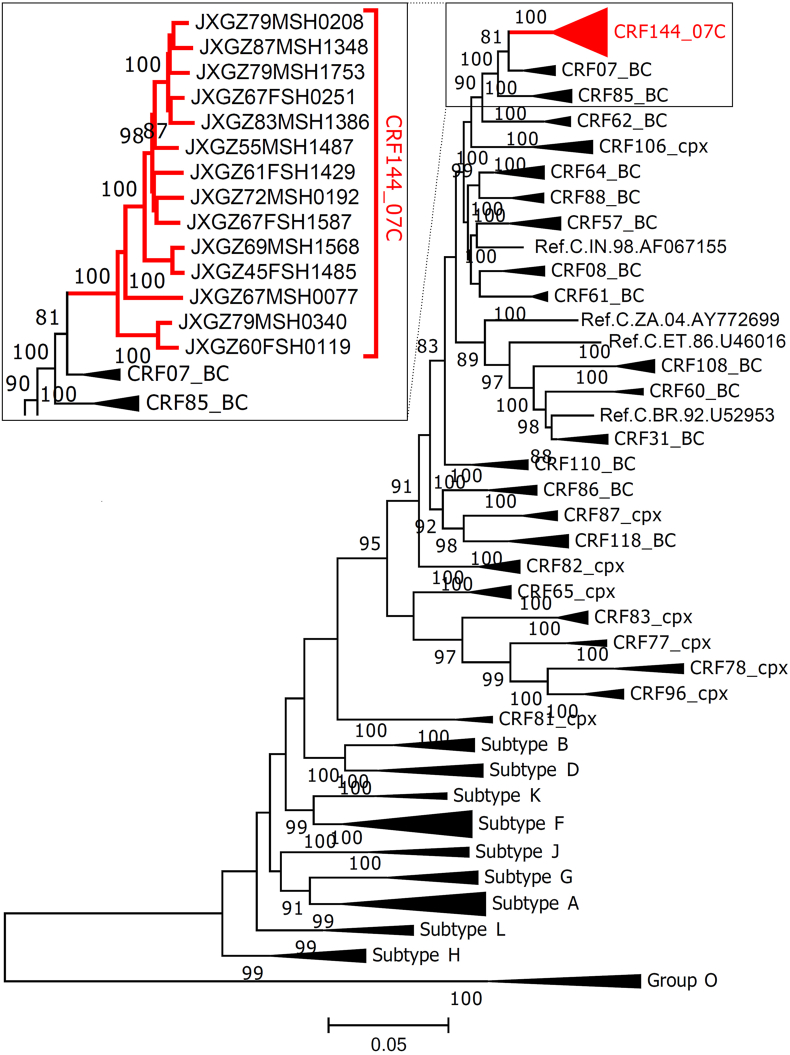 Figure 4
Peer Reviews
No public reviews on file for this paper yet. If you reviewed it on a platform where reviews are public (OpenReview, ICLR, NeurIPS, ICML), you can paste yours below so the community can read it here.
Videos
No videos yet. Explain this paper in a talk, walkthrough, or lecture? Add one.
Taxonomy
TopicsHIV Research and Treatment · HIV/AIDS drug development and treatment · HIV/AIDS Research and Interventions
Inter-subtype recombination is the main force for the complexity of HIV-1 genetic diversity, which increases the difficulty of preventing HIV-1 infection and administering antiretroviral therapy for people living with HIV. To date, 143 circulating recombinant forms (CRFs) have been reported globally, 43 of which were identified in China.1 Moreover, HIV-1 strains that are produced by second-generation combinations, including unique recombinant forms and CRFs, such as CRF105_0108, CRF123_0107, and CRF134_0185, have been commonly reported in recent years. The present study identified a novel second-generation recombinant form of HIV-1 comprising CRF07_BC and subtype C and designated CRF144_07C. To our knowledge, this was the first report of HIV CRFs comprising CRF07_BC and subtype C, further indicating the complexity of HIV genetic diversity in China.
Fourteen near full-length genomes were successfully amplified and sequenced from newly reported people living with HIV in Ganzhou, China, as described previously (Supplementary Materials and Methods).2 Among these 14 participants, most of them were male, ≥55 years, married, farmer, from Xinfeng county, infected through heterosexuals, and with viral load > 10^5^ copies/mL (Table S1). Maximum-likelihood tree using pure subtypes and CRFs comprising subtype B and subtype C as reference sequences showed that query sequences formed a unique cluster with a maximum parsimony bootstrap value of 100 %, located outside of the CRF07_BC cluster (Fig. 1). These results indicated that the query sequences might belong to a novel CRF divided from CRF07_BC and subtype C.Figure 1. Maximum-likelihood trees based on HIV-1 near full-length genomes. The reference sequences included sequences of group O, subtypes A–L, and circulating recombinant forms (CRFs) comprising subtype B and subtype C. The reliability of the tree branches was evaluated by 1000 bootstrap replicates and only bootstrap values greater than 80 % were shown at each node. The branch of the potential novel CRF is marked in red.Figure 1
Bootscan analyses revealed that these near full-length genomes comprised recombinants of three subtype B fragments and four subtype C fragments, with six identical breakpoints (Fig. S1A). Because they share the same mosaic structures, they could be designated as novel CRFs according to the HIV nomenclature proposal, which was named CRF144_07C. Compared with those of CRF07_BC, only two breakpoints of the mosaic structures of CRF144_07C were different (Fig. S1A), with the insertion of a subtype C fragment (nts 2188–2539 HXB2) into the backbone of CRF07_BC. Maximum-likelihood trees of the subregions of this novel CRF showed that subregion Ⅰ (nts 841–2187 HXB2) and Ⅲ (nts 2540–9024 HXB2) clustered with CRF07_BC, and subregion Ⅱ (nts 2188–2539 HXB2) clustered with subtype C (Fig. S2). In summary, CRF144_07C was a second-generation recombinant form of CRF07_BC and subtype C (Fig. S1B).
To estimate the emergence time of CRF144_07C, Bayesian evolutionary analyses were performed with the maximum subtype B fragment (nts 5817–6527 HXB2) and subtype C fragment (nts 3165–5816 HXB2). Maximum clade credibility trees revealed that the median time of the most recent common ancestor for the subtype B fragment (Fig. S3A) and subtype C fragment (Fig. S3B) were 2007.9 (95% highest probability density: 2003.8–2012.0) and 2007.5 (95% highest probability density: 2002.1–2011.8), respectively.
Although CRF144_07C was a newly identified HIV-1 strain, it seems to be prevalent in Ganzhou, China. According to the reanalysis of our previous study, the first patient infected with CRF144_07C was diagnosed in 2018 among outpatients in Ganzhou3 (Table S1), and the results of the present study showed that the median time of the most recent common ancestor for CRF144_07C was 2007 (Fig. S3), which indicates that CRF144_07C might have been prevalent in Ganzhou for approximately 15 years. Moreover, CRF144_07C was found to be prevalent in five different counties in Eastern, Western, and Southern Ganzhou, including Chongyi, Xinfeng, Ganxian, Ruijin, and Anyuan (Table S1). These findings showed that the newly identified CRF144_07C had become one of the main prevalent strains in Ganzhou, China.4
In the early stages of the pandemic, newly identified HIV-1 strains seemed to be highly relevant to the risk population. In the 1990s, HIV-1 CRF01_ AE and CRF07_ BC began to be prevalent in China, with the former occurring mainly among people who have heterosexual intercourse and the latter occurring mainly among people who inject drugs. Later, both strains spread to other risk populations and became the two main prevalent strains in China.5 Of the 15 individuals with CRF144_07C, 13 were aged 55 years and older (Table S1), and all of them had experienced heterosexual intercourse, suggesting that CRF144_07C might arise in the elderly population through heterosexual transmission. More extensive and systematic research was urgently needed to further understand whether CRF144_07C spread to other risk populations, as had been done for CRF01_AE and CRF07_BC.
In summary, we performed a molecular epidemiologic study of 17 newly reported people living with HIV in Ganzhou from 2020 to 2021. A novel second-generation recombinant form of HIV-1 comprising CRF07_BC and subtype C was identified and designated CRF144_07C. CRF144_07C might be one of the main prevalent strains in Ganzhou. Continuous and systematic research is urgently needed to understand the dynamics of CRF144_07C and to monitor the genetic diversity of HIV-1 in China.
Ethics declaration
The protocol of this study was approved by the Ethics Committee of Gannan Medical University (2021320). Written informed consent for sample collection and subsequent analysis was obtained from all participants.
Funding
This work was supported by the 10.13039/501100001809National Natural Science Foundation of China (No. 82060367), the Science and Technology Plan of Health Commission of Jiangxi Province, China (No. SKJP_220210624), and the Science and Technology Research Project of the Department of Education of Jiangxi Province, China (No. GJJ2201455, GJJ211527).
CRediT authorship contribution statement
Xiaoyi Zhang: Investigation, Methodology, Writing – original draft. Hongmin Cao: Conceptualization, Writing – review & editing. Yating Chen: Investigation. Chaoxian Lian: Investigation. Ting Zeng: Investigation. Junjie Liu: Data curation, Resources. Junzhi Su: Data curation, Resources. Qian Gao: Data curation, Resources. Fengxiu Zhu: Data curation, Resources. Yuning Zhang: Methodology, Software, Funding acquisition. Dandan Huang: Funding acquisition, Methodology, Software. Yanheng Zhou: Funding acquisition, Methodology, Software. Xin Chen: Conceptualization, Writing – review & editing.
Sequence data
The sequences amplified by this study were submitted to GenBank under accession nos. OR117365 to OR117378.
Conflict of interests
The authors declared no conflict of interests.
The reference list from the paper itself. Each links out to its DOI / PubMed record.
- 1He M.Li C.Chang W.Genomic characterization of a newly emerging circulating recombinant form of HIV-1, CRF 143_cpx, involving subtypes B, C and CRF 01_AE, identified in Yunnan, China J Infect 8732023 e 58e 603735504910.1016/j.jinf.2023.06.016 · doi ↗ · pubmed ↗
- 2Chen X.Ye M.Duo L.First description of two new HIV-1 recombinant forms CRF 82_cpx and CRF 83_cpx among drug users in Northern Myanmar Virulence 8520174975032757495010.1080/21505594.2016.1226722 PMC 5538334 · doi ↗ · pubmed ↗
- 3Xie Y.N.Zhang Y.N.Cheng S.W.The genetic diversity of HIV-1 within antiretroviral-naive outpatients in Ganzhou, China AIDS Res Hum Retrovir 37220211471503279964210.1089/AID.2020.0168 · doi ↗ · pubmed ↗
- 4Xie Y.N.Zhu F.X.Zhong Y.T.Distribution characteristics of drug resistance mutations of HIV CRF 01_AE, CRF 07_BC and CRF 08_BC from patients under ART in Ganzhou, China J Antimicrob Chemother 76112021297529823440251210.1093/jac/dkab 296 · doi ↗ · pubmed ↗
- 5Lu L.Jia M.Ma Y.The changing face of HIV in China Nature 455721320086096111883327010.1038/455609 a · doi ↗ · pubmed ↗