Declining BMI and possible associations with changing perceptions of masculinity in Japanese young males
Akihito Uezato, Saki Takagi, Yoshihiko Nakatani, Naoki Yamamoto

Abstract
Genes, proteins, chemicals, diseases, species, mutations and cell lines named across the full text — each resolved to its canonical identifier and authoritative record.
Click any figure to enlarge with its caption.
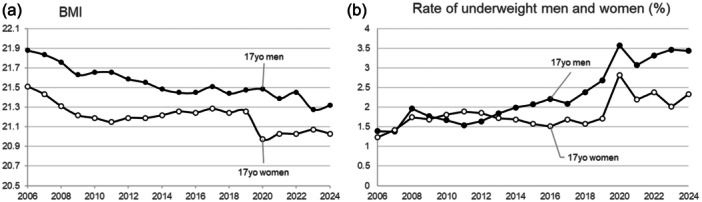 Figure 1
Peer Reviews
No public reviews on file for this paper yet. If you reviewed it on a platform where reviews are public (OpenReview, ICLR, NeurIPS, ICML), you can paste yours below so the community can read it here.
Videos
No videos yet. Explain this paper in a talk, walkthrough, or lecture? Add one.
Taxonomy
TopicsEating Disorders and Behaviors · Gender Roles and Identity Studies · Obesity and Health Practices
It is said that body image has been influenced by broader sociocultural trends. Previously, Kiriike and one of the authors reported the decreased body mass index (BMI) of young Japanese women from 1960 to 1995 and discussed the increased risk for eating disorders.1 In this report, we review changes in the BMI of young Japanese men and women over the past 20 years using publicly available data and discuss its possible association with shifts in perceptions of masculinity.
To represent the mid to late teens, the changes in the BMI of 17‐year‐old men and women from 2006 to 2024 are shown in Figure 1a. We chose 17‐year‐olds, as this is the oldest age for which data are available from the school health statistics in e‐Stat, the official portal site for Japanese Government Statistics (www.e-stat.go.jp/en). While the BMI of 17‐year‐old women remained relatively stable until 2019, a sharp decline was observed starting in 2020, during and even after the COVID‐19 pandemic. The BMI of 17‐year‐old men has continued to decrease gradually up to the present. Similarly, the BMIs of 15–19‐year‐old men and women showed comparable trends (Figures S1 and S2). Curiously, while the rate of underweight women remained stable until 2019, the rate among men steadily increased over the same period (Figure 1b).
It is unlikely that young people are eating less as the national health and nutrition survey shows the total energy intake of 15–19‐year‐old men and women appears to be constant in this period (Figure S3). Lifestyle changes, such as decreased physical activity due to increased smartphone usage and the subsequent decline in muscle mass, may be related to the reduction in BMI. However, according to a survey by the Japan Sports Agency, while grip strength among young people has shown a declining trend, core muscle strength has been increasing, making it difficult to draw clear conclusions about its relationship with BMI. Thus, although various factors may contribute to the decline in BMI, we aim to present the perspective that it is associated with changing perceptions of masculinity among Japanese people.
The perception of masculinity during the high economic growth in Japan, which ended in 1980s, was highly hegemonic focusing on productivity, labor, and breadwinning.2 During and after 1990s, the expectation of masculinities shifted from physical to “tender‐hearted” representation. A contemporary behavioral trend of young men, so‐called “Sohshokukei‐danshi,” herbivorous boys, has been a widely‐known buzzword for the past 15 years to indicate those who lack active association with women and prefer to engage in typically feminine acts such as cooking, eating sweets, or even making up.3 Their representation is in harmony with popular media icons such as idols produced by Japanese entertainment mega‐agencies, who are supposed to downplay any overt heteronormative masculinities and are not allowed to discuss any romantic relationship to maintain fans’ fantasy.4 The boom coincides with the BMI decline in young men (Figure 1). As “herbivorous boys” become increasingly accepted in Japanese society, reducing the pressure to conform to traditional masculinity, concerns about obesity continue to be raised through media messaging, which may ultimately contribute to a decline in BMI among boys. A 2016 study found that while 80% of male high school students fell within the normal BMI range (18.5–25), 30% desired weight loss.5 A study revealed that the rate of male students attempting weight reduction doubled in 2017 compared to 2010 (https://koueki.net/user/niye/110349438-2.pdf).
In Western society, concepts such as Men Going Their Own Way emphasize male autonomy but remain niche ideologies rather than widespread movements. Rather, the masculine ideal of lean muscularity and the resulting body dissatisfaction have remained consistent.6 Many western adolescent boys seek to gain weight—specifically by increasing muscle mass without becoming obese—a tendency that has been found to be associated with bulimic behavior.7, 8 While the phenomenon of “herbivorous boys” may seem unique to Japan or Asia, Japan has long been shaped by Western influence. Thus, the Western masculine ideal of lean muscularity may become more prominent. Conversely, as societal values diversify, the gentle, nonhegemonic masculinity of herbivorous boys could emerge as a global trend. Given the rising prevalence of eating disorders in men and concerns over distorted body image,9 sociocultural trends and masculinity‐related identity shifts remain key topics for future research. One promising approach is using tools like the Muscularity Oriented Eating Test to examine how young men are influenced by sociocultural factors.10
AUTHOR CONTRIBUTIONS
Data acquisition: Saki Takagi and Yoshihiko Nakatani. Data analysis: Akihito Uezato and Saki Takagi. Manuscript drafting: Akihito Uezato and Naoki Yamamoto. All authors approved the final manuscript.
CONFLICT OF INTEREST STATEMENT
The authors declare no conflict of interest.
ETHICS APPROVAL STATEMENT
N/A
PATIENT CONSENT STATEMENT
N/A
CLINICAL TRIAL REGISTRATION
N/A
Supporting information
Supporting information.
The reference list from the paper itself. Each links out to its DOI / PubMed record.
- 1Kiriike N , Nagata T , Sirata K , Yamamoto N . Are young women in Japan at high risk for eating disorders?: Decreased BMI in young females from 1960 to 1995. Psychiatry Clin Neurosci. 1998;52(3):279–281.9681578 10.1046/j.1440-1819.1998.00387.x · doi ↗ · pubmed ↗
- 2Kumagai K . Floating young men: globalization and the crisis of masculinity in Japan. Hagar Stud Cult Polit Ident. 2012;10(2):3–15.
- 3Morioka M . A phenomenological study of “herbivore men”. Rev Life Stud. 2013;4:1–20.
- 4Nagaike K . Johnny's idols as icons: female desires to fantasize and consume male idol images. In: Galbraith PW , Karlin JG , editors. Idols and celebrity in Japanese media culture. London: Springer; 2012. p. 97–112.
- 5Mita Y . Awareness research on high school students: diet and dietary habits. Memoir Hokuriku Gakuin Univ. 2016;9:231–238.
- 6Karazsia BT , Murnen SK , Tylka TL . Is body dissatisfaction changing across time? A cross‐temporal meta‐analysis. Psychol Bull. 2017;143(3):293–320.27893220 10.1037/bul 0000081 · doi ↗ · pubmed ↗
- 7Mc Cabe MP , Ricciardelli LA . Body image dissatisfaction among males across the lifespan. J Psychosom Res. 2004;56(6):675–685.15193964 10.1016/S 0022-3999(03)00129-6 · doi ↗ · pubmed ↗
- 8Baker JH , Higgins Neyland MK , Thornton LM , Runfola CD , Larsson H , Lichtenstein P , et al. Body dissatisfaction in adolescent boys. Dev Psychol. 2019;55(7):1566–1578.30985163 10.1037/dev 0000724 PMC 6586497 · doi ↗ · pubmed ↗