Characterization of the complete mitochondrial genome and phylogenetic analysis of the Southern giant petrel (Macronectes giganteus, Procellariiformes: Procellariidae)
Jong-U Kim, Jeong-Hoon Kim

TL;DR
This study sequenced the complete mitochondrial genome of the Southern giant petrel for the first time and analyzed its phylogenetic placement within the Procellariidae family.
Contribution
The first complete mitochondrial genome characterization of Macronectes giganteus, including its phylogenetic analysis.
Findings
The mitogenome is 20,169 bp in length and includes 13 protein-coding genes, 22 tRNA genes, and two rRNA genes.
A 2.9kbp duplication was found, adding extra copies of two tRNAs and ND6.
Phylogenetic analysis confirmed M. giganteus belongs to the family Procellariidae.
Abstract
The Southern giant petrel (Macronectes giganteus (Gmelin, 1789)) is a large seabird widely distributed in the southern oceans. In the present study, the complete mitochondrial genome of M. giganteus was sequenced and characterized for the first time. The mitogenome sequence was circular and 20,169 bp in length. It contains 13 protein-coding genes (PCGs) including one cis-slicing gene (ND3), 22 transfer RNA (tRNA) genes, and two ribosomal RNA (rRNA) genes. Furthermore, there was an additional copy of two tRNAs and ND6 due to a 2.9kbp duplication. The total nucleotide composition was 30.84% (A), 30.69% (C), 13.05% (G), and 25.42% (T) with an overall GC content of 43.97%. Phylogenetic analysis of all PCGs in the complete mitogenome confirmed the inclusion of M. giganteus within the family Procellariidae. These new mitochondrial genome data will be useful for further studies on the…
Genes, proteins, chemicals, diseases, species, mutations and cell lines named across the full text — each resolved to its canonical identifier and authoritative record.
Click any figure to enlarge with its caption.
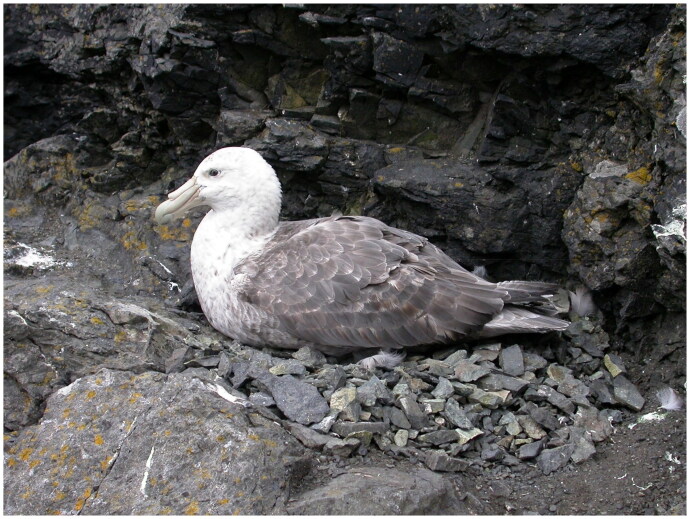 Figure 1
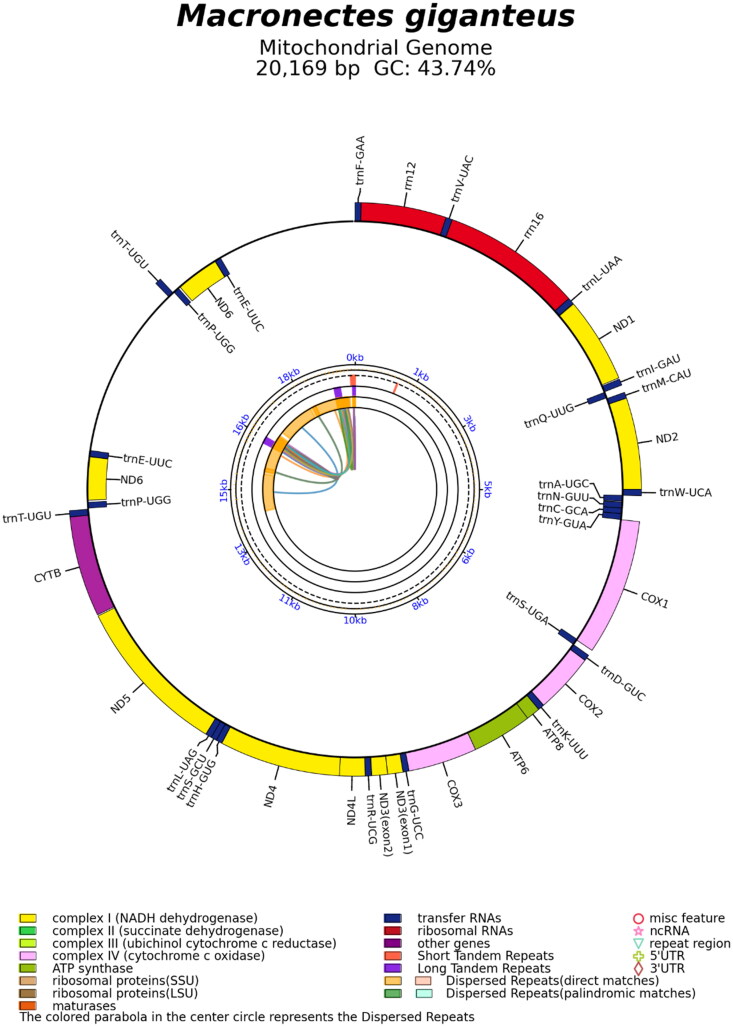 Figure 2
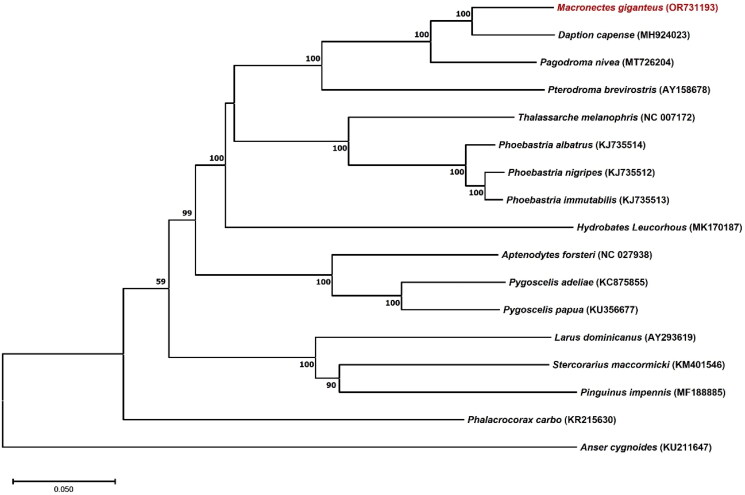 Figure 3
- —the Korea Polar Research Institute
- —Korean Ministry of Environment
Peer Reviews
No public reviews on file for this paper yet. If you reviewed it on a platform where reviews are public (OpenReview, ICLR, NeurIPS, ICML), you can paste yours below so the community can read it here.
Videos
No videos yet. Explain this paper in a talk, walkthrough, or lecture? Add one.
Taxonomy
TopicsGenomics and Phylogenetic Studies · Identification and Quantification in Food · Genetic diversity and population structure
Introduction
The Southern giant petrel (Macronectes giganteus (Gmelin, 1789)) is a member of the family Procellariidae and the order Procellariiformes. The genus Macronectes comprises two extant species (M. giganteus and M. halli Mathews, 1912), and one extinct species (M. tinae Tennyson and Salvador, 2023) (Patterson et al. 2008). M. giganteus is a large seabird widely distributed in the southern oceans (Brooke 2004); it is classified as ‘least concern’ in the International Union for Conservation of Nature (IUCN) red list (IUCN 2018). The population of this species was estimated to be 38,000 pairs in the 1980s (Hunter 1985), declining to 31,000 pairs in the late 1990s (Rootes 1988). However, the global population of M. giganteus has increased to 54,000 breeding pairs in recent years (Birdlife International 2023). Complete mitochondrial genomes can serve as baseline information for understanding the molecular evolution and taxonomic clarification of various organisms (Sebastian et al. 2018; Kim and Kim 2021). Although genomic studies on M. giganteus have been performed previously (Vianna et al. 2020; Kim et al. 2021), no description of the complete mitogenome of this species or M. halli has been published. The present study aimed to obtain and characterize the complete mitochondrial genome of M. giganteus to enhance our understanding of its phylogenetic and evolutionary processes.
Materials and methods
An adult M. giganteus was captured by hand from a nest at the Barton Peninsula, Antarctica (62°14’3.74"S, 58°46’55.10"W), on 20 February 2011. A volume of ∼100 µl blood was collected from a major wing vein after which the bird was released to avoid negative effects on the individual. The blood sample of M. giganteus (proof number SGP1) was stored at the Korea Polar Research Institute, Incheon, South Korea (Dr. Jeong-Hoon Kim: [email protected]) under proof number SGP1. The sampling locality is within the geographic range of M. giganteus and far outside that of M. halli. Total genomic DNA was extracted from the blood sample using a DNeasy Blood and Tissue kit (Qiagen, Hilden, Germany), according to the manufacturer’s instructions. The complete mitogenome was sequenced and analyzed as per previously described protocols (Kim and Kim 2021). Briefly, the 151 bp of paired-end sequencing was performed by HiSeq2500 system supplied by a commercial company (Phyzen, Seongnam, South Korea), after TruSeq DNA PCR-Free library was prepared according to the manufacturer’s instructions. The Illumina data were quality-trimmed, and used to assemble the mitochondrial genome with the CLC Assembly Cell package ver 4.2.1 (QIAGEN, Denmark). The mitochondrial genes were annotated with GeSeq (Tillich et al. 2017) and manually curated by Artemis annotation tool (Rutherford et al. 2000). The genome map of M. giganteus was visualized using the PMGmap tool (Zhang et al. 2024). The completeness of the mitochondrial genome was verified using sequencing depth coverage data calculated from raw data alignment to the complete genome map (Supplementary Figure S1). A phylogenetic analysis was performed with orthologous protein-coding genes of published mitogenomes of 16 relevant bird species, including 9 from Procellariiformes, 3 penguins, 3 other water birds and waterfowl as an outgroup, to assess the phylogenetic position of M. giganteus. Maximum likelihood (ML) phylogenies with 1,000 bootstrap replicates were obtained, and the general time reversible model with gamma distribution plus invariant sites (G + I) was applied, using the MEGA11 program (Tamura et al. 2021) after model selection with jmodeltest-2.1.10 (Darriba et al. 2012).
Results
The complete mitochondrial genome sequence of M. giganteus (Figure 1) is a circular genome that comprised 20,169 (GenBank accession no. OR731193); it has an approximately 2.9 kbp of the duplicated region (Supplementary Figure S1) and contains 13 protein-coding genes (PCGs) including one cis-slicing gene (ND3, Supplementary Figure S2), 22 transfer RNA (tRNA) genes, and two ribosomal RNA (rRNA) genes (Figure 2). The overall nucleotide base composition was 30.84% (A), 30.69% (C), 13.05% (G), and 25.42% (T), with a GC content of 43.74%. The heavy and light strands encode 28 and 9 genes, respectively. The 13 PCGs of M. giganteus encode 3,784 amino acids. Most PCGs started with the ATG codon, except for COI and ND1, which used the initiation codons GTG and ATT, respectively. A phylogenetic tree was constructed using all 13 PCGs to assess the phylogenetic position of M. giganteus with the published complete mitogenomes of 16 relevant bird species. Our phylogenetic analysis placed M. giganteus (OR731193) among members of the family Procellariidae. The phylogenetic analysis revealed that Daption capense Linnaeus, 1758 (MH924023) was the most closely related sister group with 100% bootstrap support. Further, M. giganteus and D. capense clustered with Pagodroma nivea Forster, 1777 (MT726204) and Pterodroma brevirostris Lesson, 1831 (AY158678) to form a Procellariidae clade (Figure 3).
The species reference image of Macronectes giganteus. This photograph was taken by the corresponding author (Jeong-Hoon Kim).
Genome map of the mitochondrial genome of Macronectes giganteus, consisting of 13 protein-coding, 22 transfer RNA, and two ribosomal RNA genes. Genes are shown both outside and inside the outer circle; the outside of the ring represents the positive strand, while the inside represents the negative strand.
ML phylogenetic tree of Macronectes giganteus constructed using the published complete mitogenomes of 16 relevant bird species based on all 13 mitochondrial PCGs. The numbers on the branches indicate the ML bootstrap percentages. The species analyzed in this study is shown in red and the GenBank accession numbers of the published sequences are marked on the figure: Aptenodytes forsteri NC027938 (Du et al. 2019); Pygoscelis adeliae KC875855 (Gibb et al. 2013); Pygoscelis Papua KU356677 (Ramos et al. 2018); Daption capense MH924023 (Jung et al. 2019); Hydrobates leucorhous MK170187 (originally published as Oceanodroma castro by Antaky et al. 2019 but reidentified by Sangster and Luksenburg 2021); Pterodroma brevirostris AY158678 (Slack et al. 2006); Phoebastria albatrus KJ735514, Phoebastria immutabilis KJ735513, Phoebastria nigripes KJ735512 (Lounsberry et al. 2015); Thalassarche melanophris NC007172 (Slack et al. 2006); Phalacrocorax carbo KR215630 (Zhang et al. 2017); Pinguinus impennis MF188885 (Thomas et al. 2017); Larus dominicanus AY293619 (Slack et al. 2007); Stercorarius maccormicki KM401546 (Han et al. 2016); Anser cygnoides KU211647 (Lin et al. 2018); Pagodroma nivea MT726204 (Kim and Kim 2020).
Discussion and conclusion
To the best of our knowledge, the present study is the first to sequence and characterize the complete mitochondrial genome of M. giganteus. The mitogenome of M. giganteus is 20,169 bp long and contains 13 PCGs, 22 tRNA genes, and two rRNA genes. It has two unusual characteristics compared to other animal species; one is cis-splicing ND3 and the other is 2.9kbp of duplicated that includes two tRNAs, ND6 and the control region. The cis-splicing ND3 with an extra nucleotide has been reported in various bird and turtle species (Mindell et al. 1998) as well as in other Procellariidae species including Pterodroma brevirostris (AY158678.1) and Pelecanoides urinatrix (MN356319.1). In addition, several cases of the duplicated structure were previously reported among Procellariiformes species (Abbott et al. 2005; Eda et al. 2010; Torres et al. 2019). Thus, one-base cis-splicing ND3 and duplicated control region is characteristics of mitochondrial genome of M. giganteus considering previous report. The phylogenetic analysis confirmed that M. giganteus is among members of the Procellariidae family, which is consistent with the traditional morphological classification (Nunn and Stanley 1998; Kennedy and Page 2002, Brooke 2004). The new mitochondrial genome data from the present study will be useful for further studies on the phylogenetics and evolutionary history of the family Procellariidae and the genus Macronectes. Further mitogenomic studies are required to provide basic data regarding members from the genus Macronectes in order to better understand their relationships with other species from the family Procellariidae.
The reference list from the paper itself. Each links out to its DOI / PubMed record.
- 1Abbott CL, Double MC, Trueman JWH, Robinson A, Cockburn A. 2005. An unusual source of apparent mitochondrial heteroplasmy: duplicate mitochondrial control regions in Thalassarche albatrosses. Mol Ecol. 14(11):3605–3613. doi:10.1111/j.1365-294X.2005.02672.x.16156827 · doi ↗ · pubmed ↗
- 2Antaky CC, Kitamura PK, Knapp IS, Toonen RJ, Price MR. 2019. The complete mitochondrial genome of the Band-rumped Storm Petrel (Oceanodroma castro). Mitochondrial DNA Part B. 4(1):1271–1272. doi:10.1080/23802359.2019.1591199. · doi ↗
- 3Bird Life International. 2023. Species factsheet: Macronectes giganteus. [accessed 06 December 2023]. http://datazone.birdlife.org.
- 4Brooke M. 2004. Albatrosses and Petrels Across the World. Oxford: oxford University Press.
- 5Darriba D, Taboada GL, Doallo R, Posada D. 2012. j Model Test 2: more models, new heuristics and parallel computing. Nat Methods. 9(8):772–772. doi:10.1038/nmeth.2109.PMC 459475622847109 · doi ↗ · pubmed ↗
- 6Eda M, Kuro-O M, Higuchi H, Hasegawa H, Koike H. 2010. Mosaic gene conversion after a tandem duplication of mt DNA sequence in Diomedeidae (albatrosses). Genes Genet Syst. 85(2):129–139. doi:10.1266/ggs.85.129.20558899 · doi ↗ · pubmed ↗
- 7Hunter S. 1985. The role of giant petrels in the Southern Ocean ecosystem. Berlin: Springer-Verlag.
- 8IUCN. 2018. The IUCN Red List of Threatened Species. [accessed 06 December 2023]. https://www.iucnredlist.org.