Cricothyroid Approximation Surgery (Type IV Thyroplasty): Insights From Failure Cases and an Analysis of Contributing Factors Using Three-Dimensional Computed Tomography
Ray Motohashi, Hiroyuki Hiramatsu, Ryoji Tokashiki, Eriko Sakurai, Kiyoaki Tsukahara

TL;DR
This paper discusses two cases where cricothyroid approximation surgery failed due to excessive shortening of the cricothyroid distance, analyzed using 3D CT.
Contribution
The study provides insights into the anatomical and physiological factors contributing to the failure of Type IV thyroplasty.
Findings
Excessive shortening of the cricothyroid distance can prevent vocal fold elongation during TP IV.
Monitoring vocal function under local anesthesia improves surgical outcomes.
Avoiding excessive midline traction is essential to prevent complications.
Abstract
Type IV thyroplasty (TP IV) is commonly regarded as a simple surgical procedure to raise the pitch of the speaking fundamental frequency (SFF) by lengthening the vocal folds through the approximation of the thyroid and cricoid cartilages. However, we report two cases in which TP IV was unsuccessful due to excessive shortening of the cricothyroid distance as analyzed by three-dimensional computed tomography (3D CT). One case was performed under general anesthesia and the other under local anesthesia. In normal high-pitched phonation, the rotational movement of the thyroid and cricoid cartilages and the anterior gliding movement of the inferior horn of the thyroid cartilage play essential roles in vocal fold elongation. The anterior gliding movement shifts the inferior horn, which serves as the fulcrum of rotational motion, forward to effectively elongate the vocal folds. However, when…
Genes, proteins, chemicals, diseases, species, mutations and cell lines named across the full text — each resolved to its canonical identifier and authoritative record.
Click any figure to enlarge with its caption.
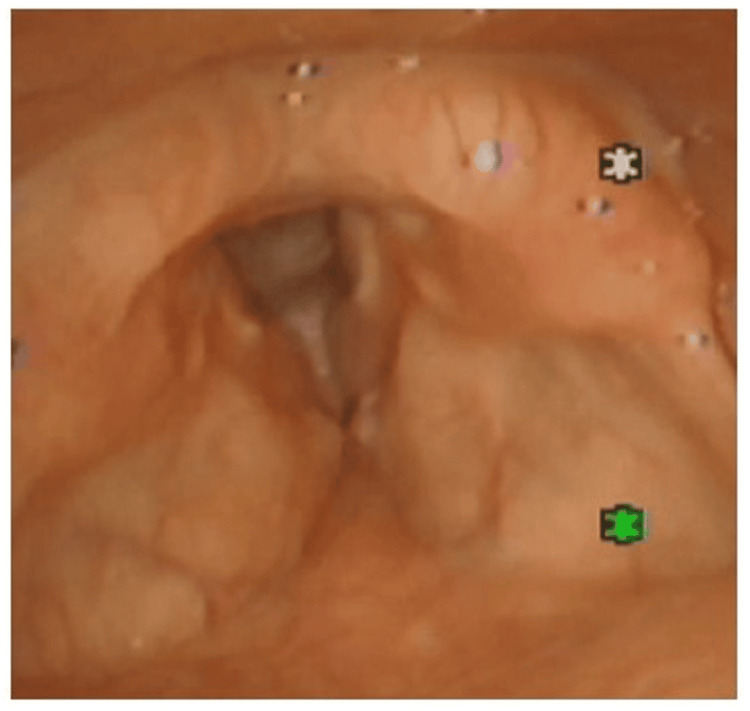 Figure 1
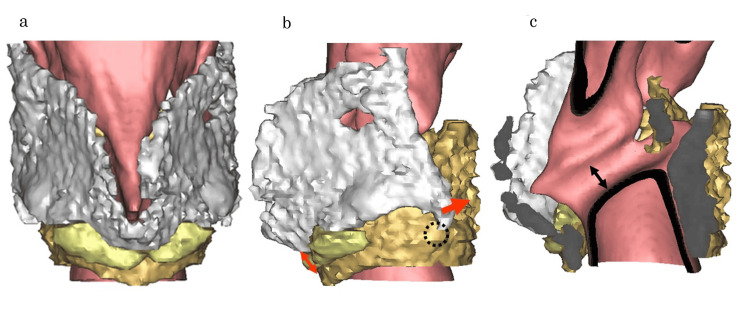 Figure 2
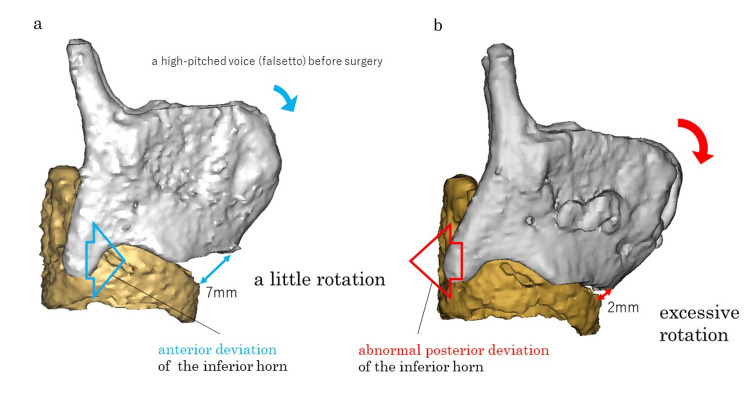 Figure 3
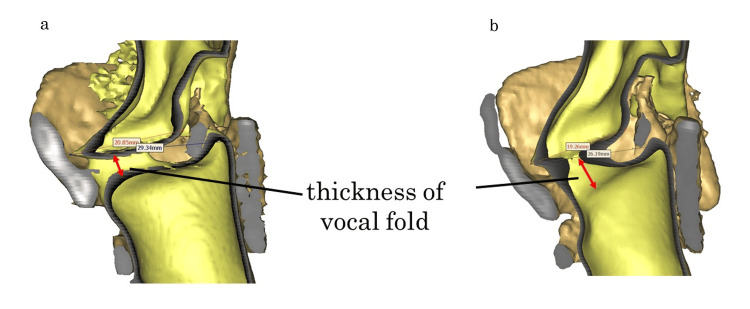 Figure 4
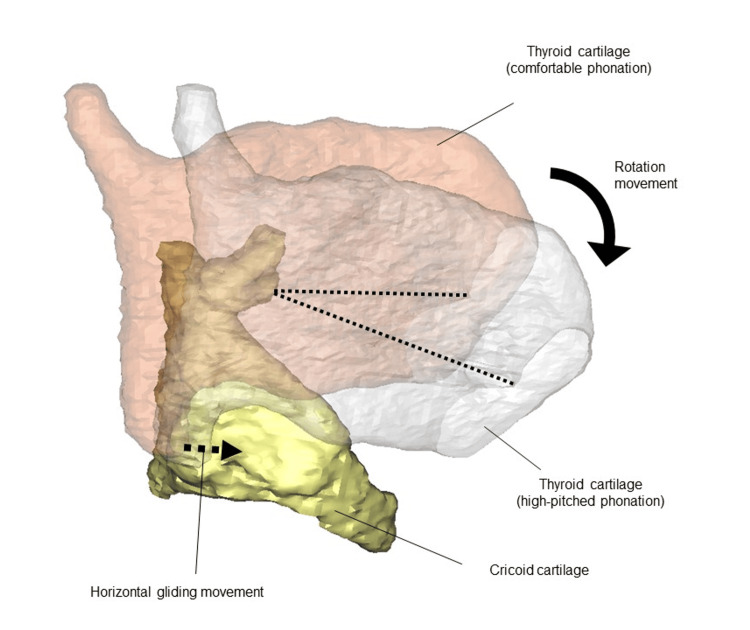 Figure 5
Peer Reviews
No public reviews on file for this paper yet. If you reviewed it on a platform where reviews are public (OpenReview, ICLR, NeurIPS, ICML), you can paste yours below so the community can read it here.
Videos
No videos yet. Explain this paper in a talk, walkthrough, or lecture? Add one.
Taxonomy
TopicsVoice and Speech Disorders · Tracheal and airway disorders · Dysphagia Assessment and Management