Psychological Therapy Outcomes and Engagement in People of Different Religions
Zainab Shafan-Azhar, Jae Won Suh, Henry Delamain, Laura-Louise Arundell, Syed Ali Naqvi, Tania Knight, Sarah Ellard, Stephen Pilling, Rob Saunders, Joshua E. J. Buckman

TL;DR
Muslim patients, especially those of White or other ethnicities, had worse psychological therapy outcomes compared to other religious groups in England.
Contribution
The study identifies inequalities in psychological therapy outcomes by religion and ethnicity, suggesting the need for culturally adapted interventions.
Findings
Muslim patients had lower odds of reliable recovery compared to non-Muslim patients after adjusting for sociodemographic and clinical factors.
White or other ethnic Muslim patients had worse outcomes than Asian, Black, or mixed race Muslim patients.
Treatment outcomes improved over time for all groups, but Muslim patients remained least likely to improve.
Abstract
This cohort study evaluates whether a patient’s religion is associated with their outcomes in psychological therapy. Are there inequalities in psychological therapy outcomes by self-identified religion, and if so, what are the contributing factors? In this cohort study of 70 098 individuals in England, UK, Muslim patients were less likely to recover following psychological therapy than patients of all other religions or none after adjusting for sociodemographic, treatment-related, and clinical characteristics. Muslim patients of White or other ethnicities had worse outcomes than Asian, Black, and mixed race Muslim patients and patients of those ethnicities with other religious identities. These findings suggest cultural adaptations at the organizational, therapist, and therapy levels should be considered to reduce inequalities in psychological therapy outcomes, particularly for…
Genes, proteins, chemicals, diseases, species, mutations and cell lines named across the full text — each resolved to its canonical identifier and authoritative record.
Click any figure to enlarge with its caption.
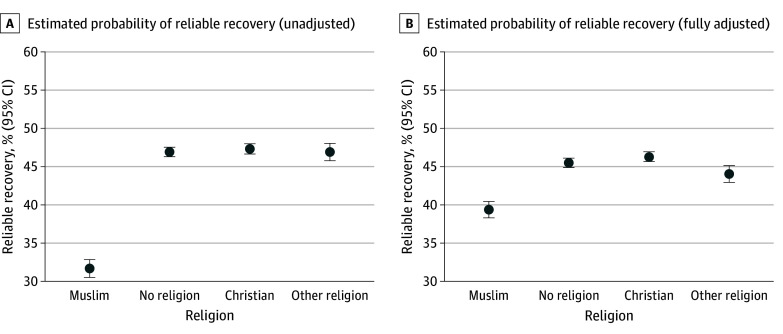 Figure 1
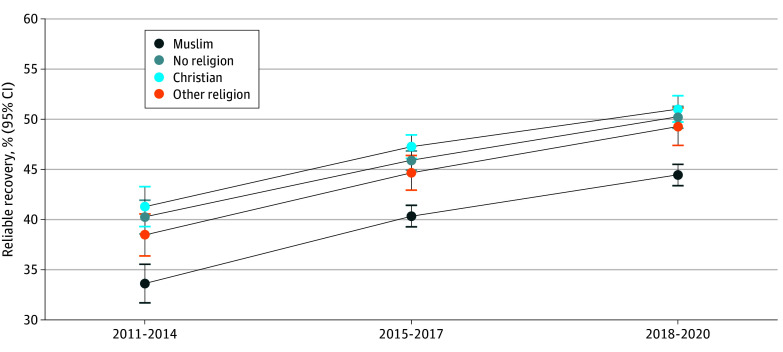 Figure 2
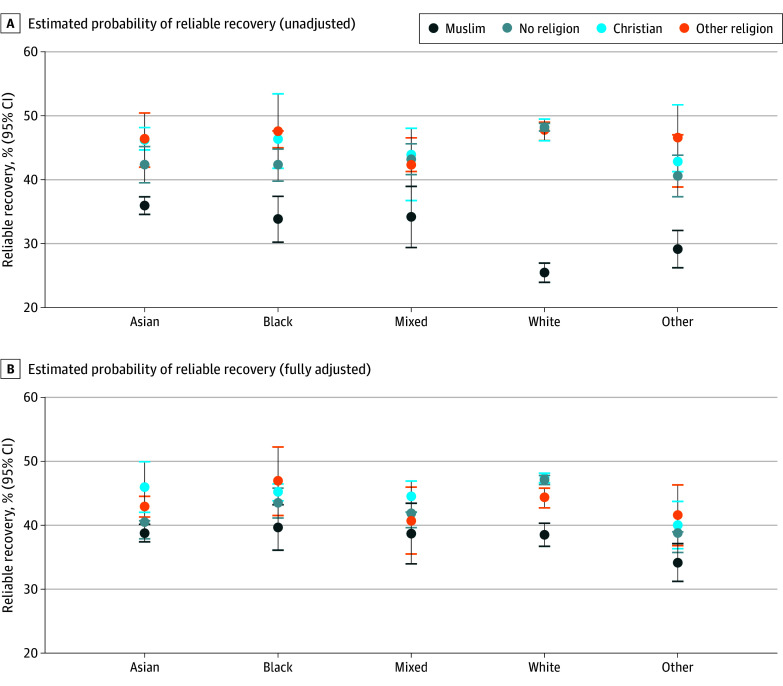 Figure 3
Peer Reviews
No public reviews on file for this paper yet. If you reviewed it on a platform where reviews are public (OpenReview, ICLR, NeurIPS, ICML), you can paste yours below so the community can read it here.
Videos
No videos yet. Explain this paper in a talk, walkthrough, or lecture? Add one.
Taxonomy
TopicsReligion, Spirituality, and Psychology · Mental Health Treatment and Access · Child and Adolescent Psychosocial and Emotional Development