Family Interviews Improve Health Service Recommendations in Mortality Review Process: A Mixed‐Methods Assessment
Catherine Kothari, Fernando Ospina, Nia Evans, Cynthia Bane, Joi Presberry Dixon, Vaishali Patil, Ruth Butters, Rosemary Fournier, Susanna C. Joy, Brenda O'Rourke, Josephine Woods, Debra Lenz, Aaron L. Davies

TL;DR
Including family interviews in mortality reviews helps identify health service gaps and leads to better recommendations for improving care.
Contribution
This study provides evidence that family interviews in mortality reviews increase the identification of stressors and generate actionable healthcare recommendations.
Findings
Family interviews were associated with a 2.6 increase in identified stressors and a 40% increase in recommendations.
Two-thirds of FIMR teams reported family interviews as 'Very Impactful' in driving system changes.
Qualitative themes highlighted challenges in obtaining interviews but emphasized their value in understanding root causes.
Abstract
Within the United States, although there is strong motivation for incorporating family interviews into Fetal Infant Mortality Reviews (FIMR) and important potential for expanding it to other types of reviews, there is limited evidence that family interviews make a difference in review team outcomes. This study aims to assess the impact of FIMR family interviews identifying health service gaps and generating actionable improvements. Mixed methods design with quantitative case‐control analysis and qualitative semi‐structured interviews. Quantitative data collection was secondary analysis of FIMR administrative records, comparing outcomes with and without family interviews using Generalized Estimating Equation (GEE) and descriptive analysis of annual FIMR team evaluation responses. Qualitative data collection included audio‐taping, transcribing and consensus coding of semi‐structured…
Genes, proteins, chemicals, diseases, species, mutations and cell lines named across the full text — each resolved to its canonical identifier and authoritative record.
Click any figure to enlarge with its caption.
 Figure 1
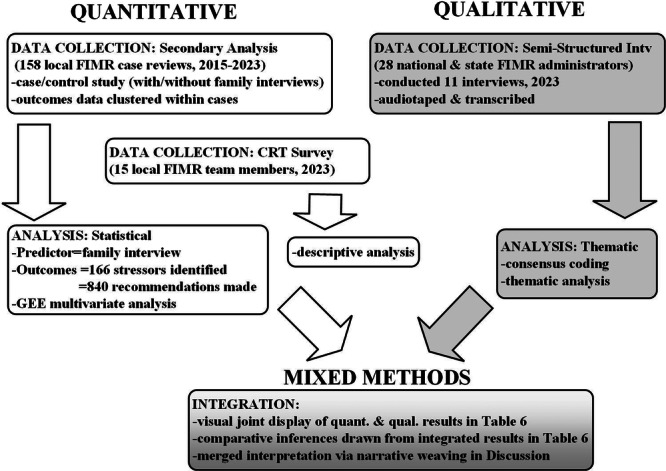 Figure 2
Peer Reviews
No public reviews on file for this paper yet. If you reviewed it on a platform where reviews are public (OpenReview, ICLR, NeurIPS, ICML), you can paste yours below so the community can read it here.
Videos
No videos yet. Explain this paper in a talk, walkthrough, or lecture? Add one.
Taxonomy
TopicsEmergency and Acute Care Studies · Healthcare Policy and Management · Health disparities and outcomes