Assessment of minimum clinically important difference in symptoms and functionality of Japanese patients with major depressive disorder following inadequate response to antidepressants: a post hoc analysis of the long-term study of brexpiprazole augmentation therapy in Japanese patients with major depressive disorder
Hikaru Hori, Masako Shiosakai, Yoshiyuki Shibasaki, Kentaro Yamato, Yilong Zhang

TL;DR
This study estimates the minimum clinically important difference in depression symptoms and functionality for Japanese patients who did not respond well to antidepressants, highlighting differences in what physicians and patients consider important.
Contribution
The study provides new MCID estimates for Japanese patients with major depressive disorder using both physician and patient perspectives.
Findings
MCID for MADRS score was 4.89–4.94, and for SDS score was 0.69–2.14.
Patient-perspective MCIDs for SDS and utility scores were nearly twice as high as physician-perspective MCIDs.
Utility scores showed the highest AUC and correlation for patient-perspective anchors.
Abstract
The aim of this study was to apply the minimum clinically important difference (MCID) concept to clinical results for Japanese patients with major depressive disorder following inadequate response to antidepressants, and to explore the disparity in what physicians and patients considered important in the treatment of depression. The original study was a 52-week, open-label, multicenter study on the administration of 2 mg/d of brexpiprazole as adjunctive therapy for patients with major depressive disorder. Here, we conducted a post hoc analysis to determine the MCID in Montgomery–Åsberg Depression Rating Scale (MADRS), Sheehan Disability Scale (SDS), and EQ-5D-5L-derived utility score. We compared the area under the curve (AUC) and correlation coefficients for the MADRS, SDS, and utility scores between the physicians’ and patients’ responses. The MCIDs for this patient group were…
Genes, proteins, chemicals, diseases, species, mutations and cell lines named across the full text — each resolved to its canonical identifier and authoritative record.
Click any figure to enlarge with its caption.
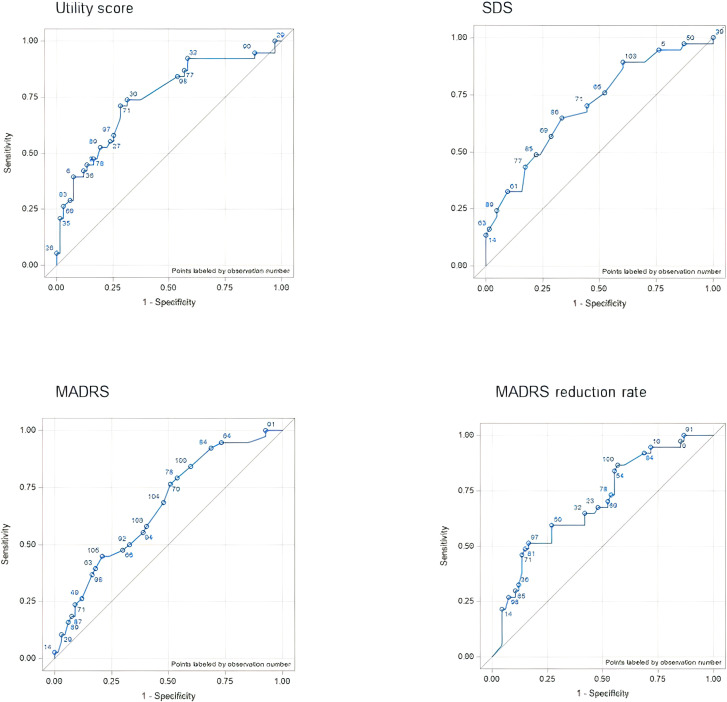 Figure 1
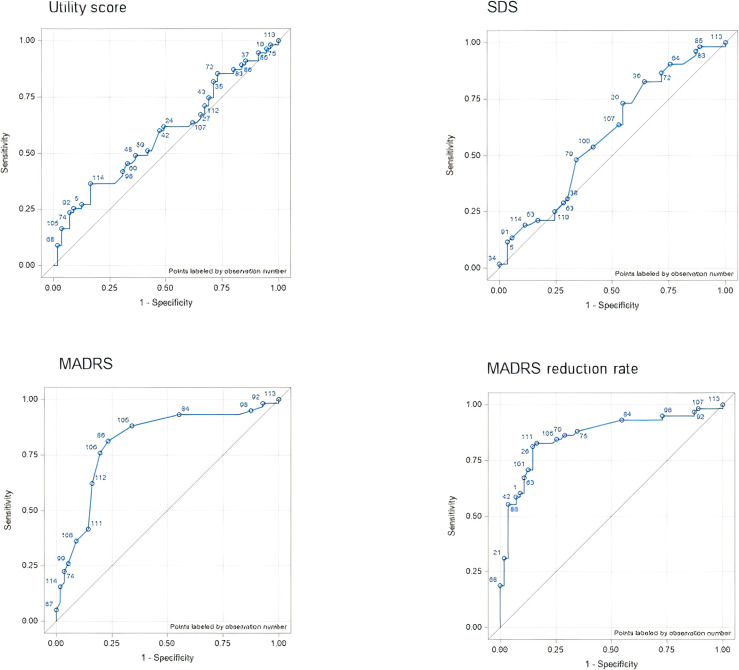 Figure 2
Peer Reviews
No public reviews on file for this paper yet. If you reviewed it on a platform where reviews are public (OpenReview, ICLR, NeurIPS, ICML), you can paste yours below so the community can read it here.
Videos
No videos yet. Explain this paper in a talk, walkthrough, or lecture? Add one.
Taxonomy
TopicsTreatment of Major Depression · Health Systems, Economic Evaluations, Quality of Life · Parkinson's Disease and Spinal Disorders