Prevalence of genital and extragenital sexually transmitted infections among women of reproductive age with and without HIV in the Southern US: results from the study of treatment and reproductive outcomes
Nicholas F. Nogueira, Laura S. Beauchamps, Yue Pan, Paola Beato Fernandez, Maria Gabriela Rodriguez, Gray Kelsey, Patricia Raccamarich, Candice A. Sternberg, Daniel Westreich, Seble G. Kassaye, Elizabeth F. Topper, Aadia Rana, Deborah Konkle-Parker, Deborah L. Jones

TL;DR
This study found high rates of genital and extragenital STIs among women with and without HIV in the Southern US, emphasizing the need for broader STI screening.
Contribution
The study provides new data on the prevalence of extragenital STIs among women with and without HIV in the Southern US.
Findings
Extragenital STIs like rectal and oropharyngeal chlamydia and gonorrhea are highly prevalent among women with and without HIV.
Trichomoniasis prevalence was 12.2%, with risk factors including low education and income.
HIV status was not associated with STI prevalence, but lack of healthcare access increased chlamydia risk.
Abstract
Sexually transmitted infections (STI) are highly prevalent among women of reproductive age (WRA) and increase the risk of HIV acquisition and transmission. However, the burden of extragenital STIs is understudied among WRA in the US. Estimates of disease are urgently needed among women living with (WWH) and without HIV (WWOH), to inform sex-specific screening guidelines. Cross-sectional data from cisgender WWH and WWOH, ages 18–45 years, enrolled in the Study of Treatment and Reproductive Outcomes (STAR) from March 2021 to August 2023 at six Southern US sites was analyzed. Sociodemographic and behavioral assessments were performed using structured interviewer-administered questionnaires. Nucleic-acid amplification tests were performed, regardless of symptoms, on self-collected urine, rectal, and pharyngeal swabs to detect trichomoniasis, chlamydia, and gonorrhea. Sociodemographic…
Genes, proteins, chemicals, diseases, species, mutations and cell lines named across the full text — each resolved to its canonical identifier and authoritative record.
Click any figure to enlarge with its caption.
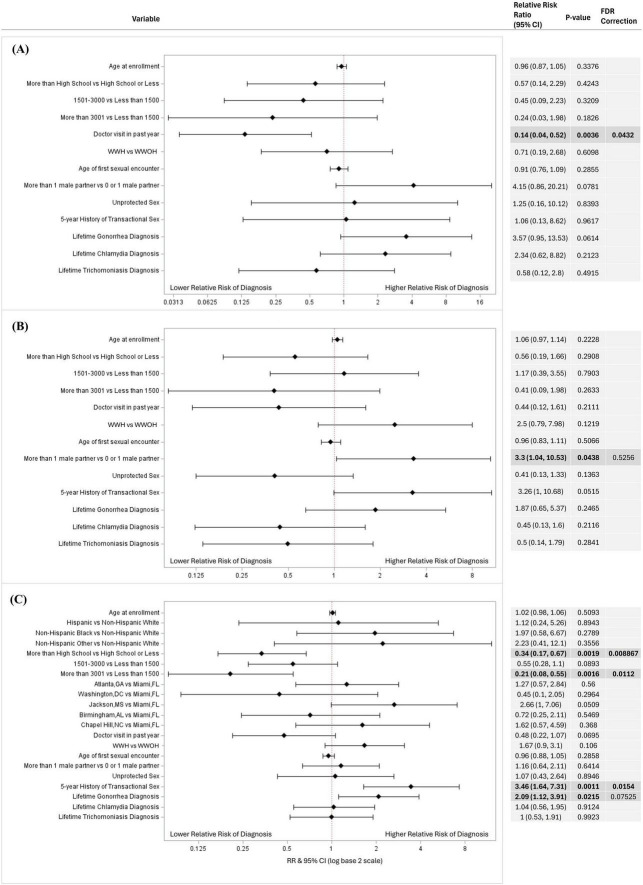 Figure 1
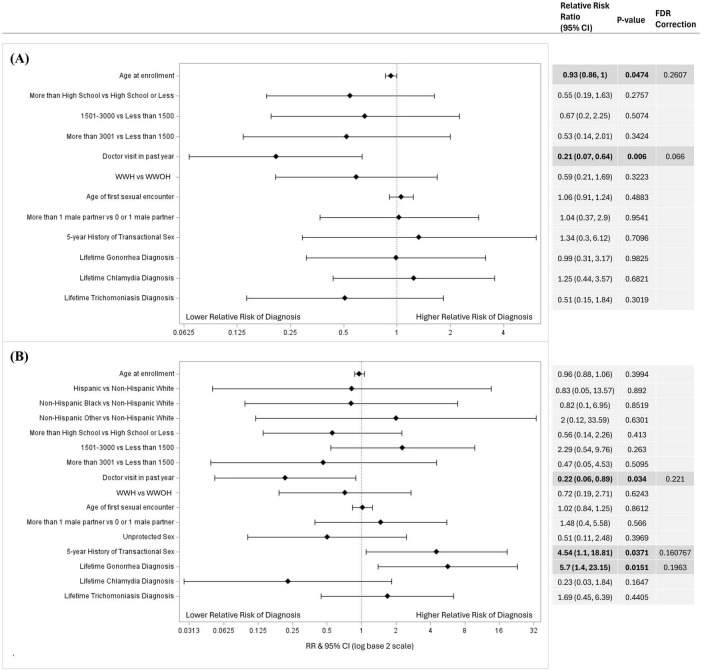 Figure 2
Peer Reviews
No public reviews on file for this paper yet. If you reviewed it on a platform where reviews are public (OpenReview, ICLR, NeurIPS, ICML), you can paste yours below so the community can read it here.
Videos
No videos yet. Explain this paper in a talk, walkthrough, or lecture? Add one.
Taxonomy
TopicsReproductive tract infections research · Syphilis Diagnosis and Treatment · Adolescent Sexual and Reproductive Health