Elevated vascular endothelial growth factor a is associated with disruption of default network connectivity in older adults
Arunima Kapoor, Jung Yun Jang, Allison C. Engstrom, Trevor Lohman, Shubir Dutt, John Paul M. Alitin, Isabel J. Sible, Anisa Marshall, Fatemah Shenasa, Aimee Gaubert, Amy Nguyen, David Robert Bradford, Kathleen Rodgers, S. Duke Han, Daniel A. Nation

TL;DR
Higher levels of VEGF-A in older adults are linked to reduced brain network connectivity, which may signal early signs of cognitive decline.
Contribution
This is the first study to link plasma VEGF-A levels with disruption of the default mode network in older adults.
Findings
VEGF-A levels were negatively associated with default mode network connectivity.
Higher VEGF-A levels correlated with reduced global efficiency of the network.
Elevated VEGF-A may indicate early neurocognitive disorder progression.
Abstract
Vascular Endothelial Growth Factor A (VEGF-A) is an angiogenic signaling protein involved in the maintenance of the cerebral vasculature. No prior study has explored whether plasma VEGF-A levels may be associated with brain functional connectivity changes, such as disruption of the default mode network (DMN), which often precedes the development of cognitive changes in aging. Seventy-six independently living older adults (mean age = 70.3 years; SD = 7.5; 31.6% male) free of dementia or clinical stroke underwent venipuncture and brain MRI. Plasma was assayed for VEGF-A. Using resting state functional MRI, region of interest (ROI) to ROI connectivity and graph theory analysis were conducted to determine average connectivity and global efficiency between each of the following ROIs comprising the DMN: medial prefrontal cortex, lateral parietal cortex and precuneus cortex. Multiple linear…
Genes, proteins, chemicals, diseases, species, mutations and cell lines named across the full text — each resolved to its canonical identifier and authoritative record.
Click any figure to enlarge with its caption.
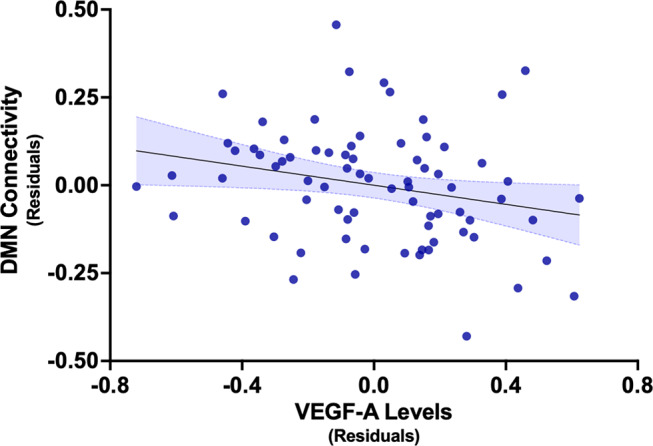 Figure 1
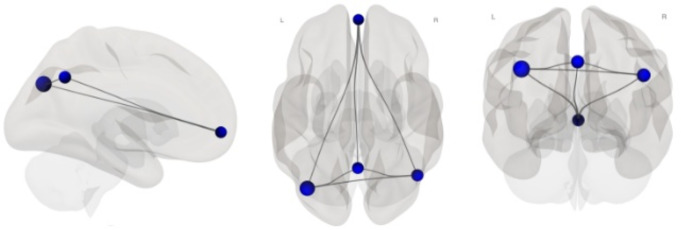 Figure 2
Peer Reviews
No public reviews on file for this paper yet. If you reviewed it on a platform where reviews are public (OpenReview, ICLR, NeurIPS, ICML), you can paste yours below so the community can read it here.
Videos
No videos yet. Explain this paper in a talk, walkthrough, or lecture? Add one.
Taxonomy
TopicsFunctional Brain Connectivity Studies · Dementia and Cognitive Impairment Research · Cerebrovascular and Carotid Artery Diseases