Infrared camouflage in leaf-sitting frogs: a cautionary tale on adaptive convergence
Devi Stuart-Fox, Katrina Joanne Rankin, Madeleine Shah Scott, Lu-Yi Wang, Amanda M. Franklin

TL;DR
Green frogs that match leaves in infrared light may not be using this for camouflage or temperature control, as experiments in natural settings showed no significant difference.
Contribution
The study experimentally tests and challenges the hypotheses of infrared camouflage and thermoregulation in leaf-sitting frogs.
Findings
Frogs with low NIR reflectance heated faster under a solar simulator.
No significant temperature differences were found between frog models in natural rainforest conditions.
NIR matching may be due to mechanisms of green coloration and translucence rather than adaptive convergence.
Abstract
Many cryptic green animals match leaves in invisible near-infrared (NIR) wavelengths. This observation is an enduring puzzle because animals do not see NIR light, so NIR background matching is unlikely to contribute to visual camouflage. Two alternative explanations have been proposed—infrared camouflage (i.e. matching the temperature of the background) and thermoregulation—but neither hypothesis has been experimentally tested. To test these hypotheses, we developed bilayer coatings that mimicked the reflectivity of green leaf-sitting frogs with high NIR (HNIR) or low NIR (LNIR) reflectance. Under a solar simulator in the laboratory, agar model frogs with LNIR reflectance heated up more quickly and reached higher temperatures than those with HNIR reflectance. However, when placed in a tropical rainforest (natural habitat of leaf-sitting frogs), HNIR and LNIR models did not significantly…
Genes, proteins, chemicals, diseases, species, mutations and cell lines named across the full text — each resolved to its canonical identifier and authoritative record.
Click any figure to enlarge with its caption.
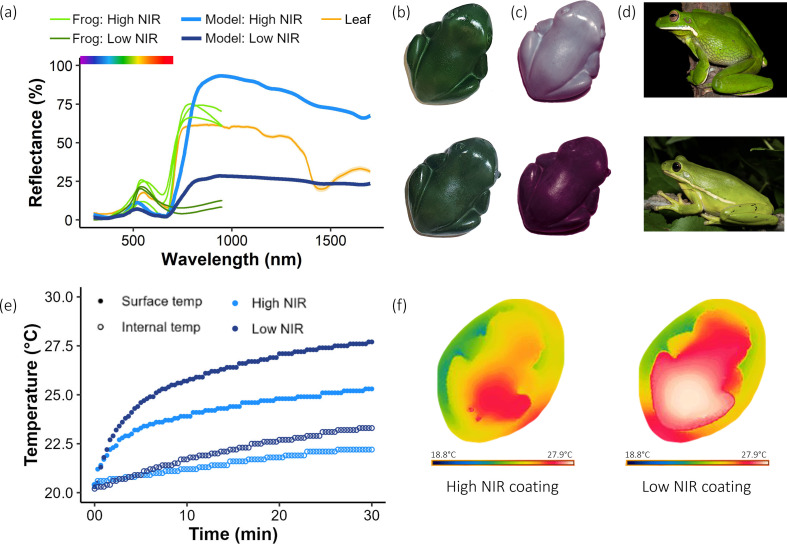 Figure 1
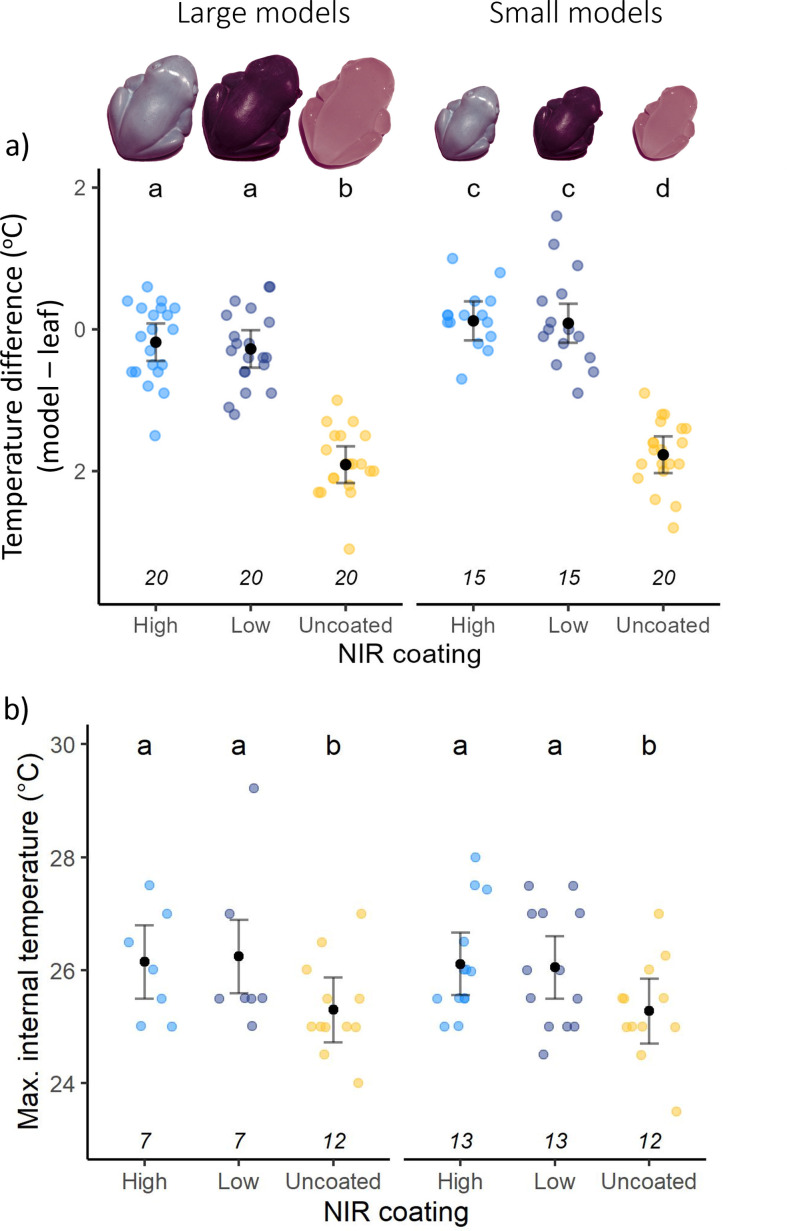 Figure 2
Peer Reviews
No public reviews on file for this paper yet. If you reviewed it on a platform where reviews are public (OpenReview, ICLR, NeurIPS, ICML), you can paste yours below so the community can read it here.
Videos
No videos yet. Explain this paper in a talk, walkthrough, or lecture? Add one.
Taxonomy
TopicsAmphibian and Reptile Biology · Animal Behavior and Reproduction · Species Distribution and Climate Change