A Simple Explanation for Harmonic Word Order
John Mansfield, Lothar Sebastian Krapp

TL;DR
The paper explains harmonic word order in languages as a result of word-class frequencies rather than an innate rule, using a computational model to show how this pattern emerges naturally.
Contribution
The paper introduces a new explanation for harmonic word order based on word-class frequencies and demonstrates it through a computational model.
Findings
The most frequent word class naturally gravitates to edge positions in phrasal replication.
The model shows harmony can emerge without positing an innate head-dependent ordering rule.
The principle remains robust with fuzzy word classes and multiword chunks.
Abstract
Harmonic word order is a well‐established tendency in natural languages, which has previously been explained as a single ordering rule for all head‐dependent relations. We propose that it can be more parsimoniously explained as an outcome of word‐class frequencies, where the purported “head” is the most frequently instantiated word class in a phrasal schema. We show that the most frequent class gravitates spontaneously to an edge position in a phrasal replication process, as long as words of one class may influence the position of words of another class. This avoids the need to posit head‐dependent ordering as an innate rule or bias, simplifying our theory of word order. We demonstrate the spontaneous emergence of harmony from word‐class frequencies using a simple computational model of phrasal replication, and in further extensions show that the principle remains robust with fuzzy word…
Genes, proteins, chemicals, diseases, species, mutations and cell lines named across the full text — each resolved to its canonical identifier and authoritative record.
Click any figure to enlarge with its caption.
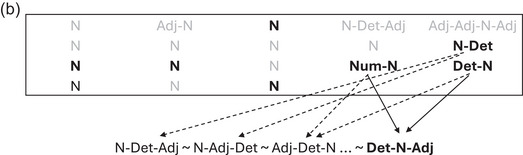 Figure 1
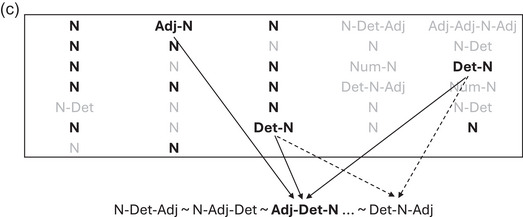 Figure 2
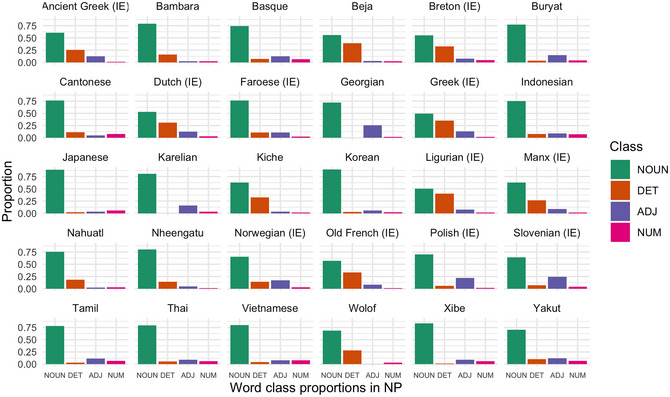 Figure 3
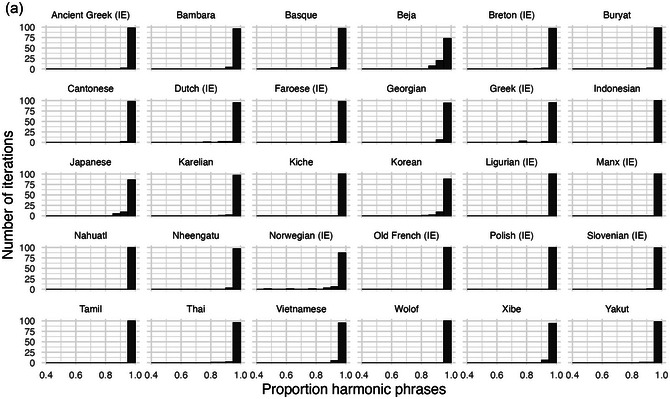 Figure 4
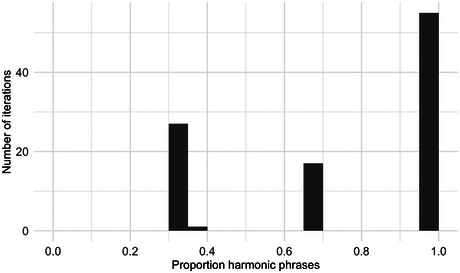 Figure 5
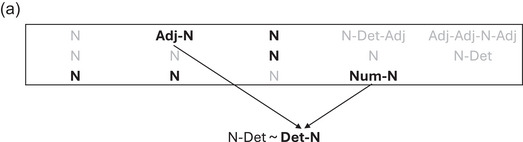 Figure 6
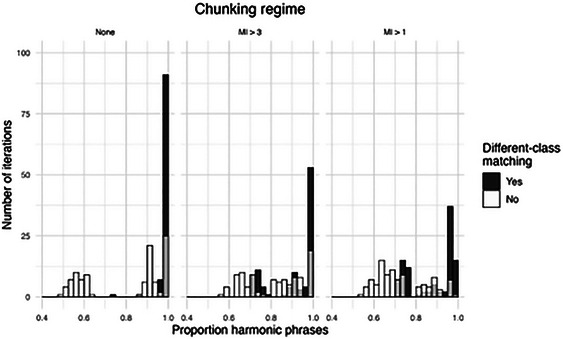 Figure 7
 Figure 8
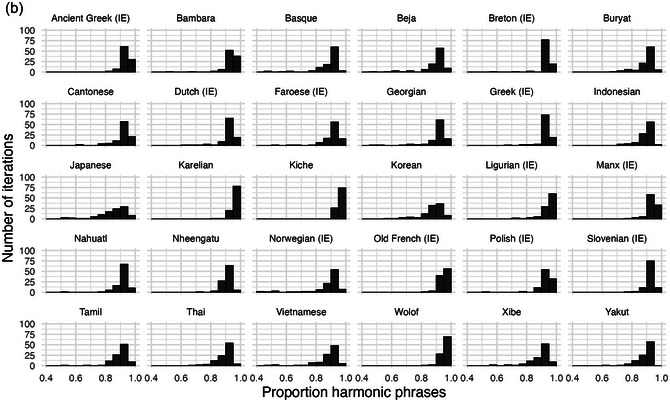 Figure 9
 Figure 10
 Figure 11
 Figure 12
 Figure 13
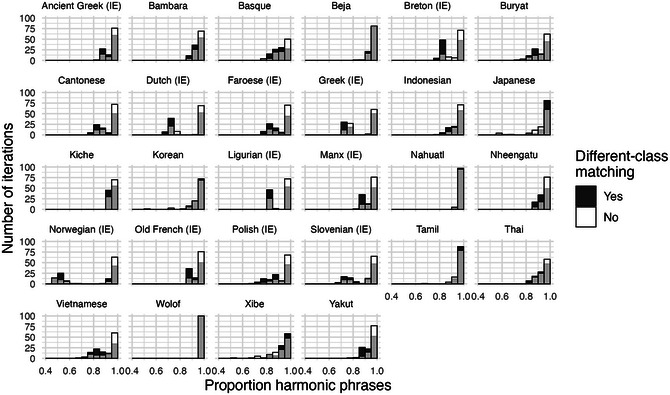 Figure 14
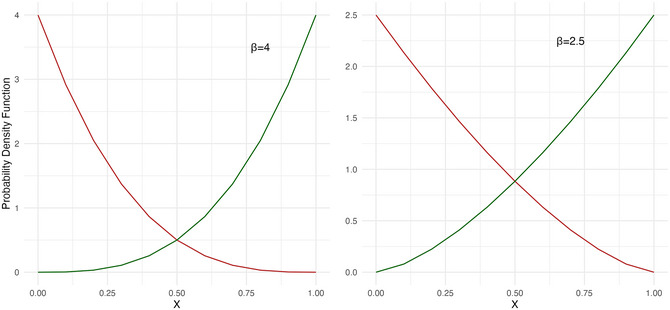 Figure 15
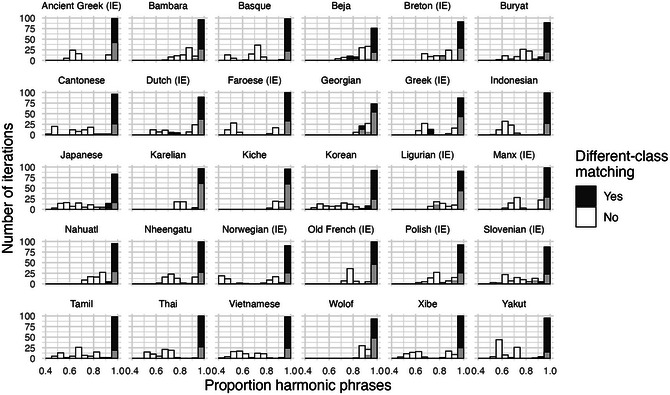 Figure 16
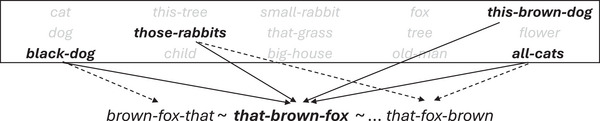 Figure 17
Peer Reviews
No public reviews on file for this paper yet. If you reviewed it on a platform where reviews are public (OpenReview, ICLR, NeurIPS, ICML), you can paste yours below so the community can read it here.
Videos
No videos yet. Explain this paper in a talk, walkthrough, or lecture? Add one.
Taxonomy
TopicsLanguage and cultural evolution · Natural Language Processing Techniques · Syntax, Semantics, Linguistic Variation