Annual risk of long-term sickness absence due to musculoskeletal disorders across the lifespan and the role of physical activity and insomnia symptoms: the HUNT Study
Karoline Moe, Eivind Schjelderup Skarpsno, Tom Ivar Lund Nilsen, Paul Jarle Mork, Paulo Ferreira, Lene Aasdahl

TL;DR
This study shows that insomnia symptoms strongly increase the risk of long-term sickness absence due to musculoskeletal disorders, especially in middle-aged workers, while physical activity has no significant effect.
Contribution
The study reveals that insomnia symptoms, combined with chronic musculoskeletal pain, significantly elevate sickness absence risk, particularly in 30–49-year-olds.
Findings
Women aged 30–39 and 40–49 with chronic MSK pain and insomnia had a 4-fold higher risk of long-term sickness absence.
Men in the same age groups had nearly a 5-fold increased risk under the same conditions.
Physical activity levels did not significantly affect the risk of long-term sickness absence due to MSK disorders.
Abstract
The risk of long-term sickness absence due to musculoskeletal (MSK) disorders could be driven by sleep problems and physical inactivity. However, it is not well explored if these associations differ across the lifespan. The aim of this study was to describe the annual risk of long-term sickness absence due to MSK disorders throughout working life, according to insomnia symptoms and physical activity, in people with and without MSK pain. A total of 38,253 working-age individuals (20–62 years) with information on self-reported chronic MSK pain, physical activity, and insomnia symptoms in the third (2006-08) and/or fourth (2017-19) survey of the Norwegian HUNT Study were included. Annual sickness absence up to 5 years after participation was obtained from national registry data. Annual risk of long-term sickness absence due to MSK disorders were estimated as the proportion receiving…
Genes, proteins, chemicals, diseases, species, mutations and cell lines named across the full text — each resolved to its canonical identifier and authoritative record.
Click any figure to enlarge with its caption.
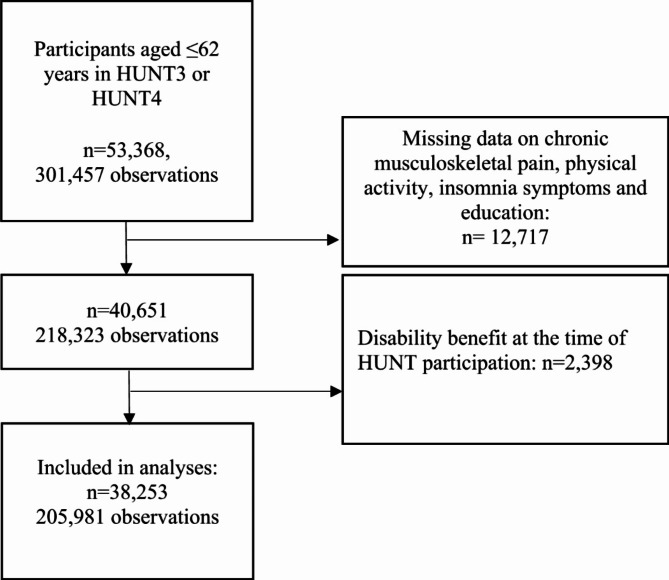 Figure 1
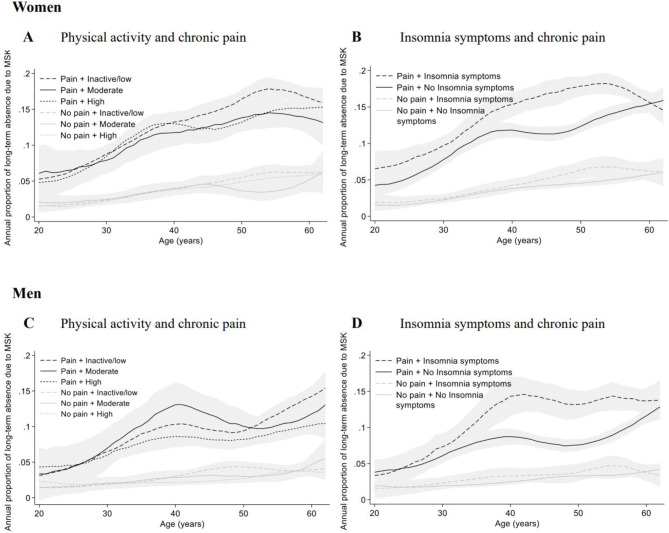 Figure 2
Peer Reviews
No public reviews on file for this paper yet. If you reviewed it on a platform where reviews are public (OpenReview, ICLR, NeurIPS, ICML), you can paste yours below so the community can read it here.
Videos
No videos yet. Explain this paper in a talk, walkthrough, or lecture? Add one.
Taxonomy
TopicsMusculoskeletal pain and rehabilitation · Workplace Health and Well-being · Fibromyalgia and Chronic Fatigue Syndrome Research