Impact of Aneurysmal Subarachnoid Hemorrhage Severity on Contrast Media Arrival Time in Head Computed Tomography Angiography
Kazutoshi Tsunou

TL;DR
This study shows that the severity of subarachnoid hemorrhage affects how quickly contrast media reaches the brain in CT scans.
Contribution
The study demonstrates a novel correlation between SAH severity and contrast media arrival time in head CTA.
Findings
CM arrival time increases with SAH severity.
Semi-severe and severe SAH groups had significantly longer CM arrival times than the non-SAH group.
Abstract
Aim This study aims to evaluate the effect of subarachnoid hemorrhage (SAH) severity on contrast media (CM) arrival time in head computed tomography angiography (CTA) at SAH onset. Method A total of 67 patients who underwent head CTA were evaluated; 41 patients developed SAH (SAH group), and 26 patients had suspected unruptured cerebral aneurysms (non-SAH group). The patients of the SAH group were divided into mild (grades I-III), semi-severe (grade IV), and severe (grade V) groups according to Japanese guidelines. CM arrival time was measured for each case. Results The CM arrival time increased with SAH severity. The semi-severe and severe groups exhibited significantly longer CM arrival times compared to the non-SAH group (non-SAH: 11.1 ± 2.03, mild: 13.2 ± 2.97, semi-severe: 15.8 ± 3.45, severe: 16.6 ± 3.40). Conclusion The CM arrival time increases with SAH severity in head…
Genes, proteins, chemicals, diseases, species, mutations and cell lines named across the full text — each resolved to its canonical identifier and authoritative record.
Click any figure to enlarge with its caption.
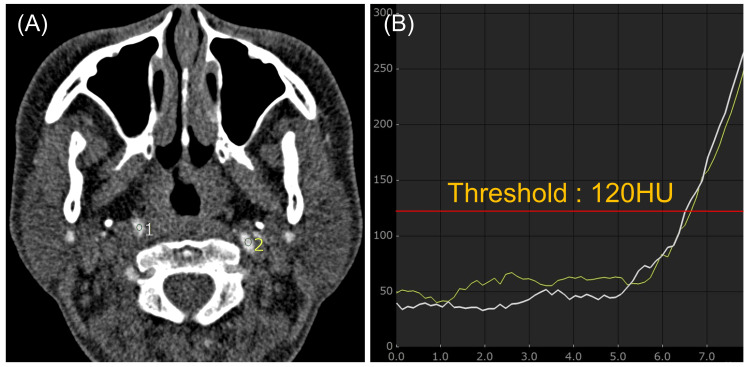 Figure 1
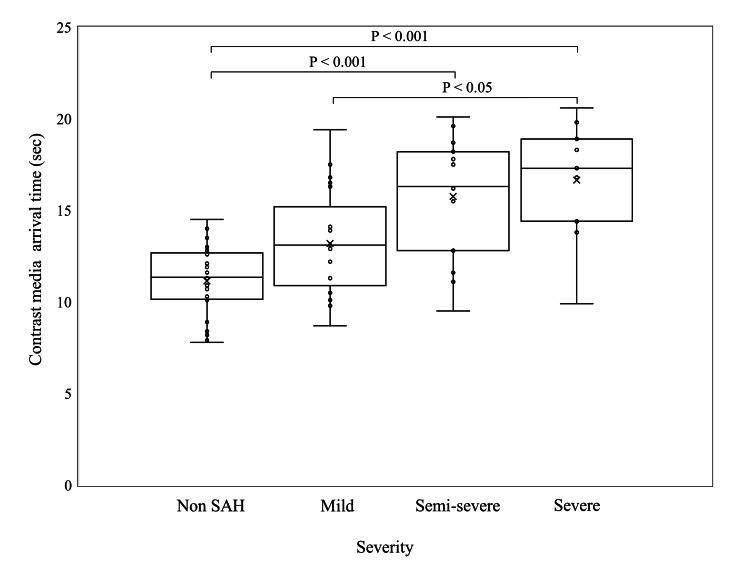 Figure 2
 Figure 3
Peer Reviews
No public reviews on file for this paper yet. If you reviewed it on a platform where reviews are public (OpenReview, ICLR, NeurIPS, ICML), you can paste yours below so the community can read it here.
Videos
No videos yet. Explain this paper in a talk, walkthrough, or lecture? Add one.
Taxonomy
TopicsIntracranial Aneurysms: Treatment and Complications · Cerebrovascular and Carotid Artery Diseases · Traumatic Brain Injury and Neurovascular Disturbances