Percutaneous Spinal Needle–Assisted Suture Passing in Medial Meniscal Posterior Root Tear Repair
Ahmet Emin Okutan, Serkan Surucu, Kerim Öner, Lokman Kehribar

TL;DR
A new minimally invasive technique using a spinal needle helps repair medial meniscal tears with less damage and better outcomes.
Contribution
Introduces a percutaneous spinal needle–assisted suture-passing technique for MMPR tear repair.
Findings
The technique reduces iatrogenic damage to articular cartilage.
It eliminates the need for medial collateral ligament release.
Enables precise suture placement with minimal meniscal injury.
Abstract
The medial meniscal posterior root (MMPR) is essential for absorbing hoop stress and preventing meniscal extrusion. MMPR tears lead to significant alterations in knee joint kinematics, increasing tibiofemoral contact pressure and accelerating knee osteoarthritis. Given the poor prognosis of untreated meniscal root tears, there has been growing interest in surgical repair techniques. The percutaneous spinal needle–assisted suture-passing technique offers a cost-effective, minimally invasive alternative that reduces iatrogenic damage to articular cartilage and eliminates the need for medial collateral ligament release compared with currently widely used suture passers. This technique allows for precise suture placement and minimizes meniscal injury during suture passing, providing a promising option for repair of the MMPR tear.
Genes, proteins, chemicals, diseases, species, mutations and cell lines named across the full text — each resolved to its canonical identifier and authoritative record.
Click any figure to enlarge with its caption.
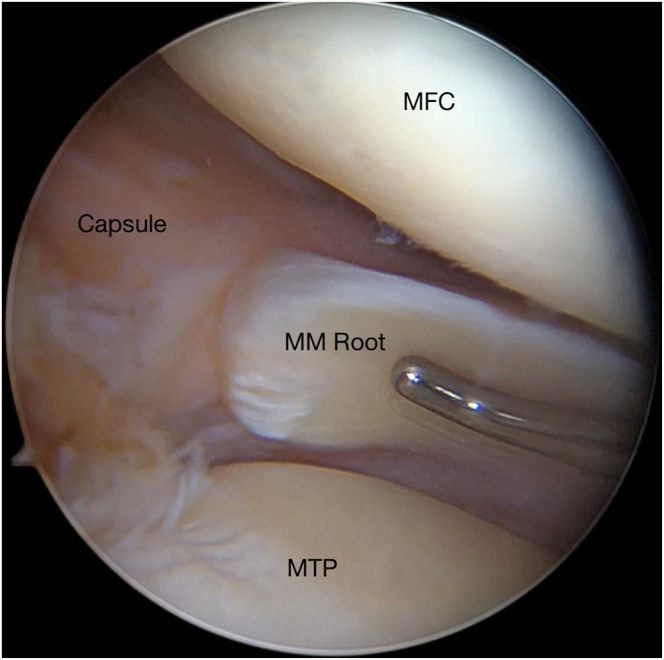 Figure 1
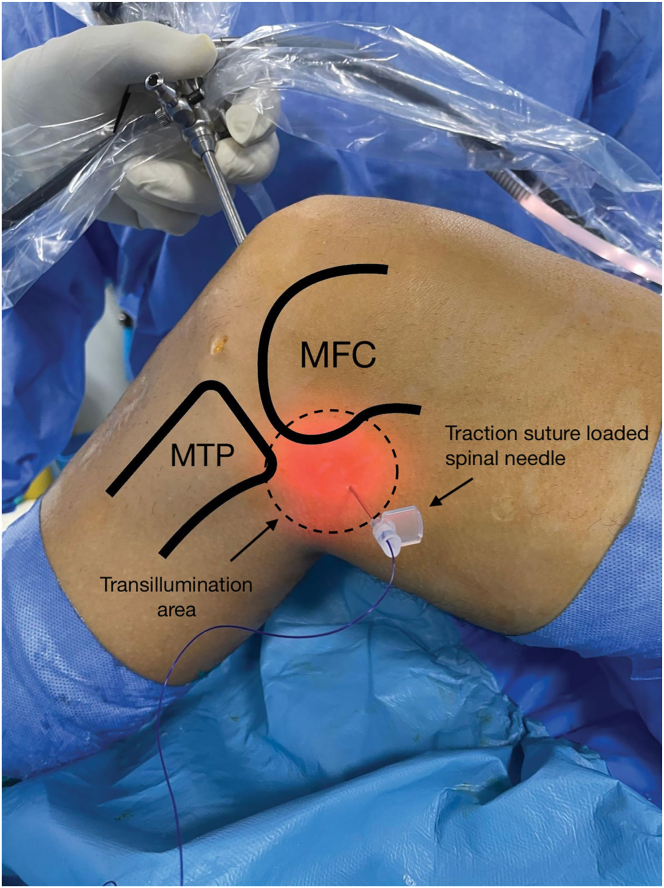 Figure 2
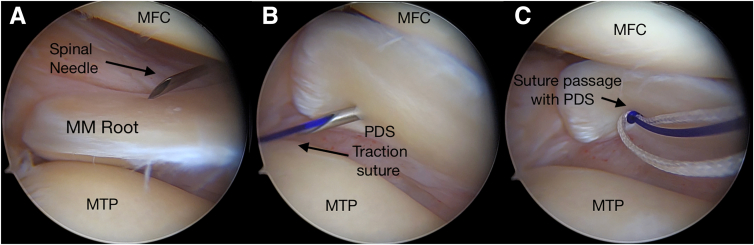 Figure 3
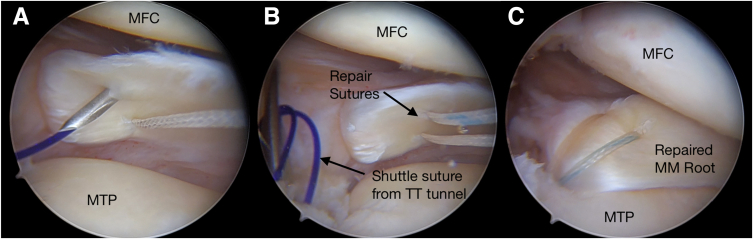 Figure 4
Peer Reviews
No public reviews on file for this paper yet. If you reviewed it on a platform where reviews are public (OpenReview, ICLR, NeurIPS, ICML), you can paste yours below so the community can read it here.
Videos
No videos yet. Explain this paper in a talk, walkthrough, or lecture? Add one.
Taxonomy
TopicsShoulder Injury and Treatment · Knee injuries and reconstruction techniques · Shoulder and Clavicle Injuries