Visual coronary artery calcification score to predict significant coronary artery stenosis in patients presenting with cardiac arrest without ST-segment elevation myocardial infarction
Maxence Brunel, Brahim Harbaoui, Laurent Bitker, Carole Chambonnet, Matthieu Aubry, Loïc Boussel, Cyril Besnard, Jean-Christophe Richard, Pierre Lantelme, Pierre-Yves Courand

TL;DR
A visual coronary artery calcification score from chest CT scans can help identify patients after cardiac arrest who may benefit from emergency heart procedures.
Contribution
The study introduces a VCAC score from chest CT to predict significant coronary artery stenosis in non-STEMI cardiac arrest patients.
Findings
A VCAC score ≥4 predicted significant coronary artery stenosis with high sensitivity and specificity.
The VCAC score ≥5 predicted culprit lesions and PCI with strong accuracy.
Non-dedicated CT scans can provide useful data for selecting patients for emergency angiograms.
Abstract
Emergency coronary angiogram after a cardiac arrest without ST-segment elevation myocardial infarction (STEMI) is still a matter of debate. To better select patients who may benefit from this procedure, we tested a visual coronary artery calcification (VCAC) score available in chest CT to predict significant coronary artery stenosis and/or culprit lesion or ad hoc or delayed percutaneous coronary intervention (PCI). A total of 113 patients with cardiac arrest and without STEMI who had a coronary angiogram and chest CT (January 2013 to March 2023, Croix-Rousse Hospital, Lyon, France) were retrospectively included. VCAC was scored from 0 (no calcification) to 3 (diffuse calcification) for each 4 four main arteries (left main, left anterior descending, circumflex, and right coronary artery). At baseline the median [interquartile range] age was 65.8 years [53.4–75.7], 61.9% were male, and…
Genes, proteins, chemicals, diseases, species, mutations and cell lines named across the full text — each resolved to its canonical identifier and authoritative record.
Click any figure to enlarge with its caption.
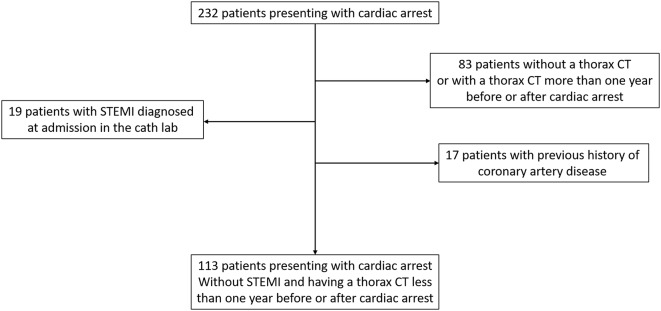 Figure 1
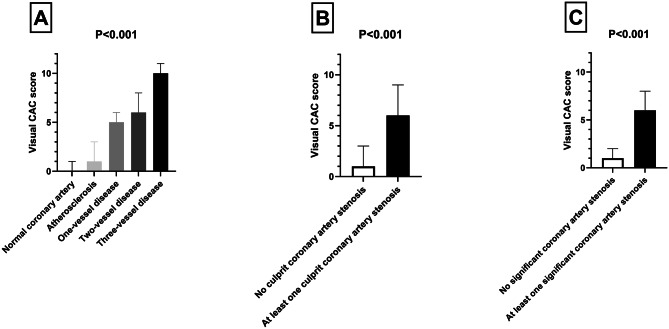 Figure 2
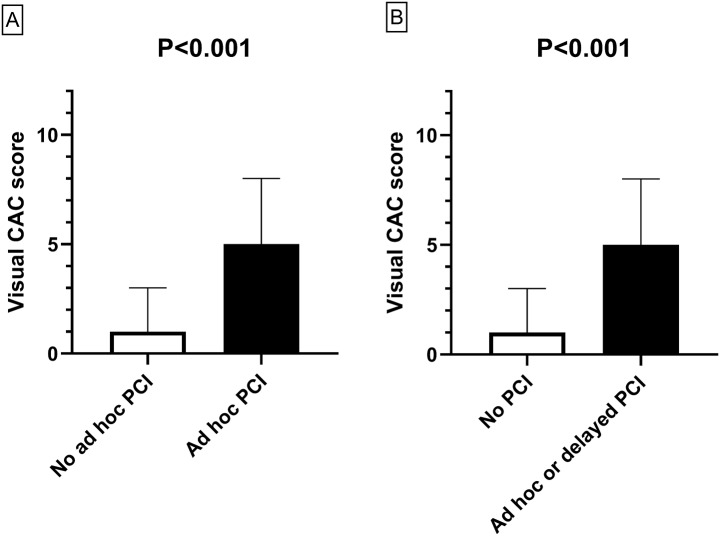 Figure 3
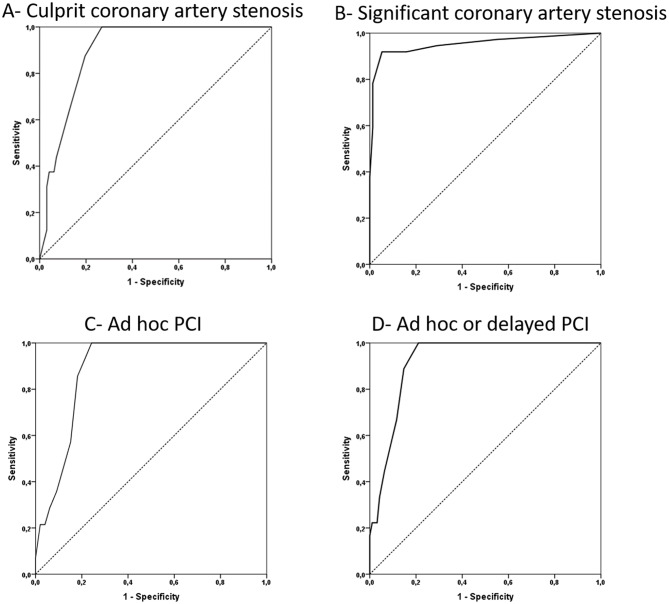 Figure 4
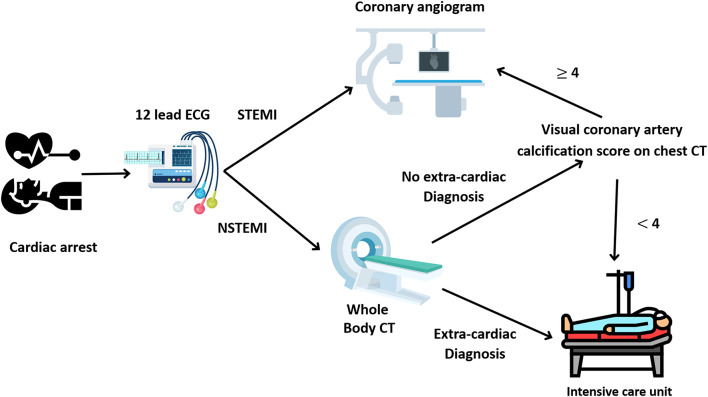 Figure 5
Peer Reviews
No public reviews on file for this paper yet. If you reviewed it on a platform where reviews are public (OpenReview, ICLR, NeurIPS, ICML), you can paste yours below so the community can read it here.
Videos
No videos yet. Explain this paper in a talk, walkthrough, or lecture? Add one.
Taxonomy
TopicsCardiac Imaging and Diagnostics · Cardiac Arrest and Resuscitation · Acute Myocardial Infarction Research