Characterization of contrast-mediated collinear interactions in the human visual system
Luca Battaglini, Giulio Contemori, Gianluca Campana, Marco Bertamini, Gianluca Ruffato, Marcello Maniglia

TL;DR
This paper explores how visual elements arranged in a line affect each other's visibility, shedding light on how the human visual system processes contrast and spatial relationships.
Contribution
The study provides a systematic characterization of how contrast, distance, and spatial frequency modulate collinear interactions in foveal and peripheral vision.
Findings
Short separations between targets and flankers reduce contrast sensitivity for high-contrast flankers.
Low-contrast flankers increase contrast sensitivity at short separations but have weaker effects at larger separations.
Eccentricity increases the spatial extent of inhibition in collinear interactions.
Abstract
Collinear modulation represents a fundamental building block of our perceptual world, and its study has enhanced our understanding of contrast sensitivity, spatial integration, and neural plasticity in the visual system. In this phenomenon, the visibility of a target is influenced by collinear elements. Four key factors modulate this effect: the distance between target and flankers, the contrast of the flankers, retinal eccentricity, and spatial frequency. Each of these elements affects collinear modulation, increasing or reducing the target’s visibility. Short target-to-flankers separations decrease contrast sensitivity, while larger separations increase it. However, this pattern holds for high contrast flankers, whereas low contrast flankers increase contrast sensitivity at short separations, while the effect is weaker or absent at large separations. Moreover, eccentricity appears to…
Genes, proteins, chemicals, diseases, species, mutations and cell lines named across the full text — each resolved to its canonical identifier and authoritative record.
Click any figure to enlarge with its caption.
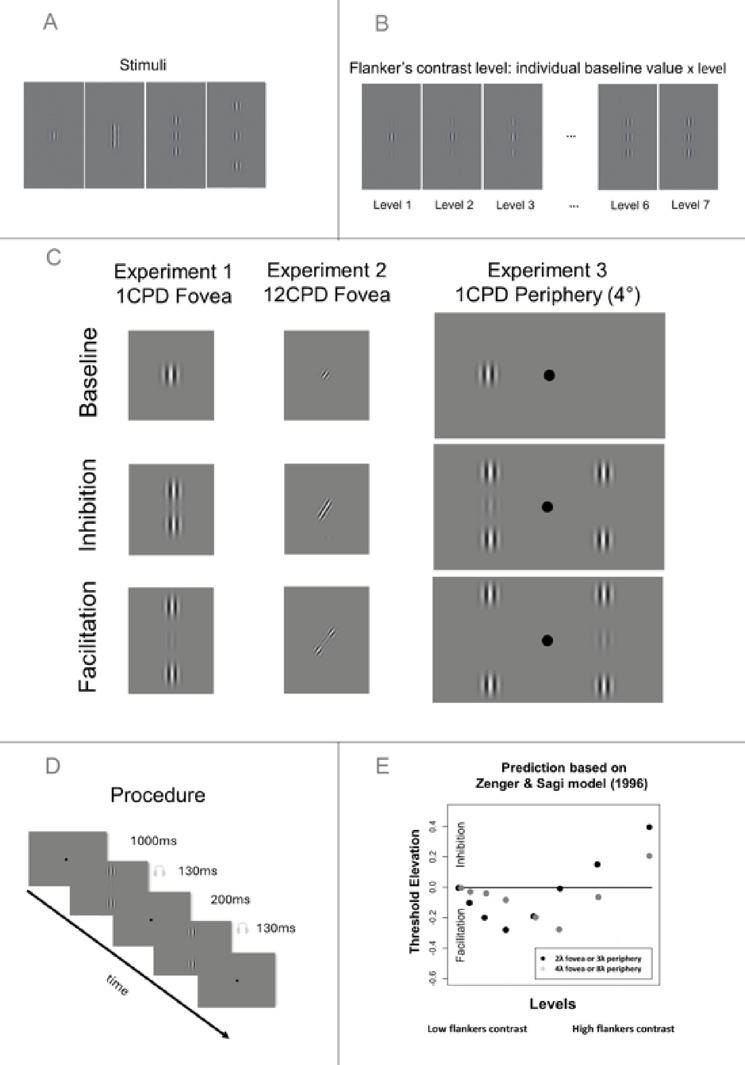 Figure 1
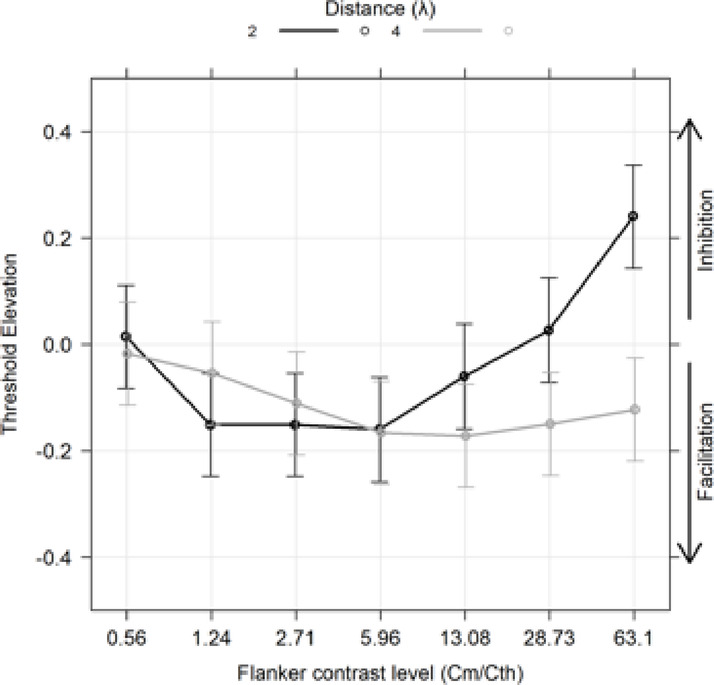 Figure 2
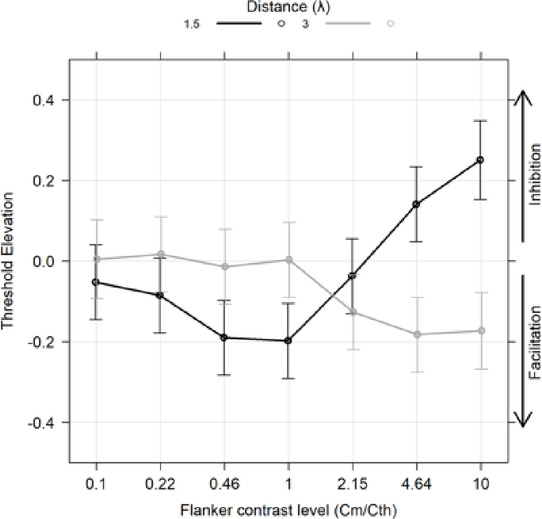 Figure 3
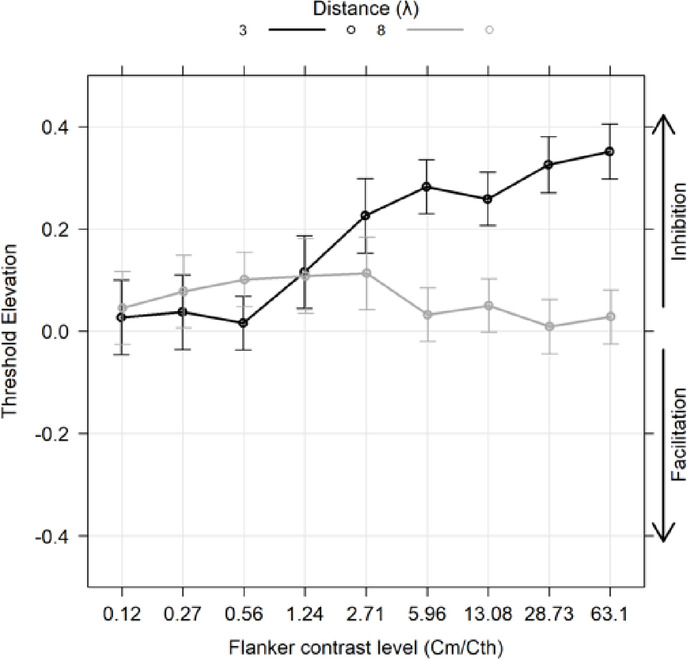 Figure 4
Peer Reviews
No public reviews on file for this paper yet. If you reviewed it on a platform where reviews are public (OpenReview, ICLR, NeurIPS, ICML), you can paste yours below so the community can read it here.
Videos
No videos yet. Explain this paper in a talk, walkthrough, or lecture? Add one.
Taxonomy
TopicsVisual perception and processing mechanisms · Neural dynamics and brain function · Ocular and Laser Science Research