The Evaluation of P‐Wave Parameters in Patients With Percutaneous Closure of Atrial Septal Defect
Ramazan Astan, Fehmi Kacmaz, Ersin Saricam, Erdogan Ilkay

TL;DR
This study shows that closing a heart defect called atrial septal defect (ASD) leads to immediate improvements in electrical signals in the heart, likely due to reduced volume overload.
Contribution
The study demonstrates immediate post-procedural changes in P-wave parameters following ASD closure, linking them to acute volume overload cessation.
Findings
P-wave duration (Pmax) and P-wave dispersion (PWD) significantly decreased after ASD closure.
Pmax values correlated with ASD size and patient age, but not with PWD.
There was no significant correlation between PWD and defect size or duration of overload.
Abstract
Atrial septal defect (ASD) can lead to volume overload and related changes in P‐wave parameters in surface electrocardiograms of these patients. In this study, we aimed to evaluate the effect of volume overload on P‐wave parameters in patients with ASD. This study is a retrospective cohort analysis. A total of 142 patients with secundum ASD who underwent percutaneous closure were evaluated. P‐wave duration (Pmax) and P‐wave dispersion (PWD) were measured on the surface ECG before and 1 h after the closure procedure. We evaluated P‐wave parameters in terms of defect size, duration of the volume overload, and closure device sizes. Pmax and PWD were significantly decreased after the procedure compared with the values before the procedure (p < 0.001). Pmax values had a statistically significant correlation with ASD size (< 20 mm or ≥ 20 mm) both before and after the procedure. Pmax values…
Genes, proteins, chemicals, diseases, species, mutations and cell lines named across the full text — each resolved to its canonical identifier and authoritative record.
Click any figure to enlarge with its caption.
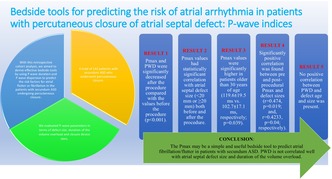 Figure 1
Peer Reviews
No public reviews on file for this paper yet. If you reviewed it on a platform where reviews are public (OpenReview, ICLR, NeurIPS, ICML), you can paste yours below so the community can read it here.
Videos
No videos yet. Explain this paper in a talk, walkthrough, or lecture? Add one.
Taxonomy
TopicsCardiovascular and Diving-Related Complications · Congenital Heart Disease Studies · Cardiac Structural Anomalies and Repair