SWAPS: A Modular Deep-Learning Empowered Peptide Identity Propagation Framework Beyond Match-Between-Run
Zixuan Xiao, Johanna Tüshaus, Bernhard Kuster, Matthew The, Mathias Wilhelm

TL;DR
SWAPS is a new framework that improves peptide identification in proteomics by using MS1 data and deep learning, outperforming traditional methods in varied experimental conditions.
Contribution
SWAPS introduces a modular, MS1-centric framework for peptide identity propagation that works across diverse LC gradients and improves identification rates significantly.
Findings
SWAPS increases precursor identification by 46.3-112.1% over MS2-based methods in different LC gradients.
SWAPS maintains quantitative accuracy while effectively deconvoluting MS1 signals.
Current peptide property prediction models are not yet fully comparable to experimental data, highlighting a need for improvement.
Abstract
Mass spectrometry (MS)-based proteomics relies heavily on MS/MS (MS2) data, which do not fully exploit the available MS1 information. Traditional peptide identity propagation (PIP) methods, such as match-between-runs (MBR), are limited to similar runs, particularly with the same liquid chromatography (LC) gradients, thus potentially underutilizing available proteomics libraries. We introduce SWAPS, a novel and modular MS1-centric framework incorporating advances in peptide property prediction, extensive proteomics libraries, and deep-learning-based postprocessing to enable and explore PIP across more diverse experimental conditions and LC gradients. SWAPS substantially enhances precursor identification, especially in shorter gradients. On the example of 30, 15, and 7.5 min gradients, SWAPS achieves increases of 46.3, 86.2, and 112.1% on precursor level over MaxQuant’s MS2-based…
Genes, proteins, chemicals, diseases, species, mutations and cell lines named across the full text — each resolved to its canonical identifier and authoritative record.
Click any figure to enlarge with its caption.
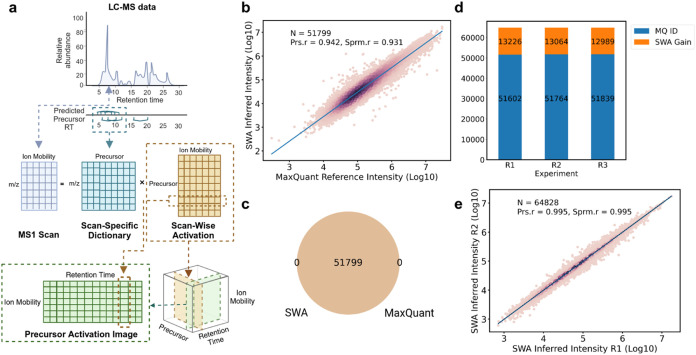 Figure 1
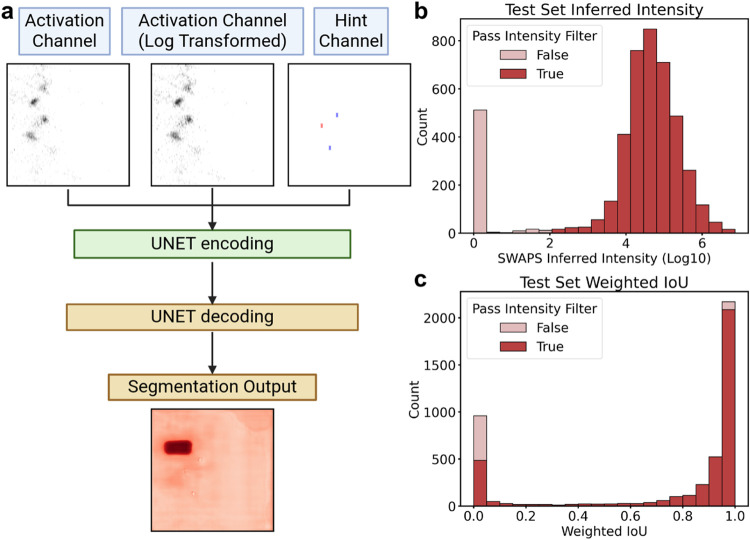 Figure 2
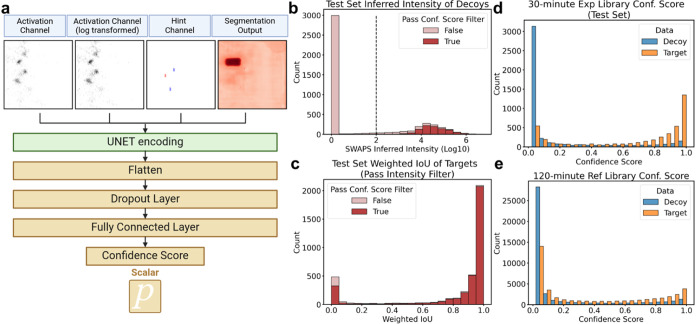 Figure 3
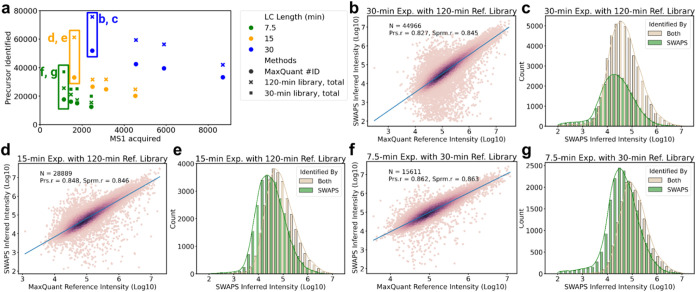 Figure 4
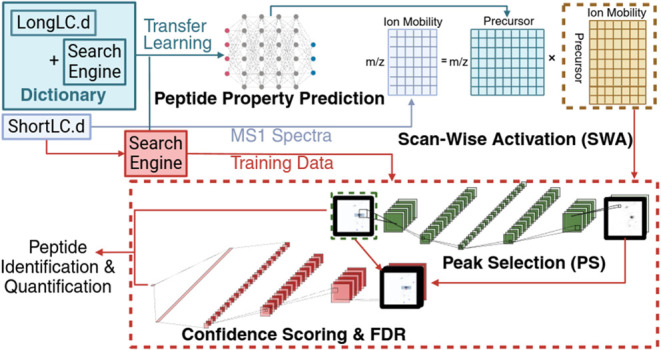 Figure 5
 Figure 6
Peer Reviews
No public reviews on file for this paper yet. If you reviewed it on a platform where reviews are public (OpenReview, ICLR, NeurIPS, ICML), you can paste yours below so the community can read it here.
Videos
No videos yet. Explain this paper in a talk, walkthrough, or lecture? Add one.
Taxonomy
TopicsAdvanced Proteomics Techniques and Applications · Machine Learning in Bioinformatics · vaccines and immunoinformatics approaches