Alcohol and Other Substance Screening in Bariatric Surgery Candidates: Utility of Self-Report and Toxicology Tests, Including Ethyl-Glucoronide
Silvia Cañizares, Laura Nuño, Pablo Barrio, Mireia Forner-Puntonet, Carolina Gavotti, Miquel Monràs, Patricia Gavín, Ricard Navinés, Lilliam Flores, Maite Barrios, Alba Andreu, Judit Molero, Amanda Jimenez, Josep Vidal, Anna Lligoña

TL;DR
This study examines alcohol and substance use in bariatric surgery candidates, finding that self-reports and toxicology tests help identify risky drinking behaviors.
Contribution
The study introduces the use of ethyl-glucuronide in urine tests alongside self-reports to better assess alcohol misuse risks in bariatric surgery candidates.
Findings
15% of bariatric surgery candidates had ethyl-glucuronide levels indicating recent alcohol use.
Men were more likely to be risky drinkers compared to women and the general population.
Combining self-reports and objective toxicology tests improves the accuracy of substance use assessment.
Abstract
Following bariatric surgery (BS) patients have an increased risk of alcohol misuse. This 1-year cross-sectional study in potential BS candidates had several objectives: (a) assess the prevalence of risky drinking, alcohol use disorder (AUD), and other substance use/disorder; (b) compare the prevalence of these behaviors to that of the general Spanish population; (c) determine the proportion of patients with positive results in toxicology tests; and (d) study the predictive factors of risky drinking. Setting: tertiary university hospital. Alcohol and other substance use were evaluated with the AUDIT-C and ASSIST questionnaires. Urine tests analyzed several markers (ethyl-glucoronide [EtG] ≥ 500 ng/ml, amphetamine, benzodiazepine, cannabinoid, cocaine, and opioid). The Mini-International-Neuropsychiatric-Interview (5.0.0) was employed to assess psychiatric diagnoses. Among 308…
Genes, proteins, chemicals, diseases, species, mutations and cell lines named across the full text — each resolved to its canonical identifier and authoritative record.
Click any figure to enlarge with its caption.
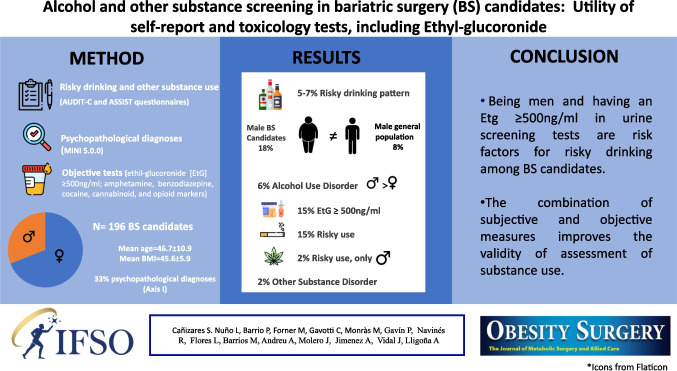 Figure 1
Peer Reviews
No public reviews on file for this paper yet. If you reviewed it on a platform where reviews are public (OpenReview, ICLR, NeurIPS, ICML), you can paste yours below so the community can read it here.
Videos
No videos yet. Explain this paper in a talk, walkthrough, or lecture? Add one.
Taxonomy
TopicsBariatric Surgery and Outcomes · Eating Disorders and Behaviors · Diet and metabolism studies