PROTOCOL: Understanding Intergenerational Programmes to Improve the Psychosocial Health and Well‐Being of Older Adults in Residential Aged Care: A Rapid Realist Review Protocol
Lysha Z. Y. Lee, Patricia Nicholson, Katrin Gerber, Ramona Naicker, Alison M. Hutchinson

TL;DR
This paper outlines a review protocol to understand how intergenerational programs with preschool children can improve the mental health of older adults in care homes.
Contribution
The study introduces a realist review protocol focusing on non-familial intergenerational programs and their impact on older adults' psychosocial well-being.
Findings
The review will identify effective intergenerational programs for older adults.
It will explore how these programs work and under what conditions.
The focus is on psychosocial health outcomes in residential aged care.
Abstract
This is the protocol for a Campbell systematic review. The main objective of this realist review is to gather, critically appraise, and synthesize evidence to identify what works, for whom, in what circumstances, and how non‐familial intergenerational programs involving pre‐school children work to improve the psychosocial well‐being of older adults living in residential aged care settings.
Genes, proteins, chemicals, diseases, species, mutations and cell lines named across the full text — each resolved to its canonical identifier and authoritative record.
Click any figure to enlarge with its caption.
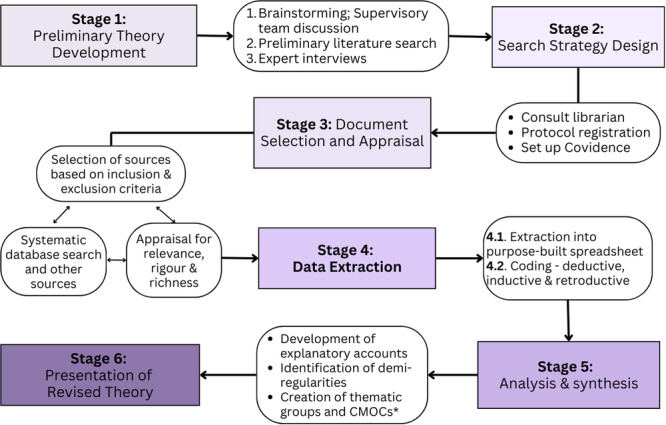 Figure 1
Peer Reviews
No public reviews on file for this paper yet. If you reviewed it on a platform where reviews are public (OpenReview, ICLR, NeurIPS, ICML), you can paste yours below so the community can read it here.
Videos
No videos yet. Explain this paper in a talk, walkthrough, or lecture? Add one.
Taxonomy
TopicsHealth disparities and outcomes · Aging and Gerontology Research · Geriatric Care and Nursing Homes