Additional accommodative controls in near heterophoria targets do not improve accommodative responses in young adults
John Siderov, Baskar Theagarayan, Muneebah Zahir, Niall J. Hynes

TL;DR
A study found that new near heterophoria tests do not improve accommodative responses in young adults compared to traditional methods.
Contribution
The study introduces new heterophoria test designs and evaluates their impact on accommodative responses.
Findings
Newly designed HHT cards did not significantly improve accommodative responses compared to traditional tests.
Test-retest measurements showed small and non-significant differences across all methods.
Accommodative responses were not influenced by the configuration of test targets in young adults.
Abstract
This study evaluated newly designed tests to measure near heterophoria, comparing them to the Maddox Wing and Howell card, and assessed whether accommodative responses differed between the different heterophoria test targets. Near horizontal heterophoria of 20 visually normal young adults was measured using the Maddox Wing, Howell Card and two versions of a newly designed Huddersfield Heterophoria Test (HHT) card. The HHT cards are based on the Prentice method, either with or without an additional spatially defined grating superimposed on the scale. The addition of a spatially defined grating has been suggested to control accommodation better. A single examiner was used to take measurements on two separate occasions, presenting each test in a random order. Monocular accommodative responses to each heterophoria target were also obtained in a separate session by another examiner.…
Genes, proteins, chemicals, diseases, species, mutations and cell lines named across the full text — each resolved to its canonical identifier and authoritative record.
Click any figure to enlarge with its caption.
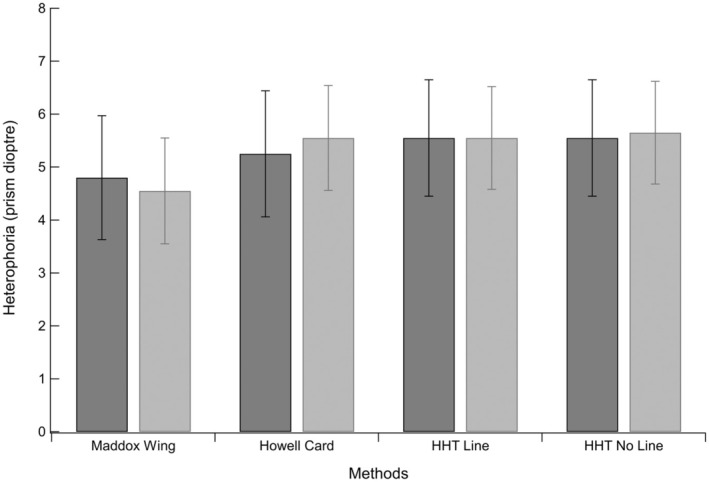 Figure 1
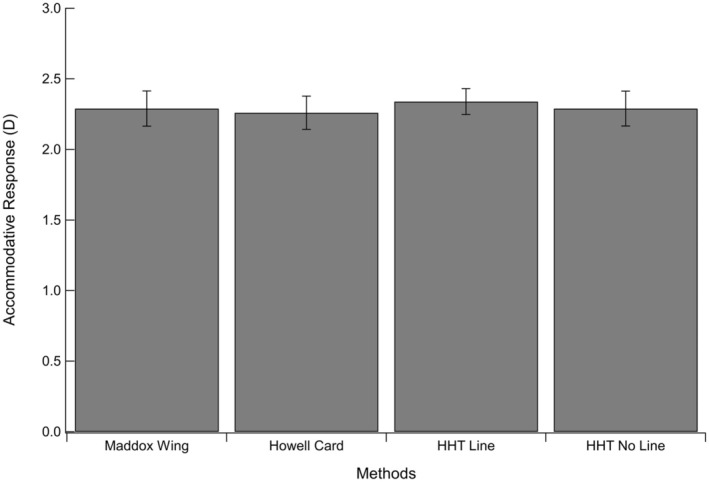 Figure 2
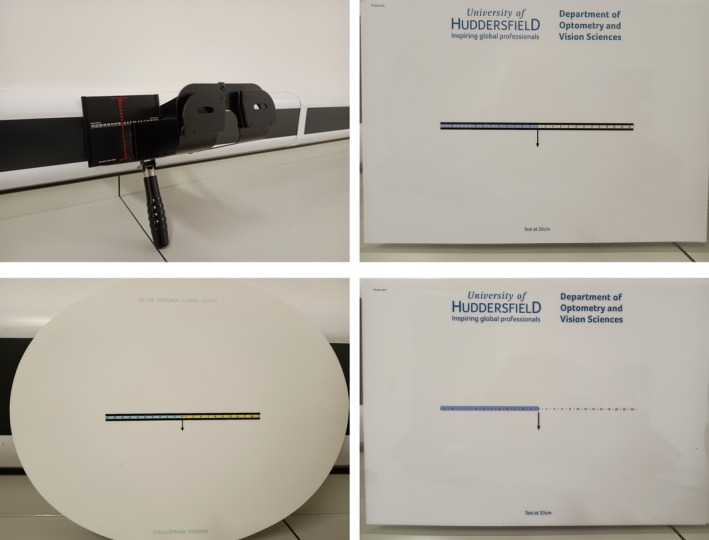 Figure 3
Peer Reviews
No public reviews on file for this paper yet. If you reviewed it on a platform where reviews are public (OpenReview, ICLR, NeurIPS, ICML), you can paste yours below so the community can read it here.
Videos
No videos yet. Explain this paper in a talk, walkthrough, or lecture? Add one.
Taxonomy
TopicsBehavioral Health and Interventions · Autism Spectrum Disorder Research