Advances in human induced pluripotent stem cell (hiPSC)-based disease modelling in cardiogenetics
Timon Seeger, Sandra Hoffmann

TL;DR
This paper reviews how human stem cells are used to model heart diseases, enabling personalized medicine through genetic and tissue engineering advances.
Contribution
The paper provides an updated overview of advanced methods in hiPSC-based disease modeling, emphasizing genome editing and tissue engineering in cardiogenetics.
Findings
hiPSC-based models allow patient-specific study of genetic heart disease mechanisms using genome editing.
Cardiac tissue engineering improves disease modeling by recreating heart architecture and function.
Multi-omics integration enhances understanding of cardiac disease at molecular and cellular levels.
Abstract
Human induced pluripotent stem cell (hiPSC)-based disease modelling has significantly advanced the field of cardiogenetics, providing a precise, patient-specific platform for studying genetic causes of heart diseases. Coupled with genome editing technologies such as CRISPR/Cas, hiPSC-based models not only allow the creation of isogenic lines to study mutation-specific cardiac phenotypes, but also enable the targeted modulation of gene expression to explore the effects of genetic and epigenetic deficits at the cellular and molecular level. hiPSC-based models of heart disease range from two-dimensional cultures of hiPSC-derived cardiovascular cell types, such as various cardiomyocyte subtypes, endothelial cells, pericytes, vascular smooth muscle cells, cardiac fibroblasts, immune cells, etc., to cardiac tissue cultures including organoids, microtissues, engineered heart tissues, and…
Genes, proteins, chemicals, diseases, species, mutations and cell lines named across the full text — each resolved to its canonical identifier and authoritative record.
Click any figure to enlarge with its caption.
 Figure 1
 Figure 2
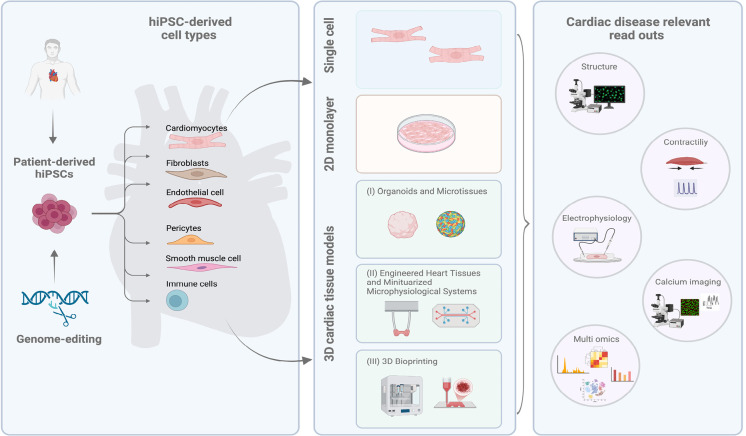 Figure 1
Peer Reviews
No public reviews on file for this paper yet. If you reviewed it on a platform where reviews are public (OpenReview, ICLR, NeurIPS, ICML), you can paste yours below so the community can read it here.
Videos
No videos yet. Explain this paper in a talk, walkthrough, or lecture? Add one.
Taxonomy
TopicsCRISPR and Genetic Engineering · Pluripotent Stem Cells Research · 3D Printing in Biomedical Research