Geographic Variation in the Prevalence of Candidatus Neoehrlichia procyonis in Raccoons (Procyon lotor) in the United States and Canada
Meghan Lewis, Kayla B. Garrett, Christopher A. Cleveland, Sonia M. Hernandez, Mark Swain, Michael J. Yabsley

TL;DR
This study finds that a tick-borne pathogen in raccoons is widespread in the U.S. but varies by region, with higher rates in the Southeast and California.
Contribution
The study provides the first comprehensive geographic prevalence data for Candidatus Neoehrlichia procyonis in raccoons across the U.S. and Canada.
Findings
42.4% of raccoons tested positive for Candidatus Neoehrlichia procyonis.
Higher prevalence was observed in the Southeast U.S. (68%) and California (55.1%).
No positive cases were found in Canadian raccoons.
Abstract
Raccoons (Procyon lotor) are reservoirs for pathogens of other wildlife species, domestic animals, and humans, including several tick‐borne pathogens. A relatively understudied organism in raccoons is Candidatus Neoehrlichia procyonis which has been detected in raccoons from the southeastern United States. A related species in Europe and Asia, Neoehrlichia mikurensis, uses rodents as reservoirs and Ixodes spp. as vectors; however, studies on rodents suggest they are not susceptible to Ca. N. procyonis. N. mikurensis has been associated with cases of neoehrlichiosis in people and dogs, which emphasizes the need to better understand the natural history of Ca. N. procyonis. We conducted a molecular survey of raccoons from selected regions of the United States and Canada. Of 394 raccoons tested, 167 (42.4%) were confirmed to be positive for Ca. N. procyonis based on sequence analysis. There…
Genes, proteins, chemicals, diseases, species, mutations and cell lines named across the full text — each resolved to its canonical identifier and authoritative record.
Click any figure to enlarge with its caption.
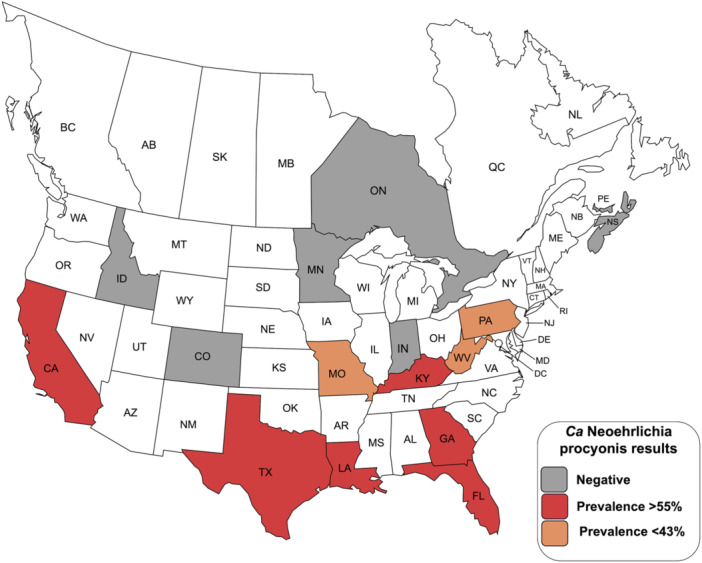 Figure 1
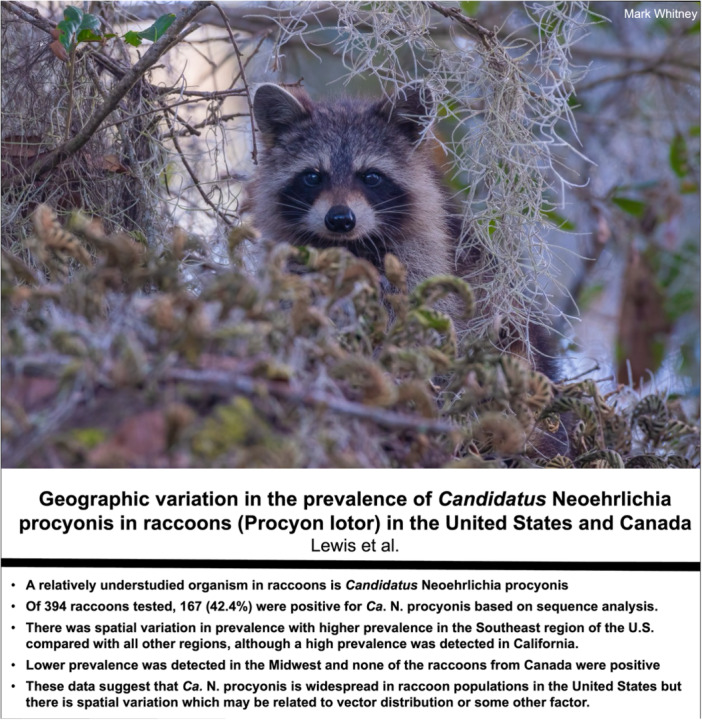 Figure 2
Peer Reviews
No public reviews on file for this paper yet. If you reviewed it on a platform where reviews are public (OpenReview, ICLR, NeurIPS, ICML), you can paste yours below so the community can read it here.
Videos
No videos yet. Explain this paper in a talk, walkthrough, or lecture? Add one.
Taxonomy
TopicsVector-borne infectious diseases · Helminth infection and control · Parasitic Infections and Diagnostics