Salinity-Driven Stratification Enhances Riverine Mercury Export to the Coastal Ocean
Roland P. Ovbiebo, Cathryn D. Sephus, Amina T. Schartup

TL;DR
This study shows that salinity-driven stratification in estuaries increases mercury export to coastal oceans, with implications for mercury pollution under climate change.
Contribution
The study introduces a novel modeling approach to assess mercury transport and methylation under different estuarine stratification regimes.
Findings
Stratification increases riverine mercury export by 19% in Chesapeake Bay and 20% in Hudson River Estuary.
Slightly stratified conditions boost methylmercury production and export by 11.5% and 16.4% in Chesapeake Bay.
Unstratified estuaries favor mercury burial in sediments due to longer residence times and increased particle settling.
Abstract
Rivers transport 300 to 5,000 Mg of mercury (Hg) annually to coastal oceans through estuaries, contributing 20–45% of total Hg input, with 100 to 1,500 Mg reaching the open ocean. However, the impact of estuarine circulation and stratification on Hg transport and methylation remains uncertain despite their known influence on other metal exports. This study developed three models to assess Hg transformation under different salinity-driven stratification regimes—well-mixed, slightly stratified, and highly stratified—using data from the Chesapeake Bay (CPB) and Hudson River Estuary (HRE), U.S.A. Results show that stratification increases riverine Hg export by 19% in CPB and 20% in HRE, with shorter Hg residence times promoting faster export. Unstratified estuaries favor Hg burial in sediments due to longer residence times and increased particle settling. Seasonal river discharge variations…
Genes, proteins, chemicals, diseases, species, mutations and cell lines named across the full text — each resolved to its canonical identifier and authoritative record.
Click any figure to enlarge with its caption.
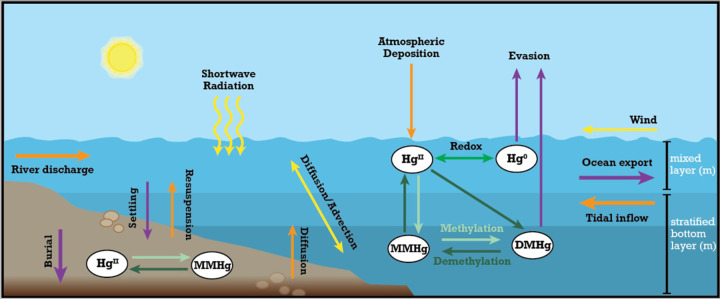 Figure 1
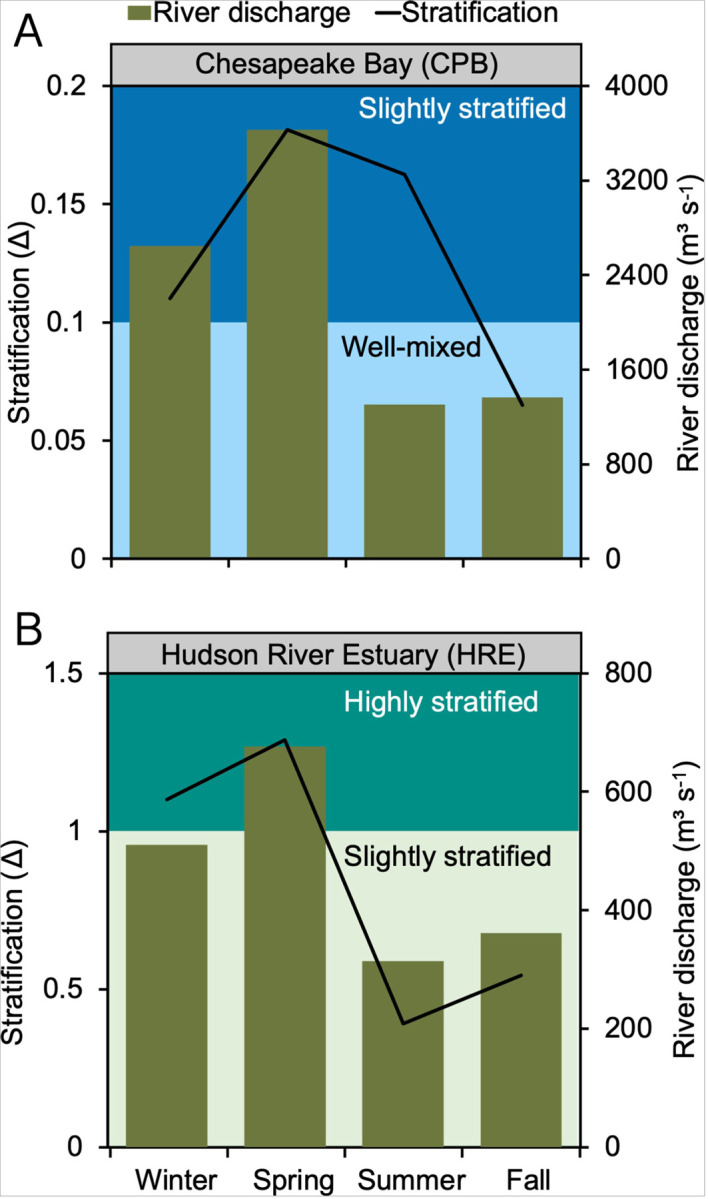 Figure 2
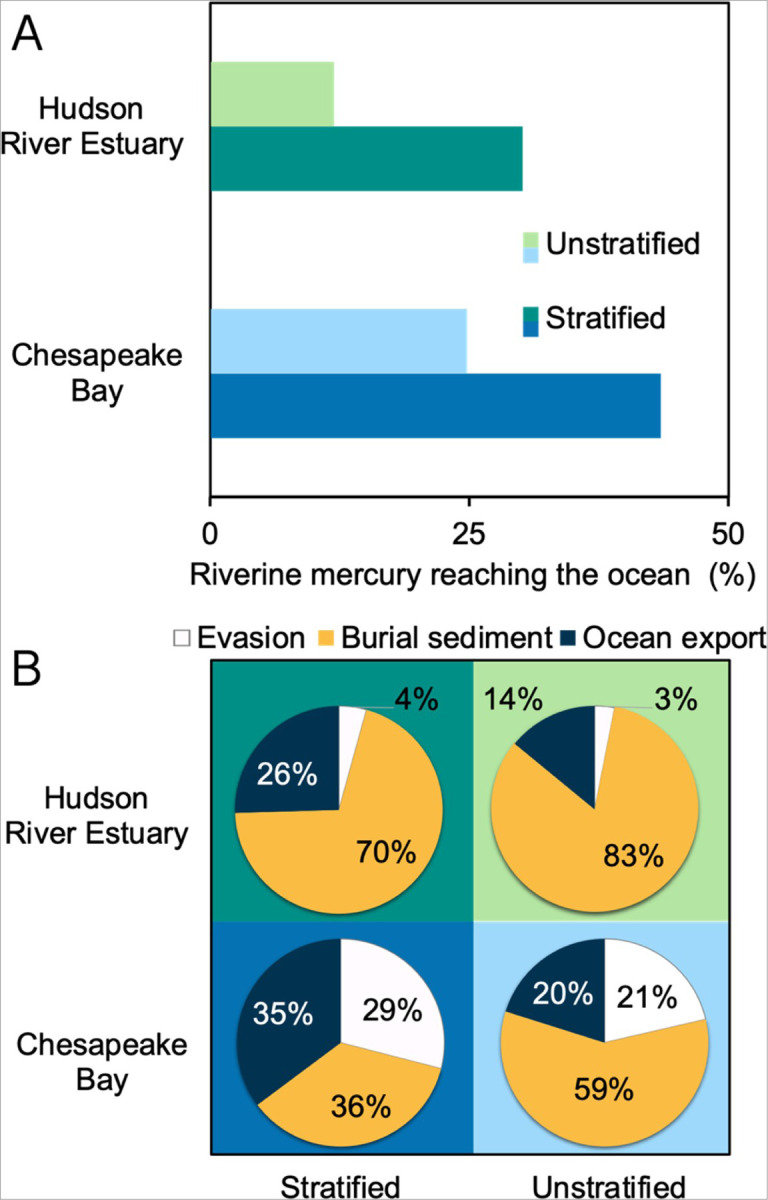 Figure 3
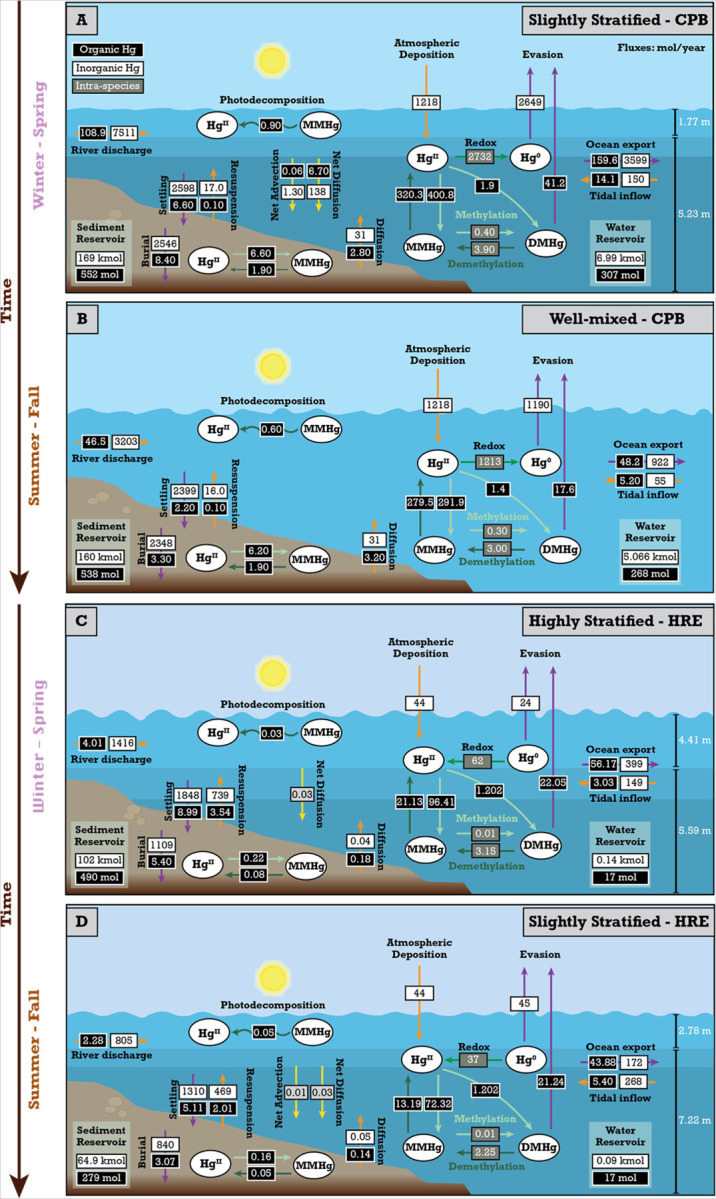 Figure 4
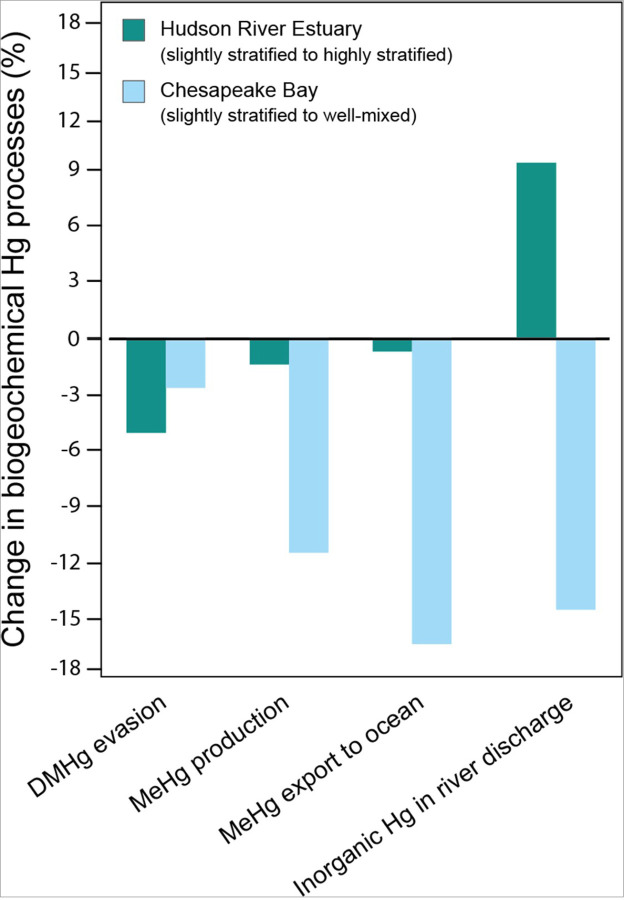 Figure 5
Peer Reviews
No public reviews on file for this paper yet. If you reviewed it on a platform where reviews are public (OpenReview, ICLR, NeurIPS, ICML), you can paste yours below so the community can read it here.
Videos
No videos yet. Explain this paper in a talk, walkthrough, or lecture? Add one.
Taxonomy
TopicsMercury impact and mitigation studies · Toxic Organic Pollutants Impact · Heavy metals in environment
Introduction
Estuarine mercury (Hg) biogeochemical cycling is unique due to the dynamic mixing of riverine freshwater and saline ocean water; thus, understanding the estuarine processes that regulate Hg export to the ocean is important. These mixing processes influence Hg speciation, behavior, and transport across the land-ocean continuum, affecting regional and global Hg cycles.^1,2^ While much attention has historically been given to Hg deposited to the ocean through atmospheric processes, recent studies indicate that riverine sources contribute 1,000 Mg of Hg to the coastal ocean annually,^3^ which is three times more than the 310 Mg of Hg deposited through atmospheric processes. Accurately quantifying the riverine flux of Hg is challenging, as it is affected by numerous factors, including variations in river discharge, sampling limitations, hydrodynamic processes, and the influence of suspended sediment and organic matter.^3,4^ Consequently, current global riverine Hg export estimates to the oceans vary widely, ranging from 300 to 5,000 Mg annually.^3–6^
The behavior and fate of contaminants within estuaries, including Hg, are influenced by the estuarine circulation and stratification patterns, which vary among estuary types.^7–9^ Estuaries are typically classified into three main types based on stratification: well-mixed, slightly stratified, and highly stratified. These classifications reflect variations in vertical and horizontal water movement, significantly affecting how contaminants are retained, flushed, or deposited, which has implications for water quality and ecosystem health.^10–12^ Within these stratification regimes, physical and hydrodynamic processes further impact Hg’s speciation into its inorganic divalent (Hg^II^) and elemental Hg (Hg^0^), and organic forms – mono- and di- methylmercury (MMHg and DMHg, respectively). In highly stratified estuaries, dense bottom water restricts vertical mixing, trapping Hg species in deeper waters and sediments, where microbial activity in anoxic sediments converts inorganic Hg into methylmercury (MeHg; sum of MMHg and DMHg), a bioaccumulating neurotoxicant,^13–15^ through various methylation processes.^2,16–18^ In slightly stratified systems, vertical and horizontal mixing disperses Hg throughout the water column, and methylation processes can occur in the pycnocline,^19^ which is a layer within the water column where there is a rapid change in water density with depth caused by variations in salinity, temperature, or both. These systems also enhance Hg binding with organic matter, which promotes settling and subsequent methylation in the benthic sediment.^18,20,21^ In well-mixed estuaries, Hg species are more evenly distributed due to the absence of stratification, reducing localized accumulation between different salinity layers. However, strong tidal forces in these systems can resuspend Hg-containing sediments, releasing Hg into the water column, where it may undergo methylation if conditions permit.^22,23^
Considering these dynamics, we propose that incorporating the distinct stratification characteristics of these estuarine types in modeling riverine Hg flux to the coastal ocean could help reduce uncertainties in current global Hg flux estimates. To address this, we develop three empirically constrained models of Hg cycling dynamics tailored to each stratification-specific estuarine system, aiming to refine estimates of riverine Hg discharge into the coastal ocean. We use these models to examine the role of salinity-driven stratification in modulating Hg speciation within a specific coastal framework. Our model was evaluated using observational data from the Chesapeake Bay (CPB) and Hudson River Estuary (HRE) in the United States. These two estuarine systems exhibit seasonal variability in stratification; CPB transitions from slightly stratified to well-mixed, and HRE transitions from highly stratified to slightly stratified, reflecting fluctuations in freshwater inflow and tidal mixing. By modeling Hg dynamics across these stratification scenarios, we offer new insights into the role of estuarine stratification in Hg transport and transformation, with implications for better estimates of riverine Hg contributions to the coastal ocean and an improved understanding of its global distribution.
Methods
Study Area Description
The CPB, the largest estuary in the United States, stretches about 322 km from the Susquehanna River in Maryland to Cape Charles and Cape Henry in Virginia, with a surface area of about 11,600 km^2^ and a watershed that spans over 165,000 km^2^ (Supplementary Fig. S1). The Susquehanna River significantly affects salinity levels in the estuary, providing approximately 62% of the freshwater supply and directly feeding into the Bay’s main stem. Other significant rivers flowing into the Bay include the Potomac, James, York, and Rappahannock Rivers. With an average water depth of 7 m and an exchange rate of 8000 m^3^ s^− 1^ with the ocean,^24^ the estuary features a two-layer circulation: fresh, lighter water flows seaward on the surface, while denser, saltier water moves landward below. The pycnocline separates these layers, resulting in slightly stratified conditions with seasonal variation. The stratification is strongest in spring and mixing increases in fall due to seasonal changes in river discharge and wind-driven mixing, creating well-mixed conditions in the summer months. The estuary experiences tidal mixing, but large portions are brackish water (0.5–25 ppt). Tidal forces are modest, rarely exceeding a 1 m range,^25^ with wind and tidal mixing influencing the estuary salinity and residual circulation.^26,27^
The HRE is a tidal estuary that spans 246 km from Battery at New York Harbor to the Federal Dam at Troy, located on the northeastern coast of the United States (Supplementary Fig. S1). It is much smaller in surface area (5,700 km^2^) than the CPB, with a watershed of about 34,700 km^2^. The Hudson River is the primary water body, with smaller tributaries feeding into the estuary, such as the Mohawk Creek, Rondout Creek, and Esopus Creek. The estuary has an average depth of roughly 10 m with a mean tidal flow of around 12,040 m^3^ s^− 1^.^28^ It features a dynamic ecosystem shaped by freshwater inflows, tides, and varying salinity (5–30 ppt), with tidal ranges reaching 2 m and peak velocities of 1 m s^− 1^.^29^ Freshwater from upstream flows into the Atlantic, while tidal forces push saltwater upstream, creating a salt-wedge or highly stratified estuary.^30^ The estuary’s strong tides dominate the river’s flow patterns over much of its length. The HRE is more stratified than the CPB, with salinity extending up to 140 km from the Battery depending on freshwater flow.^31^
Model Framework
We constructed an empirically constrained mass budget for the four main Hg species based on the stratification type of estuaries building on Sunderland et al.^32^ in Python (version 3.12.2). Our model considers how the different physical, chemical, and hydrodynamic processes affect the speciation and transformation of Hg species in estuaries and what this means for the export of riverine Hg to the ocean and MeHg production in the water column and sediments (Fig. 1). The various processes and fluxes of Hg species captured in the model include (1) external inputs from river discharge, atmospheric deposition, and inflow of tidal water from the ocean, (2) chemical transformation through inorganic Hg^II^ and Hg^0^ redox reactions, methylation of Hg^II^ and MMHg, and demethylation of MMHg and DMHg, (3) advective and diffusive mixing in the water column and outflow into the ocean, (4) diffusion/bioturbation from sediment porewater to the overlaying water through the sediment-water interface, (5) settling of particulate Hg^II^ and MMHg in the water column and to sediments, the resuspension from and burial in benthic sediments, and (6) evasion of Hg^0^ and DMHg from the water surface through air-sea gas exchange (Fig. 1).
Figure 1 illustrates Hg cycling within an estuary, highlighting the interactions between the atmosphere, water column, and sediment. Hg enters the estuary through river discharge, tidal inflow, and atmospheric deposition, undergoes transformations (methylation, demethylation, redox reactions), and is transported through diffusion, advection, settling, and resuspension processes. Hg can also evade into the atmosphere or be exported to the ocean. Physical factors like wind, shortwave solar radiation, and water currents also influence this cycling.
Mass budget model
The concentration of Hg species in each system is based on a review of measured concentrations and fluxes from the literature (Table 1), which are used to calculate the species’ initial reservoir size (Supplementary Tables S1-S2). Previous literature does not contain the measurements of all four species of Hg needed to accurately model the biogeochemical, physical, and hydrodynamic processes affecting Hg cycling in the two estuaries. Therefore, we separated the total Hg (THg) and MeHg measurements into the four Hg species (Hg^II^, Hg^0^, MMHg, and DMHg). Many studies report MeHg concentrations without distinguishing between MMHg and DMHg. Based on average ratios from previous studies, we estimated MMHg to be 60% and DMHg to be 40% of MeHg.^33–36^ The Hg^II^ concentration was calculated as the difference between the THg and the sum of Hg^0^ and MeHg. The Hg^0^ concentration in CPB is assumed to be about the same concentration of dissolved gaseous Hg (the sum of Hg^0^ and DMHg), and is estimated to contain > 90% of Hg^0^ in surface water.^37^ No published data for Hg^0^ concentrations in HRE exist, so we assume the concentration of Hg^0^ in the water column to be approximately 5% of THg concentrations based on literature, where Hg^0^ ranges between 1–9.3% in various estuarine environments.^19,38–40^ Mass budgets for each Hg species are used to create a set of coupled first-order differential equations to simulate changes in chemical mass over time.^32,40,41^ THg loading from external input into and export out of the system (Supplementary Tables S3) drives the model to a steady state with a 12-hour time step using average Hg^II^ methylation and MMHg and DMHg demethylation rate constants from literature. See Supplementary Tables S4-S16 for a detailed description of how the flux rates of the different hydrodynamic and Hg species biogeochemical processes are calculated.
Stratification and residence time
The stratification of the estuaries was used to separate each estuary’s water column into different compartments and estimate the sizes of Hg reservoirs and residence times in each system (Supplementary Tables S4-S6). To identify the stratification class of each estuary, we use the estuary’s basin-wide average vertical salinity data from Xu et al.^43^ and the New York City Department of Environmental Protection^44^ to calculate the stratification parameter (Δ). We chose the salinity scheme method to estimate the stratification because there were multiple spatial salinity measurements along the estuary transect^45^. Δ is computed as the tidally average salinity difference ratio between the surface (Ssal) and bottom water (Bsal) to the depth-averaged salinity (Asal) (Eq. 1).^45,46^
When Δ is less than 0.1, it is classified as well-mixed; when Δ is between 0.1 and 1, it is slightly/partially stratified, and if larger than 1, it is highly/strongly stratified.^45,46^
The CPB stratification class varies seasonally from slightly stratified during the period coinciding with higher river inflow (> 2600 m^3^ s^− 1^) to well-mixed estuary under low river flow conditions (< 1400 m^3^ s^−1^) (Fig. 2A). The system is more stratified in the winter (Δ = 0.11, December-February) and spring (Δ = 0.18, March-May). The stratification persists into the summer (Δ = 0.16, June-August) as the surface water warms up and transitions into well-mixed conditions in the fall (Δ = 0.07, September-November) as river outflow decreases.
The stratification types in HRE range from highly to slightly stratified. The strongest stratification occurs at intermediate salinities (13.7–14.9 ppt) during the winter (Δ = 1.1) and spring (Δ = 1.29) due to higher river outflow (> 500 m^3^ s^− 1^) and increased precipitation runoff into the estuary from its 34,700 km^2^ watershed area (Fig. 2B). The highly stratified conditions (Δ > 1) in the HRE are not solely due to increased freshwater inflow. The freshwater input rate must exceed the tidal mixing rate for stratification to persist. This balance can result from strong freshwater inflows, reduced tidal mixing, or a moderate combination of both influences, leading to the observed stratification.^47^
After determining the stratification type of each estuary, we used a hydrological budget equation (Equations 2 and 3 below) to estimate the seasonal depth of each compartment, which we classified as the mixed surface layer and stratified bottom layer. The calculations for the surface mixed layer and stratified bottom layer depths in both highly and slightly stratified systems incorporated the estuary’s total freshwater volume, surface area, and mean central depth (Supplementary Table S5). This approach enabled us to estimate the water volume in each system, which is necessary for calculating Hg residence time. Monthly river discharge data for the CPB and HRE were sourced from the USGS Water Data at the river mouths (Susquehanna, Potomac, Rappahannock, York, and James Rivers)^48,49^ and Green Island (near Troy Dam)^49,50^, respectively (Fig. S1).
where Mdep is the mixed surface layer depth (m), Rivfl is the river discharge (m^3^ s^− 1^), Pre is the precipitation inflow into the estuary (m^3^ s^−1^), SAw is the water surface area (m^2^), Wdep is central channel average depth (m), and Sdep is the stratified bottom layer depth (m).
The time spent by Hg species in each system was determined using the water residence time in the estuary. The residence time (τ) in days was calculated using the freshwater method.^51–53^ This method uses the salinity of the water volume (Volw), freshwater fraction (FWF), and freshwater inflow rate (FWfl) to estimate the estuary turn-over time (Eq. 4–5 and Supplementary Table S6). This calculation was done for the 12 months of the year based on changes in the monthly river inflow and salinity.
Seasonally, the residence times in the CPB range from 63 to 280 days, whereas those in the HRE are shorter, ranging from 12 to 20 days. These values are consistent with findings from previous studies in the two estuaries.^45,54–60^ The longer residence times in CPB can be attributed to its larger size and lower flushing rates, while the shorter residence times in HRE are due to its smaller size and strong tidal flushing dynamics.^61^
Results and Discussion
Water column stratification impacts riverine Hg flux to the coastal ocean and Hg removal in estuarine systems
We compare two estuary model simulations: one that is stratified, where the water column is divided into layers based on the salinity gradient, and another that is unstratified, where the salinity is uniform throughout the entire water column. Both models use the same physical, hydrodynamic, and Hg transformation processes to evaluate how stratification affects Hg removal in the estuaries and, ultimately, the amount of Hg that reaches the coastal ocean.
Model results indicate that stratification enhances the export of Hg from rivers to the ocean. This trend is seen for both systems modeled in Fig. 3A, where we observe a 19% increase in Hg export in the CPB and 20% in the HRE as the system becomes more stratified. These results align with prior studies; for example, Mason et al. (1999)^19^ reported that 29% of the riverine Hg is exported to the ocean from CPB, which overlaps with our findings (25–44%). However, the prior study did not include stratification in estimating this Hg export. To our knowledge, no comparable analysis has been performed on the HRE. Our model suggests that the development of a pycnocline is key to controlling Hg export in stratified systems. In a stratified system, riverine THg remains in the surface water above the pycnocline, resulting in a shorter residence time within the estuary, and is more readily exported to the ocean.
We used the model to evaluate how water column stratification changes the Hg removal processes; these findings are summarized in Fig. 3B. We see that when a system is well-mixed, the fraction of THg removed by burial in sediments increases. We attribute this to the longer residence time of Hg species in unstratified conditions, which allows for more particle-bound Hg to settle out of the water column and be sequestrated in the sediment. Our findings regarding the higher fraction of THg buried in unstratified systems align with other studies that assumed well-mixed conditions in their modeling of Hg in estuaries. These studies have reported that over 70% of riverine Hg is ultimately buried in estuarine sediment.^4,23,62–65^ We also see that evasion of Hg decreases by 23 and 13% in CPB and HRE, respectively, when the systems are unstratified (Fig. 3B). The observed changes can largely be attributed to longer residence time and the absence of a pycnocline. The longer residence time leads to a higher settling of Hg in unstratified conditions, leaving less Hg in the water column and decreasing the pool available for evasion. The absence of pycnocline in the unstratified system enhances tidal mixing of the large surface riverine Hg pool delivered to the estuary surface with the entire water column, leaving a lower concentration of Hg in the surface water for evasion. In unstratified estuaries, the mixing of riverine freshwater with seawater results in a shoaling of the euphotic depth, which occurs due to particles in the water that decrease the intensity of ultraviolet solar radiation. As a result, the euphotic depth decreases by 6% in CPB and by 32% in HRE, lowering the production and evasion of volatile Hg^0^. Our model results show that the absence of stratification in the estuary water column will increase the amount of Hg buried in estuarine sediment while decreasing evasion to the atmosphere and export to the coastal ocean.
Hg removal processes in estuaries respond to seasonal variability in Hg sources and stratification type
In the previous section, we tested how estuaries respond to changes in stratification while keeping conditions constant over a year. However, the presence and strength of stratification vary by estuary and season. For example, CPB and HRE transition to more stratified states as river discharge increases (Fig. 2). Here, we model how seasonal variations in stratification influence Hg cycling in HRE and CPB.
Figures 4A and 4B show that CPB transitions from well-mixed to slightly stratified conditions when river discharge increases, resulting in a 20% increase in THg export to the coastal ocean. This is because river discharge accounts for 71–85% of the annual THg input to CPB, while tidewater inflow and atmospheric deposition contribute less than 30% of the annual THg input. The fraction of THg removed through burial in sediment also varies with stratification, with well-mixed conditions leading to 25% more THg being buried in estuarine sediments compared to slightly stratified conditions. This is again due to increased residence time in well-mixed conditions, which enhances sedimentation efficiency for particle-bound Hg and improves sediment mixing from wave action and tidal forces. Our model’s sensitivity to particle settling indicates that these processes effectively lower Hg concentrations in the water column and enhance its burial in estuarine sediment. This aligns with findings in other coastal environments, such as the Gulf of Trieste, where Hg concentrations in the settling sediment particles were found to be of the same order of magnitude as the amount of Hg observed in the surface sediments,^66^ further showing that settling processes play a crucial role in the transfer of particle-bound Hg from the water column to the sediment. The evasion flux in CPB is highest under slightly stratified conditions due to a larger pool of Hg^0^ and DMHg in the surface water, higher wind speeds, and an increased reduction of Hg^II^ to Hg^0^ (Fig. 4A). Slight stratification allows for the input of Hg^0^ and DMHg from depth to advect to the surface, where it can easily evade into the atmosphere under suitable conditions. This advective transport process is absent in well-mixed conditions due to the uniform salinity of the water column. In addition, tidal circulation influences the vertical and horizontal distribution of this Hg species in the slightly stratified systems, with diffusive and advective transport processes redistributing Hg throughout the water column, allowing for more frequent exchanges between the surface and bottom water layers.^67,68^
In contrast, we see that HRE transitions from slightly stratified to highly stratified conditions as river discharge increases (Fig. 4C and 4D), resulting in a 9% increase in THg export to the coastal ocean. Like CPB, river discharge constitutes 71–88% of the annual THg input to HRE, while tidewater inflow and atmospheric deposition account for less than 30% of the annual THg input. The fraction of THg removed through burial in sediment is also influenced by stratification, with slightly stratified conditions leading to 6% more THg being buried compared to highly stratified conditions. This variation arises from the strong pycnocline in highly stratified conditions. This pycnocline limits vertical mixing, causing Hg species that settle to the bottom layer to remain trapped in the bottom layer, extending their residence time and enhancing particle-bound Hg deposition^69^. The evasion flux of gaseous Hg in HRE mirrors that of CPB, with the highest flux observed under slightly stratified conditions due to the accumulation and subsequent release of Hg^0^ and DMHg from the surface waters (Fig. 4D). Observations from Long Island Sound,^70^ an estuary 28 km from HRE, further support these findings, as higher concentrations of dissolved gaseous Hg and saturation levels were recorded in the surface waters of Long Island Sound during summer when HRE was also slightly stratified. These further show that the local hydrodynamics and climatic conditions that influence stratification in HRE contribute to higher evasion of Hg^0^ and DMHg during periods of slight stratification.
Our findings highlight the important role that river discharge plays in controlling Hg input and stratification dynamics, which in turn influences Hg export and other removal processes in estuarine systems. In a changing climate, increasing storm runoff and freshwater input into estuaries are expected to enhance stratification, increasing Hg export to the coastal ocean. Land use changes, such as deforestation, can further exacerbate this process by remobilizing previously deposited Hg in the terrestrial environment globally (170–300 Mg yr^−1^).^71,72^ It is estimated that 1088 ± 379 Gg of Hg is stored in the global surface soil,^73^ and land use changes can remobilize this stored Hg and result in elevated concentrations in river discharge. Moreover, estuaries deliver significant amounts of nutrients and organic matter to the coastal ocean,^74^ which can stimulate biological activity^75^ and MeHg formation, potentially contributing to higher Hg burdens in coastal communities. Our model demonstrates that while well-mixed conditions in CPB act as a substantial sink for riverine Hg, highly and slightly stratified conditions in both estuaries enhance Hg export to the coastal ocean, potentially elevating coastal Hg concentrations and posing risks to marine ecosystems and human health.
The presence of stratification in the water column enhances the production and export of estuarine MeHg to the coastal ocean.
Similarly, as in the previous section, we use the model to investigate how seasonal changes in the strength of stratification affect the production of MeHg in CPB and HRE. Additionally, we examine how these changes influence the quantity of MeHg exported to the coastal ocean from the two estuaries.
In CPB, as the system transitions from slightly stratified to well-mixed conditions, the MeHg production decreases by 11.5%, leading to a 16.4% decrease in the quantity of MeHg exported to the coastal ocean annually (Fig. 5). We attribute the higher MeHg production under slightly stratified conditions to greater river discharge (Fig. 2A), which delivers 14.5% more inorganic Hg to the slightly stratified system (Fig. 4A & 5). This higher river influx increases the bioavailable pool of dissolved Hg^II^, the primary substrate for MeHg formation,^76,77^ as stratification intensifies within the water column. This is consistent with findings from Mason et al. (2012),^78^ which highlight the importance of riverine Hg loading in controlling MeHg concentrations in estuarine and coastal environments. Moreover, the increase in net primary production under slightly stratified conditions, which we used to parameterize Hg^II^ biotic reduction rates (Supplementary Table 16), supports greater Hg^II^ formation and subsequent methylation, thereby facilitating MeHg production.^19^ Earlier studies have also shown that increased primary production boosts the availability of organic matter,^79^ which, when decomposed, consumes oxygen and contributes to the formation of anoxic zones, thus promoting the methylation of Hg^II^.
In the HRE, the transition from slightly stratified to highly stratified conditions leads to a 1.6% decrease in MeHg production. This shift results in a 0.7% decrease in the amount of MeHg exported to the coastal ocean annually (Fig. 5). The decrease in MeHg production in the highly stratified conditions, despite a 9.4% increase in inorganic Hg input from river discharge, can be attributed to the shorter residence time of the water in the surface mixed layer. This leads to a higher flushing rate,^11,51,58^ resulting in less time for Hg^II^ to undergo methylation within the estuary. The increase in MeHg export to the coastal ocean under slightly stratified conditions is also attributed to the advective and diffusive mixing between the surface mixed layer and the stratified bottom layers. This mixing allows some of the MeHg produced at greater depths to reach the surface,^80^ where it can be readily exported to the coastal ocean. In contrast, during highly stratified conditions, strong pycnoclines restrict the mixing of MeHg produced in the bottom layers, preventing it from reaching the surface. As a result, MeHg accumulates in the stratified bottom layers, where it undergoes further demethylation and a portion of it is eventually deposited into the sediment (Fig. 4C).^19^ This means that when stratification is high, there is less MeHg available in the highly productive surface waters, which may lead to less biological uptake depending on the depth of the euphotic zone, the location of phytoplankton, and other estuarine mixing processes, possibly resulting in lower MeHg accumulation in organisms at the base of the food chain. Despite this, MeHg accumulation in the more stratified bottom layer remains available to deep-dwelling organisms.
Our study highlights the roles of stratification and estuarine mixing in the formation of MeHg from Hg species entering estuaries via river discharge. Studies show that many estuaries may experience enhanced water column stratification in the coming decades due to climate change. While exact figures have not yet been published, modeling studies using regional conditions and specific climate scenarios suggest that estuaries—particularly those in temperate regions—could exhibit increased stratification as a result of rising sea levels, warming surface waters, reduced wind mixing, and altered freshwater inflows.^81–87^ Increased freshwater input into estuaries is likely to enhance stratification due to the difference in density between freshwater (less dense) and seawater (more dense);^45,88,89^ this density gradient (pycnocline) separates the less dense freshwater in the surface layer and the denser, saline water below.^45,90,91^ This strong pycnocline weakens vertical oxygen exchange and can lead to the development of near-bed hypoxia,^82,88,92^ a condition known to favor the formation of MeHg.^19,76^ Our findings reveal that MeHg production and export to the coastal ocean increased by 11.5% and 16.4%, respectively, when the stratification conditions in CPB shifted from well-mixed to slightly stratified. This indicates that many estuaries may experience an increased export of MeHg to the coastal ocean as the climate changes.
The reference list from the paper itself. Each links out to its DOI / PubMed record.
- 1Fitzgerald W. F., Lamborg C. H. & Hammerschmidt C. R. Marine Biogeochemical Cycling of Mercury. Chem. Rev. 107, 641–662 (2007).17300143 10.1021/cr 050353 m · doi ↗ · pubmed ↗
- 2Mason R. P. Mercury biogeochemical cycling in a stratified estuary. Limnol. Oceanogr. 38, 1227–1241 (1993).
- 3Liu M. Rivers as the largest source of mercury to coastal oceans worldwide. Nat. Geosci. 14, 672–677 (2021).
- 4Amos H. M. Global Biogeochemical Implications of Mercury Discharges from Rivers and Sediment Burial. Environ. Sci. Technol. 48, 9514–9522 (2014).25066365 10.1021/es 502134 t · doi ↗ · pubmed ↗
- 5Cossa D., Coquery M., Gobeil C. & Martin J.-M. Mercury Fluxes at the Ocean Margins. in Global and Regional Mercury Cycles: Sources, Fluxes and Mass Balances (eds. Baeyens W., Ebinghaus R. & Vasiliev O.) 229–247 (Springer Netherlands, Dordrecht, 1996). doi:10.1007/978-94-009-1780-4_11. · doi ↗
- 6Outridge P. M., Mason R. P., Wang F., Guerrero S. & Heimbürger-Boavida L. E. Updated Global and Oceanic Mercury Budgets for the United Nations Global Mercury Assessment 2018. Environ. Sci. Technol. 52, 11466–11477 (2018).30226054 10.1021/acs.est.8b 01246 · doi ↗ · pubmed ↗
- 7Costa I., Bordalo A. & Duarte P. Influence of River Discharge Patterns on the Hydrodynamics and Potential Contaminant Dispersion in the Douro Estuary (Portugal). Water Res. 44, 3133–46 (2010).20409570 10.1016/j.watres.2010.03.011 · doi ↗ · pubmed ↗
- 8Iglesias I. Linking contaminant distribution to hydrodynamic patterns in an urban estuary: The Douro estuary test case. Sci. Total Environ. 707, 135792 (2019).31865079 10.1016/j.scitotenv.2019.135792 · doi ↗ · pubmed ↗