Spinal Accessory Nerve Mononeuropathy Following Trapezius Lipoma Resection: A Case Report
Michael A Serra-Jovenich, Adam T Friedman, Zachary Noll, Trina Lisko

TL;DR
A patient developed spinal accessory nerve injury after surgery to remove a trapezius lipoma, highlighting the need for careful surgical techniques and early diagnosis.
Contribution
This is the first documented case of isolated spinal accessory nerve mononeuropathy following trapezius lipoma resection.
Findings
A 54-year-old male developed SAN mononeuropathy one week after trapezius lipoma resection.
Electrodiagnostic studies confirmed severe focal SAN neuropathy with active denervation.
Early recognition and diagnosis are crucial for improved functional outcomes following SAN injury.
Abstract
The spinal accessory nerve (SAN) is crucial for the motor function of the trapezius and sternocleidomastoid muscles, playing a significant role in scapular stability and upper limb mobility. While SAN injuries are commonly associated with iatrogenic causes such as lymph node biopsies, neck dissections, and posterior cervical trauma, injury following trapezius lipoma resection has not been well-documented. Given the SAN's superficial location and proximity to surgical fields in the posterior cervical triangle, it is vulnerable to inadvertent injury during tumor excision. To the best of our knowledge, this case report presents the first documented instance of isolated SAN mononeuropathy following trapezius lipoma resection and underscores the importance of early recognition, diagnosis, and management. A 54-year-old male developed SAN mononeuropathy following an elective surgical removal…
Genes, proteins, chemicals, diseases, species, mutations and cell lines named across the full text — each resolved to its canonical identifier and authoritative record.
Click any figure to enlarge with its caption.
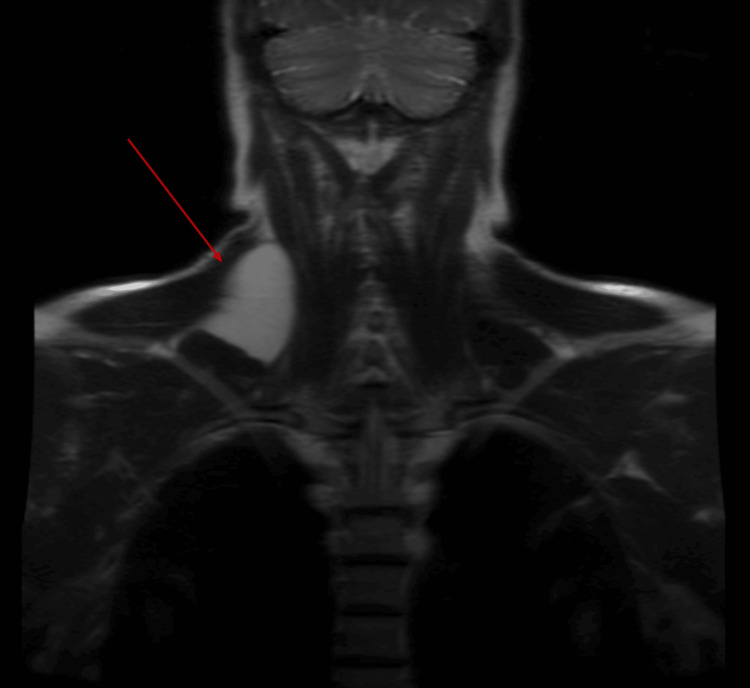 Figure 1
| Side | Muscle | Nerve | Root | Ins Act | Fibs | Psw | Amp | Dur | Poly | Recrt | Int Patt | Comment |
| Right | Deltoid | Axillary | C5-6 | Nml | Nml | Nml | Nml | Nml | 0 | Nml | Nml | Nml |
| Right | Biceps | Musculocutaneous | C5-6 | Nml | Nml | Nml | Nml | >12ms | 0 | Nml | Nml | Nml |
| Right | Triceps | Radial | C6-7-8 | Nml | Nml | Nml | Nml | >12ms | 0 | Nml | Nml | Nml |
| Right | Brachioradialis | Radial | C5-6 | Nml | Nml | Nml | Nml | >12ms | 0 | Nml | Nml | Nml |
| Right | Extensor Indicis | Radial (Posterior Interosseous) | C7-8 | Nml | Nml | Nml | Nml | Nml | 0 | Nml | Nml | Nml |
| Right | Flexor Carpi Radialis | Median | C6-7 | Nml | Nml | Nml | Nml | >12ms | 0 | Nml | Nml | Nml |
| Right | Flexor Carpi Ulnaris | Ulnar | C8-T1 | Nml | Nml | Nml | Nml | Nml | 0 | Nml | Nml | Nml |
| Right | Abductor Pollicus Brevis | Median | C8-T1 | Nml | Nml | Nml | Nml | Nml | 0 | Nml | Nml | Nml |
| Right | 1st Dorsal Interosseous | Ulnar | C8-T1 | Nml | Nml | Nml | Nml | Nml | 0 | Nml | Nml | Nml |
| Right | Cervical Paraspinal Middle | Dorsal Rami | C4-6 | Increased | Nml | Nml | Nml | Nml | 0 | Nml | Nml | Nml |
| Right | Trapezius | Spinal Accessory | CN XI, C3-4 | Nml | Nml | Nml | Nml | Nml | 0 | Nml | Nml | Nml |
| Right | Supraspinatus | Suprascapular | C5-6 | Nml | Nml | Nml | Nml | Nml | 0 | Nml | Nml | Nml |
| Right | Infraspinatus | Suprascapular | C5-6 | Nml | Nml | Nml | Nml | Nml | 0 | Nml | Nml | Nml |
| Side | Muscle | Nerve | Root | Insp Act | Fibs | Psw | Amp | Dur | Poly | Recrt | Int Patt | Comment |
| Right | Deltoid | Axillary | C5-6 | Nml | Nml | Nml | Nml | Nml | 0 | Nml | Nml | Nml |
| Right | Biceps | Musculocutaneous | C5-6 | Nml | Nml | Nml | Nml | Nml | 0 | Nml | Nml | Nml |
| Right | Triceps | Radial | C6-7-8 | Nml | Nml | Nml | Nml | Nml | 0 | Nml | Nml | Nml |
| Right | Brachioradialis | Radial | C5-6 | Nml | Nml | Nml | Nml | Nml | 0 | Nml | Nml | Nml |
| Right | Flexor Carpi Radialis | Median | C6-7 | Nml | Nml | Nml | Nml | Nml | 0 | Nml | Nml | Nml |
| Right | Flexor Carpi Ulnaris | Ulnar | C8-T1 | Nml | Nml | Nml | Nml | Nml | 0 | Nml | Nml | Nml |
| Right | 1st Dorsal Interosseous | Ulnar | C8-T1 | Nml | Nml | Nml | Nml | Nml | 0 | Nml | Nml | Nml |
| Right | Abductor Pollicus Brevis | Median | C8-T1 | Nml | Nml | Nml | Nml | Nml | 0 | Nml | Nml | Nml |
| Right | Trapezius | Spinal Accessory | CN XI, C3-4 | Increased | 4+ | Nml | Nml | Nml | 0 | Reduced | 75% | CRD |
| Right | Rhomboid Major | Dorsal Scapular | C5 | Nml | Nml | Nml | Nml | Nml | 0 | Nml | Nml | Nml |
| Right | Rhomboid Minor | Dorsal Scapular | C5 | Nml | Nml | Nml | Nml | Nml | 0 | Nml | Nml | Nml |
| Right | Supraspinatus | Suprascapular | C5-6 | Nml | Nml | Nml | Nml | Nml | 0 | Reduced | 25% | Nml |
| Right | Infraspinatus | Suprascapular | C5-6 | Nml | Nml | Nml | Nml | Nml | 0 | Nml | Nml | Nml |
| Right | Latissimus Dorsi | Thoracodorsal | C6-8 | Nml | Nml | Nml | Nml | Nml | 0 | Nml | Nml | Nml |
| Right | Serratus Anterior | Long Thoracic | C5-7 | Nml | Nml | Nml | Nml | Nml | 0 | Nml | Nml | Nml |
Peer Reviews
No public reviews on file for this paper yet. If you reviewed it on a platform where reviews are public (OpenReview, ICLR, NeurIPS, ICML), you can paste yours below so the community can read it here.
Videos
No videos yet. Explain this paper in a talk, walkthrough, or lecture? Add one.
Taxonomy
TopicsNerve Injury and Rehabilitation · Peripheral Nerve Disorders · Shoulder Injury and Treatment
Introduction
The spinal accessory nerve (SAN) plays a critical role in the motor function of the trapezius and sternocleidomastoid muscles, contributing to scapular stabilization and movements such as shoulder elevation and head rotation [1,2]. Lesions to the SAN can result in significant functional impairment, including weakness in shoulder shrugging, difficulty with overhead activities, scapular winging, and potentially result in chronic pain [3]. Injury to the SAN is most often associated with iatrogenic injuries during surgical procedures, such as lymph node biopsies and neck dissections, or trauma to the posterior cervical region [4]. However, its occurrence following trapezius lipoma resection is yet to be defined.
Lipomas are the most common benign mesenchymal tumors, often presenting as painless, slow-growing masses. Although generally harmless, their location near neurovascular structures can pose surgical challenges. The SAN’s superficial course in the posterior triangle of the neck and its deep penetration into the trapezius muscle make it particularly vulnerable to injury during tumor excision [5].
To date, only one documented case of SAN injury following lipoma removal exists; however, the exact location of the lipoma was not specified in that report [4]. To the best of our knowledge, this case report presents the first published case of isolated SAN injury following a trapezius lipoma resection. By detailing the clinical presentation, diagnostic approach, and management strategy, this study aims to raise awareness among physicians about potential SAN injury. Understanding the delicate anatomy of the SAN and implementing nerve-sparing surgical approaches are essential to preventing iatrogenic injury, highlighting the importance of early recognition and intervention to optimize patient outcomes [6,7].
Case presentation
A 54-year-old right-hand dominant male presented in 2023 with a 12-year history of gradually worsening right anterolateral shoulder pain, rated 7/10 on the Visual Analog Scale. His discomfort was accompanied by periscapular pain, particularly aggravated by overhead activities. Electrodiagnostic studies (EDX) with electromyography (EMG) were conducted on January 22, 2024, which showed mild chronic C6-C7 radiculopathy. No signs of focal nerve entrapment, brachial plexopathy, peripheral neuropathy, or myopathy were identified (see Table 1). A magnetic resonance image (MRI) of the cervical spine without contrast on January 31, 2024, revealed a large, deep right trapezius lipoma measuring 5.8 cm x 2.6 cm x 5.8 cm at the cervicothoracic junction (see Figure 1).
MRI cervical spine without contrastDeep right trapezius lipoma (red arrow) measuring 5.8 cm x 2.6 cm x 5.8 cm at the level of the cervicothoracic junction.
In May 2024, the patient underwent elective surgical resection of the lipoma. Although the operative report was unavailable for review, the patient reported no known intraoperative complications. However, within a week after surgery, the patient began experiencing new symptoms, including paresthesias in the upper pectorals and trapezius regions, along with weakness during shoulder shrugging and abduction. These symptoms significantly restricted his ability to perform daily tasks and engage in recreational activities involving overhead movements.
Six months after lipoma resection, physical examination revealed mild atrophy of the right lower trapezius, with worsened myofascial trigger points in the scapulothoracic region. The surgical site showed a well-healing trapezius scar with hypertrophic changes, consistent with the location of the procedure. Active range of motion testing revealed new-onset scapular dyskinesis, with lateral scapular winging observed during active shoulder abduction at 100 degrees. Provocative testing revealed the following key findings: asymmetric weakness during resisted right shoulder shrug, lateral scapular winging, positive active external rotation test, and a positive wall push-up test.
Due to these new symptoms, repeat EDXs were performed on January 29, 2025. EMG of the right trapezius revealed increased insertional activity, prominent fibrillations (4+), widespread spontaneous activity, diminished recruitment, complex regional discharges (CRD), and a moderately decreased (75%) interference pattern (see Table 2). The right supraspinatus muscle demonstrated diminished recruitment and a reduced interference pattern, while all other muscles tested were unremarkable (see Table 2). In summary, the findings indicated severe focal neuropathy of the right SAN with ongoing denervation, evidenced by CRD in the trapezius and poor insertional patterns in the supraspinatus. The intact activation of the infraspinatus suggests that the issue was primarily muscular and related to the lipoma removal rather than an isolated nerve injury.
This patient was subsequently referred to a peripheral nerve surgeon, with clinical recommendations for conservative versus procedural considerations pending.
Discussion
SAN mononeuropathy is an uncommon but significant complication following surgical procedures in the posterior cervical and shoulder region. While it has been well-documented in the context of lymph node biopsies, radical neck dissections, and penetrating trauma, its occurrence after lipoma resection is yet to be published. To the best of our knowledge, this case represents the first reported instance of isolated SAN injury following trapezius lipoma resection, highlighting not only the importance of this potential complication, but also the importance of early recognition and intervention.
Mechanism of injury
The SAN has a particularly vulnerable anatomic course, traversing the posterior triangle of the neck before penetrating the deep surface of the trapezius muscle [1,2]. On average, the SAN runs 2.67 cm beneath the skin, 3.80 cm from the vertebral spinous process, and only 0.70 cm from the medial border of the scapula, making it particularly susceptible during posterior cervical surgeries [8]. In this case, the resection of a deeply situated trapezius lipoma likely led to indirect SAN injury through excessive traction, compression, or thermal damage rather than direct transection, as no intraoperative complications were noted [9].
Clinically, SAN injury manifests with characteristic signs, including lateral scapular winging, vague shoulder pain, muscle atrophy, and functional limitations in shoulder elevation and abduction [6]. These findings were evident in the patient in this report within a week postoperatively, emphasizing the importance of early recognition. EDX confirmed severe focal SAN mononeuropathy with ongoing denervation, reinforcing the vulnerability of this nerve in the posterior cervical triangle.
Clinical and functional implications
SAN injury often results in scapular dyskinesis, leading to abnormal scapulohumeral rhythm, reduced shoulder stability, and compensatory overuse of surrounding musculature. This can lead to chronic pain and functional impairment, particularly in overhead activities [6,8]. The persistence of denervation findings on follow-up EMG six months postoperatively suggests a more severe nerve injury that may not fully recover without intervention.
The literature suggests that functional recovery following SAN injury is time-sensitive. Outcomes vary widely, with better prognosis if surgical repair is performed within seven months of injury, whereas delayed interventions beyond 20 months have progressively worse results [6,7].
Management considerations
The management of iatrogenic SAN injury varies depending on the severity and chronicity of the condition. Early identification is crucial, as timely intervention can improve functional outcomes. Treatment for SAN mononeuropathy ranges from conservative rehabilitation to surgical intervention. Physical therapy focusing on scapular stabilization, neuromuscular re-education, and myofascial release can be effective in mild to moderate cases, especially if nerve regeneration occurs spontaneously [7,10]. However, in this case, the patient’s persistent weakness and progressive symptoms beyond the expected recovery period suggest a more severe injury - potentially warranting surgical exploration of nerve reconstruction [7,11,12].
Given the severity of this case, surgical interventions such as nerve grafting, neurolysis, or dynamic tendon transfers may be considered. Tendon transfers, particularly Eden-Lange procedures or levator scapulae-rhomboid transfers, have been described for cases of persistent trapezius paralysis with significant scapular winging [13,14].
The only limitation of this report is the lack of intraoperative details, making it difficult to determine the precise mechanism of nerve injury. Further studies are needed to establish the best practices for preventing and managing SAN injuries in similar cases.
Conclusions
This case highlights the significant risk of SAN injury following trapezius lipoma resection. The patient’s postoperative symptoms, including scapular dyskinesis and persistent weakness, emphasize the importance of early recognition and diagnostic confirmation through EDX. Given the evidence of ongoing denervation, conservative management alone is insufficient, warranting consideration of surgical interventions such as nerve grafting or tendon transfers. This report underscores the necessity of meticulous surgical technique to minimize iatrogenic SAN injury and the critical role of timely intervention in optimizing patient outcomes. This case was selected due to its unique presentation of isolated SAN injury following trapezius lipoma resection. This is a complication not previously documented in the literature. Given the SAN's anatomical vulnerability in the posterior cervical triangle, this case provides valuable insight into an under-recognized surgical risk. The findings contribute to the growing awareness of nerve preservation strategies and highlight the importance of early diagnosis and intervention to optimize patient outcomes. By sharing this case, we aim to inform physicians about the potential for SAN injury in similar procedures.
The reference list from the paper itself. Each links out to its DOI / PubMed record.
- 1Spinal accessory and suprascapular nerve injury after human bite Am J Phys Med Rehabil Dididze M Jimsheleishvili S Ward WB Ramos-Vargas KE 03100202110.1097/PHM.000000000000147232452882 · doi ↗ · pubmed ↗
- 2Spinal accessory nerve palsy: associated signs and symptoms J Orthop Sports Phys Ther Kelley MJ Kane TE Leggin BG 78863820081856018710.2519/jospt.2008.2454 · doi ↗ · pubmed ↗
- 3Neuropathies and nerve entrapments around the scapula and the shoulder Shoulder Arthroscopy Motta M Djemetio MT Milano G 379403 Berlin Springer 2023
- 4Spinal accessory nerve injury: eight cases and review of the literature Clin Ter Gun K Uludag M Delil S 21121616520142520333610.7417/CT.2014.1736 · doi ↗ · pubmed ↗
- 5Lateral cervical swellings Head and Neck and Endocrine Surgery Sakr M 379403 Cham Springer 2024
- 6Clinical signs of accessory nerve palsy J Trauma Chan PK Hems TE 114211446020061668808810.1097/01.ta.0000174718.83440.75 · doi ↗ · pubmed ↗
- 7Surgical management of trapezius palsy J Bone Joint Surg Am Teboul F Bizot P Kakkar R Sedel L 188418908620041534274910.2106/00004623-200409000-00005 · doi ↗ · pubmed ↗
- 8Preoperative ultrasound mapping of the suprascapular and spinal accessory nerves: a surgeon's guide to precision J Plast Reconstr Aesthet Surg Agarwal P Ravi S Bhrath S Prabhakar T Sharma D Dhakar JS 27027510020253967524410.1016/j.bjps.2024.11.039 · doi ↗ · pubmed ↗