Contribution to the knowledge of the genus Calcyopa Stüning, 2000 (Lepidoptera, Geometridae, Ennominae, Boarmiini), with description of a new species

Abstract
Genes, proteins, chemicals, diseases, species, mutations and cell lines named across the full text — each resolved to its canonical identifier and authoritative record.
Click any figure to enlarge with its caption.
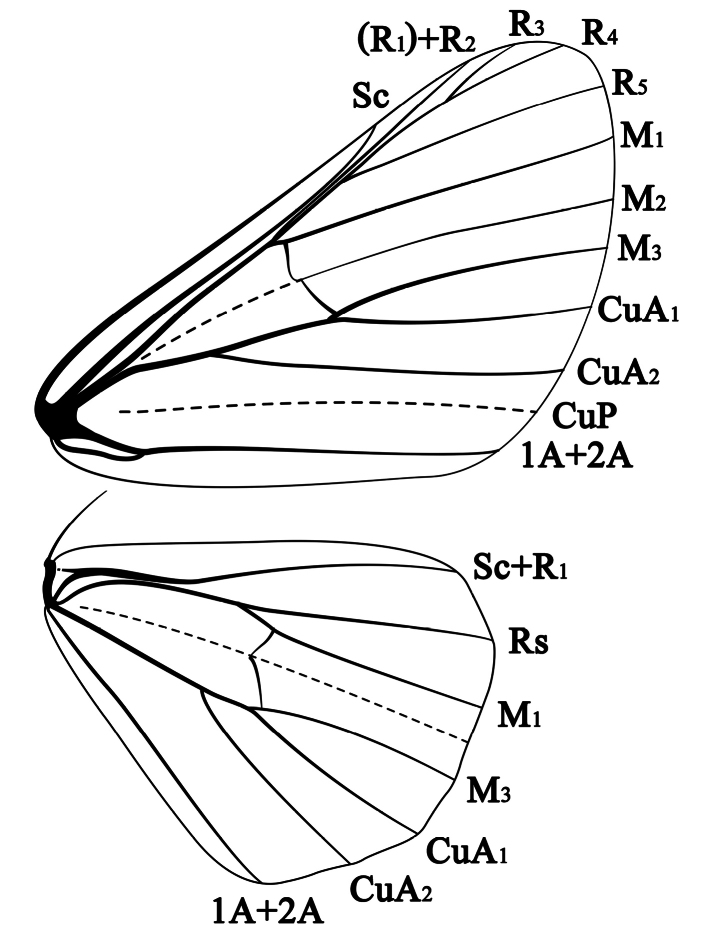 Figure 1
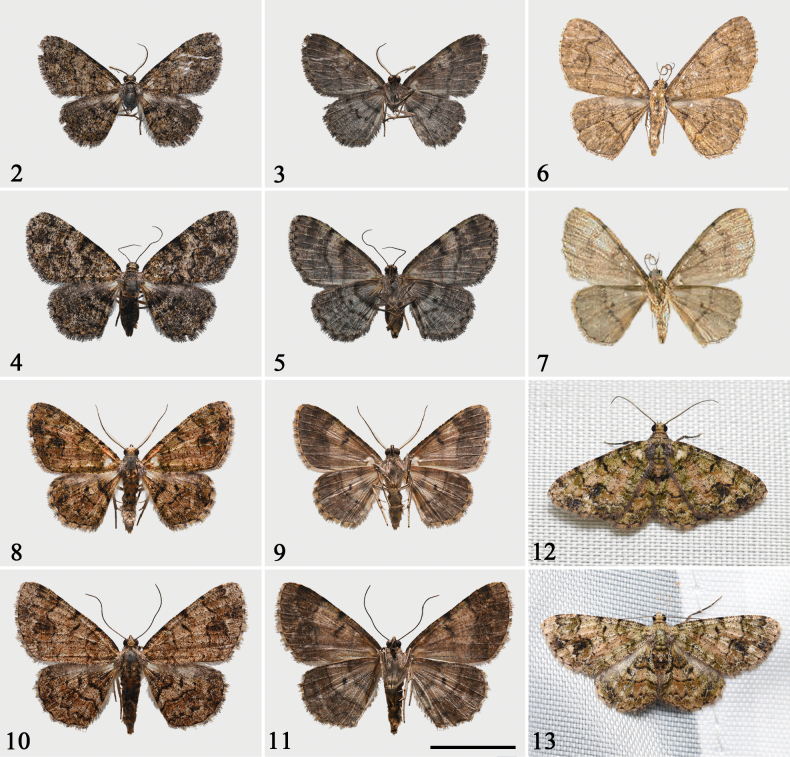 Figures 2–13
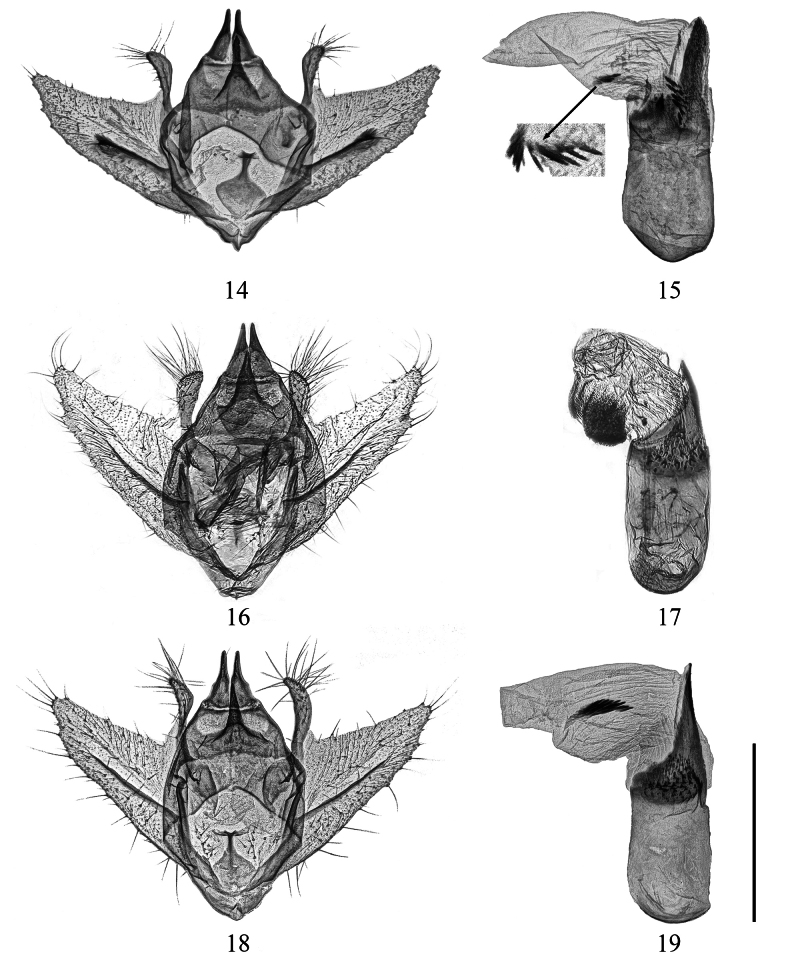 Figures 14–19
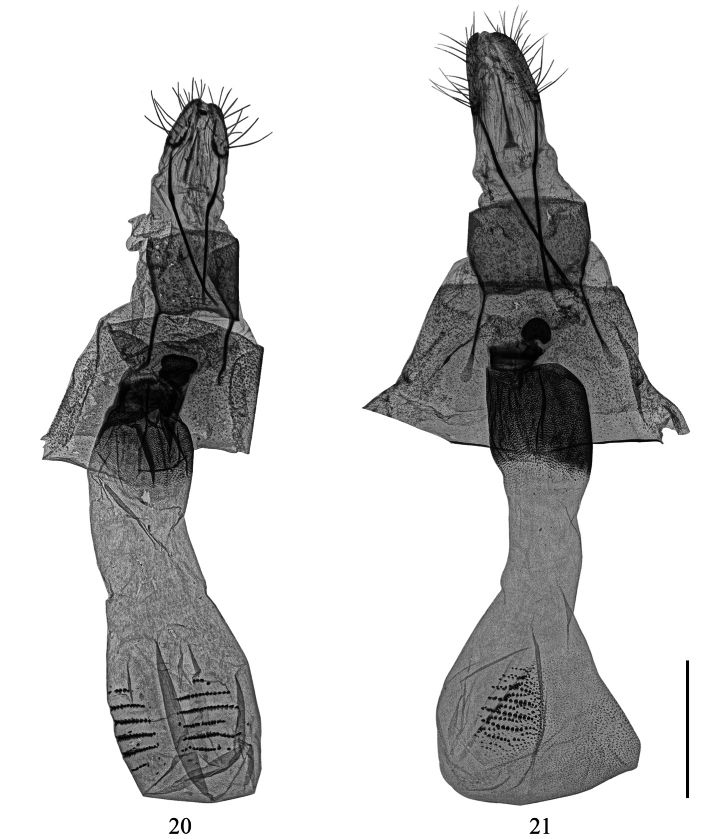 Figures 20, 21
| Diagnostic characters | ||
|---|---|---|
| Intersegmental abdominal coremata between ST 6 and ST 7 | absent | present |
| Uncus | moderately long, apex slightly curved ventrad | rather long, apex strongly bent ventrad |
| Saccular process | without spines or spined at apex only | spined over half its length |
| Aedeagus | rather stout, apical sclerotization long, tapering; cornuti spine-like | thin, apical sclerotization absent or indistinct, cornuti absent |
| Lamella postvaginalis | rather small, rounded | large, with a large, round incision medio-anteriorly |
| Introitus | small, sclerotized | large, membranous |
| Corpus bursa | long, cylindrical, proximally slightly inflated | short, oval or squarish |
| 1 | Uncus stout, deeply bifid until half its length, moderately long, apically slightly curved ventrad; saccular process without spines or spined at apex only; aedeagus large, rather stout, apical sclerotization long, tapering; cornuti spine-like; corpus bursae long, cylindrical, proximally slightly inflated; lamella postvaginalis rather small, rounded |
|
| – | Uncus rather long and slender, deeply bifid until ¾ of its length, apically strongly bent ventrad; saccular process spined over half its length; aedeagus small, finer, apical sclerotization indistinct; cornuti absent; corpus bursae short, inflated, triangular or squarish; lamella postvaginalis large, rectangular, with a large, round incision medio-anteriorly |
|
| 2 | Saccular process spined at the tip |
|
| – | Saccular process less developed, without spines |
|
| 3 | Costal arm of valva slender; cornuti a group of long, juxtaposed spines |
|
| – | Costal arm of valva stouter; cornuti smaller, arranged in two groups |
|
| 4 | Signum a small group of dentate processes, partly arranged in short lines |
|
| – | Signum consisting of two groups of spines or oblique grooves |
|
| 5 | Signum consisting of two groups of many minute spines, covering large areas of bursa |
|
| – | Signum consisting of two oblique grooves covered with spines internally |
|
Peer Reviews
No public reviews on file for this paper yet. If you reviewed it on a platform where reviews are public (OpenReview, ICLR, NeurIPS, ICML), you can paste yours below so the community can read it here.
Videos
No videos yet. Explain this paper in a talk, walkthrough, or lecture? Add one.
Taxonomy
TopicsLepidoptera: Biology and Taxonomy · Biological Control of Invasive Species · Species Distribution and Climate Change
Introduction
The genus-group name Calichodes was first published by Warren (1897: 246) with the description of Calichodesfoveata from Penang (Peninsular Malaysia). However, Warren did not mention it as a new genus, as the author usually did. Therefore, Wehrli (1943: 544) considered the name to be merely a manuscript name (“Warren M. S.”) and proposed it for a new subgenus of Boarmia, with a different type species, B. (Calichodes) difoveata Wehrli. Subsequently, Fletcher (1979: 32) only referenced Calichodes Wehrli, 1943, and raised it to the rank of a genus. Holloway ([1994]: 251) redefined Calichodes Warren as a monotypic genus, distinct from Calichodes Wehrli, and emphasized, based on a personal communication with I. W. B. Nye, that “the earlier usage is valid under the International Code of Zoological Nomenclature and therefore has priority”. Parsons et al. (1999: 100) followed this treatment and mentioned only Calichodes Warren, 1897, but included the type species difoveata of Calichodes Wehrli, without addressing the later invalid usage of Wehrli.
Consequently, the generic name Calcyopa was proposed by Stüning (2000: 134) as a replacement name for Calichodes Wehrli, 1943, with Boarmia (Calichodes) difoveata Wehrli, 1943 designated as the type species. Additionally, Calcyopaprasina Stüning, 2000 was described from Thailand, with its distribution extending from Vietnam, Peninsular Malaysia, and Myanmar to northern India and Nepal. Furthermore, the latter author included two other species, Ectropisrosearia Joannis, 1929 from “Tonkin” (N. Vietnam), Yunnan (China), Thailand, and Sumatra (Indonesia), and an undescribed species from Vietnam in this genus. Two decades later, two new species – Calcyopafansipana Sato, 2022 from N. Vietnam and Calcyopasubprasina Sato, 2022 from Laos – were added to the genus. Rajaei et al. (2022) mistakenly considered Calcyopa Stüning as a replacement name for Calichodes Warren and included all the species mentioned under Calichodes Warren in the catalogue of Parsons et al. (1999) under Calcyopa Stüning, 2000.
Currently, five species of the genus Calcyopa are known, and this paper describes a new species from Hainan Island, China.
Material and methods
Specimen collection
The study is based on moth specimens housed in the following collections: Coconut Research Institute, Chinese Academy of Tropical Agricultural Sciences, Wenchang, China (CRICATAS); Institute of Zoology, Chinese Academy of Sciences, Beijing, China (IZCAS); Natural History Museum, London, United Kingdom (NHMUK); Institute for Agro-Environmental Sciences, NARO, Tsukuba, Japan (NIAES); Zoologisches Forschungsmuseum Alexander Koenig, Bonn, Germany (ZFMK); Zoologische Staatssammlung München, Germany (ZSM).
Morphology
Terminology of the wing venation follows the Comstock-Needham System (Comstock, 1918) as adopted for Geometridae by Scoble (1992) and Hausmann (2001), while genitalia terminology is based on Klots (1970) and Skou and Sihvonen (2015). For genitalia examination, abdomens were removed and placed in a hot 10% KOH solution. Genitalia were then dissected in 10% ethanol and stained with Chlorazol Black E. Photographs of adult moths were taken using a Nikon camera (D750) equipped with a Nikon lens (AF-S Micro 60 mm f/2.8G ED). Photos of genitalia were taken with a digital camera (KUY NICE E31SPM) attached to a Nikon microscope (SMZ745T). Focus-stacked images were generated using Helicon Focus software (version 8.2.2 Pro).
DNA barcoding
Genomic DNA was extracted from the legs of dried adult specimens, and the barcode fragments were amplified using primers pairs: LCO-1490 and HCO-2198 or LepF1 and LepR1 (Folmer et al. 1994; Hebert et al. 2004). The obtained sequences (658 bp) were deposited in the Barcode of Life Data Systems (BOLD: Ratnasingham and Hebert 2007; http://www.boldsystems.org). All sequences mentioned in this study were obtained from the BOLD Systems. Genetic distances between species are reported as uncorrected pairwise distances (p-distance).
Taxonomic account
Calcyopa
Taxon classificationAnimaliaLepidopteraGeometridae
Stüning, 2000
4DDD0DBB-2F75-57CE-90A6-6A78C707FC9A
Calcyopa Stüning, 2000, Moths of Nepal, Part 6. Tinea Vol. 16 (Suppl. 1):134. Type species: Boarmia (Calichodes) difoveata Wehrli, 1943.
Generic characters.
Small ennomine geometrid moths with forewing length 11–14 mm. Ground color light to dark grey or brown, with distinct black antemedial and postmedial lines on both wings. Head. Male antennae fasciculate, with two pairs of shortly conical, sclerotized, ciliate projections latero-ventrally on each segment. Cilia curved ventrad, 3–4 times longer (depending on species) than diameter of flagellomeres. Female antennae with cilia much shorter, the sclerotized projections absent. Vertex covered with lamellar scales. Frons smooth-scaled, not protruding. Labial palpi slightly extending beyond frons, basally with long scales. Proboscis rather short. Chaetosemata present, near eye margin. Thorax. Patagia and tegulae densely covered with somewhat longer lamellar scales, distal end of tegulae with a few long hair-scales. Legs slender, index of spurs 0-2-4, hind tibia not dilated, without scent brush (= hair-pencil of authors) in males. Forewings moderately elongate, apex angled, termen smoothly curved, with a double fovea in males. Antemedial and postmedial lines conspicuous on both wings. Postmedial line on forewing curved outward between M_1_ and M_3_, with the extent of curvature varying among species; outside postmedial line between veins M_3_ and CuA_1_ or even CuA_2_ with a dark, round, oval or squarish patch (absent in C.rosearia only) and a faint, square pale patch outside the strongly dentate submarginal line (absent in C.rosearia). Marginal line consisting of small, black dots in the middle between veins, alternating with groups of dark fringe-scales. Hindwing with apex rounded, termen minutely concave between vein-ends, marginal dots rather lunulate. Tornus without distinct spot (elongate black spot present near tornus in C.prasina and C.subprasina) Postmedial line straighter than on forewing. Discal dot distinct, visible on both wings, but larger on forewing. Underside with pattern paler. Venation (Fig. 1). R_1_ and R_2_ coincident (distal branch of R_1_ reduced, only R_2_ reaching costa closer to apex), the base of the combined veins running closely parallel to vein Sc and the stem of R_3-5_. (R_1_) +R_2_ and the stalk of R_3-5_ both arising from the same position, shortly before anterior angle of cell. M_2_ from the middle of the discoidal vein. CuA_1_ from shortly before posterior angle of cell. Hindwing: Sc+R_1_ running closely parallel to upper vein of cell for a short distance; Rs arising widely before anterior angle of cell; M_2_ absent, represented by a fold; CuA_1_ from shortly before posterior angle of cell; 3A absent. Folds through cells of both wings and those replacing CuP in forewings and M_2_ in hindwings very vague. Pregenital abdomen. Tympanal organs of moderate size, without lacinia. Sterno-tympanal process and setal comb on third sternite absent. Lateral coremata on the posterior portion of the third segment only present in C.difoveata and C.hainana (very small and easily brushed off during abdominal preparation). Seventh segment strongly modified, short, sternite membranous, with a pair of external corematous lobes, both laterally with a dense row of fine setae; anterior invaginated coremata, with intersegmental opening between segments 6 and 7 absent (not “weak, scarcely invaginated” as described in Stüning (2000) for C.difoveata) in all difoveata-group species (present in rosearia-group species).
Wing venation of Calcyopadifoveata.
**Male genitalia. ** Uncus deeply divided, stout, triangular, apically straight, slightly curved ventrad in species of the difoveata-group (elongate, more deeply divided, distally slender, apical part strongly bent ventrad in rosearia-group species). Gnathos with broad, flattened lateral arms, central part strong, thorn-shaped, elongate, slightly curved, pointed in difoveata-group species (central part delicate, spine-shaped in rosearia-group species). Juxta small, basally a rounded plate, extended into a narrow arm distally, slightly cup-shaped and laterally bifurcate at apex. Valvae acutely triangular. Basal costal arm free, standing obliquely upright towards the upper valva margin, apically dilated, with long bristles. Saccular process stick-like, spined at apex only (C.difoveata) or without spines (C.hainana and C.fansipana) (spined over half or more of its length in rosearia-group species). Aedeagus short and stout, apically with a long, acutely triangular, sclerotized process, shaft distally with short spines or groups of strong teeth, vesica with a small row of cornuti or a round diverticulum covered with numerous spicules in difoveata-group species (aedeagus smaller, narrower, without distal extension and without teeth on shaft and vesica without cornuti in rosearia-group species).
**Female genitalia. ** Ovipositor short, papillae anales rounded, scarcely setose. Needle-like sclerotization between their bases present. Anterior apophyses short, about ½ length of posterior apophyses. Lamella postvaginalis a rounded, rather small plate in difoveata-group species (a large, sclerotized plate with a wide rounded incision anteriorly in rosearia-group species). Introitus small, sclerotized; posterior part of bursa sclerotized, scobinate inside; anterior part of bursa swollen, broader than posterior part, signum consisting of 6 to 8 chains of small dentate projections in difoveata-group species (bursa short, rounded, signum built of dentate projections arranged to small chains or distributed over larger areas of the bursa surface in rosearia-group species).
Diagnosis.
The genus Calcyopa currently comprises a total of six species, including the newly described species presented in this study. These species can be distinctly divided into two groups, mainly based on the genitalia (both male and female) characters and the abdominal coremata. Despite their differences, all Calcyopa species share a deeply divided uncus, similarly triangular-shaped valvae, a free basal costal arm that is strongly setose at the apex, and a unique stick-like saccular process with or without spines in the male genitalia. These characters collectively set them apart from other related genera such as Paracalcyopa Sato, Myrioblephara Warren, and Chrysoblephara Holloway. The closely related genus Necyopa Walker exhibits most of these traits; however, its saccular process is replaced by a strong, longitudinal fold that extends close to the apex of the valva. In the present study, we separate all the known Calcyopa species into two groups: the C.difoveata species group, which includes C.difoveata, C.fansipana and C.hainana; and the C.rosearia species group, which comprises C.rosearia, C.prasina and C.subprasina. The main diagnostic characters of these two species groups are outlined in Table 1. While the two species groups share several common characters, they are also distinguished by a set of stable features. For the time being, we tentatively retain all of these species within the genus Calcyopa. However, depending on further molecular evidence, there might be a possibility of establishing a new genus for the C.rosearia species group or merging it with the genus Necyopa Walker.
Calcyopa
difoveata
Taxon classificationAnimaliaLepidopteraGeometridae
(Wehrli, 1943)
B921389F-F17E-519E-BD33-D48299A16A9C
Boarmia (Calichodes) difoveata Wehrli, 1943, in: Seitz, Gross-Schmett. Erde 4 (Suppl.): 544. Type-locality: “West-Tien-Mu-Shan, Chekiang” (West Tianmushan, Zhejiang Province, China) Calichodes difoveata Wehrli: Fletcher, 1979, In: Nye IWB (ed.), The Generic Names of Moths of the World 3: 32; Parsons et al. 1999, in: Scoble, Geometrid Moths of the World, A Catalogue, 1: 100. Aethalura lushanalis Sato, 1987, Japan Heterocerists’ J. 144: 289, 290, figs 3, 4, 8. Synonymized with C.difoveata by Stüning (2000). Calcyopa difoveata : Stüning, 2000, Tinea 16 (Suppl. 1): 135, fig. 1507; Sato 2020, in: Kishida Y, Moths of Laos, Part 1, Tinea 25 (Suppl. 2): 81, pl. 28, fig. 30; Sato 2022, Tinea 26 (3): 228, 230, figs 9, 10, 24, 36.
Type material examined.
Lectotype: China – Zhejiang Province • ♂; Pz. Chekiang, West-tien-mu-shan (= Zhejiang, West Tianmushan); 1600 m; 26 Apr. 1932; H. Höne leg.; gen. prep. slide no. 2451-DS; ZFMK (des. Stüning, 2000).
Adults of Calcyopa species. 2–5C.difoveata, Hainan, China, CRICATAS2 male, upperside 3 ditto, underside 4 female, upperside 5 ditto, underside 6C.fansipana, holotype, male, upperside, N. Vietnam, NIAES7 ditto, underside 8–11C.hainana sp. nov., Hainan, China, CRICATAS/ IZCAS8 holotype, male, upperside 9 ditto, underside 10 paratype, female, upperside 11 ditto, underside 12, 13 specimens of C.hainana sp. nov. in resting position, type series, Hainan, China 12 male 13 female. Scale bar: 1 cm.
Paralectotypes: China – Zhejiang Province • 2 ♂♂, 1 ♀; same locality and collector as lectotype; 30 Apr. 1932; ZFMK. – Guangdong Province • 1 ♀; Lienping (Heyuan City, Lianping County); May; H. Höne leg.; coll. Wehrli, ZFMK. Remark: Wehrli (1943: 544) mentioned seven syntypes that were collected between 23 April and 13 June. Two female paralectotypes not included in the preceding material examined are not in coll. ZFMK, but should be the two specimens given to coll. NHMUK in exchange (1961).
Additional material examined.
China – Zhejiang Province • 4 ♂♂, 2 ♀♀; same locality and collector as lectotype; 3 Apr., 4 Apr., 10 Apr., 17 Apr. (2), 18 Apr. 1932; ZFMK • 5 ♂♂, 2 ♀♀; same locality and collector as lectotype; 400 m; mid-April 1936; gen. glycerol no. 6/B1♂; ZFMK • 1 ♀; Chekiang, Wenchow (= Zhejiang, Wenzhou); 18 Apr. 1939; H. Höne leg.; ZFMK • 3 ♂♂, 1 ♀; same locality and collector as for preceding; June 1939; ZFMK • 1 ♂, 2 ♀♀; same locality and collector as for preceding; July 1939; gen. glycerol no. 6/B3♀; ZFMK. – Fujian Province • 1 ♂; Fukien, Kuatun (= Fujian, Guadun); 27.40°N, 117.40°E; 2300 m; 3 Apr. 1938; J. Klapperich leg.; ZFMK. – Guangdong Province • 2 ♂♂, 3 ♀♀; Canton or Lienping; ZFMK. – Taiwan Province • 2 ♂♂ (paratypes of Aethaluralushanalis Sato, 1987); Nantou Hsien, Lushan-wenchuan; 13–14 Aug. 1983; R. Sato leg.; ZFMK • 2 ♀♀; Kaohsiung, Liukuei Sanping; 650 m; 24–26 Jul. 1987; R. Sato leg.; ZFMK • 1 ♂; Nantou Co., Hueisun Forest; 600 m; 22 Jun. 1993; F. Aulombard & J. Plante leg.; ZFMK • 1 ♂, 1 ♀; same locality and collectors as for preceding; 570–800 m; 28/29 Sep. 1992; ZFMK. – Hainan Province • 1 ♂, 1 ♀; Wuzhishan; 1333 m; 10 Jan. 2008; V. Siniaev leg.; ZSM • 5 ♂♂, 3 ♀♀; Wuzhishan; 756 m; 25 Mar. 2023; Bo Liu leg.; CATASCRI.
Diagnosis.
The diagnostic characters are given under the newly described species.
Distribution.
China (Zhejiang, Fujian, Jiangxi, Guangdong, Hainan, Taiwan), Vietnam, Laos.
Genetic data.
The Barcode Index Number for Calcyopadifoveata is BOLD: AAH0723 (N = 3, Sample IDs: CRICATAS00104, BC ZSM Lep 16015, BC ZSM Lep 15995).
Remarks.
This species is now recorded for the first time from Hainan Island, China. Some specimens from Hainan show minor differences in genitalia compared to those from Taiwan and Vietnam, including variation in the thickness of the gnathos in male genitalia as well as the shape of the lamella postvaginalis in female genitalia. At present, we treat these as infrasubspecific variations.
Calcyopa
fansipana
Taxon classificationAnimaliaLepidopteraGeometridae
Sato, 2022
021361F1-B418-59D0-8BAD-1F753A2DB818
Calcyopa fansipana Sato, 2022, Tinea 26 (3): 226, figs 1, 2, 23. Type-locality: Mt Fan-si-pan, N. Vietnam.
Type material examined.
Holotype: Vietnam • ♂; N. Vietnam, Cha-pa (Sa Pa), Mt Fan-si-pan, N. Seite; 22°17'N, 103°44'E; 1600 m; 21–23 Apr. 1995; leg. Sinjaev & Sammler, ex coll. A. Schintlmeister; Prim Urwald; NIAES.
Male genitalia of Calcyopa species. 14, 15C.difoveata, Hainan, China 14 genitalia capsule 15 aedeagus, close-up of cornuti at the bottom left 16, 17C.fansipana, holotype, N. Vietnam, gen. prep. no. RS8731 16 genitalia capsule 17 aedeagus 18, 19C.hainana sp. nov., paratype, Hainan, China, gen. prep. no. CRICATAS00101 18 genitalia capsule 19 aedeagus. Scale bar: 1 mm.
Paratype: Vietnam • 1 ♂; same data as holotype; NIAES.
Additional material examined.
Vietnam • 5 ♂♂; same locality and elevation as holotype; 01–05 Mar. 1995; ex coll./ leg. Dr. R. Brechlin; ZFMK • 1 ♂; same locality and collector as for preceding; 1520 m; ZFMK.
Diagnosis.
Diagnostic characters are given under the newly described species. The male adult and genitalia are illustrated in Sato (2022), but we depict them here again for comparison with the other two species of difoveata-group. The female is still unknown at present.
Distribution.
Vietnam.
Genetic data.
No data available.
Remarks.
Stüning (2000: 135) already mentioned this species as “an undescribed species also from Vietnam”, which was later described as fansipana by Sato (2022: 226). He wrote in the description: “Third abdominal sternite with setal comb” and “Hind tibia with hair-pencil”. These two characters were mentioned by an unexplainable error (Sato 2023, pers. comm.). Both setal comb and hair-pencil are absent in all species of the genus Calcyopa, which, of course, was known to Sato.
Calcyopa
hainana
sp. nov.
Taxon classificationAnimaliaLepidopteraGeometridae
46EF748F-026C-59FF-B0CA-F8D4ECF2CB83
https://zoobank.org/8AC4C54D-B7E3-4F34-B811-E5AB81F959CF
Type material.
Holotype: China – Hainan Province • ♂; Lingshui, Diaoluoshan; 922 m; 16–19 Apr. 2024; Bo Liu & Wei Yan leg.; CRICATAS/ IZCAS.
Paratypes: (12 ♂♂, 21 ♀♀) China – Hainan Province • 1 ♂; Wuzhishan; 1333 m; V. Siniaev leg.; 10 Jan. 2008; ZSM • 2 ♂♂, 2 ♀♀; same locality as holotype; 20 Apr. 2023; Bo Liu leg.; gen. prep. nos. CRICATAS00101, CRICATAS00103; CRICATAS/ IZCAS • 4 ♀♀; same locality and collectors as holotype; 05–07 Mar. 2024; CRICATAS/ IZCAS • 1 ♂, 1 ♀; same locality as holotype; 01–03 Apr. 2024; Bo Liu, Wei Lin & Miaofeng Xu leg.; CRICATAS/ IZCAS • 4 ♂♂, 5 ♀♀; same data as holotype; CRICATAS/ IZCAS • 4 ♂♂, 9 ♀♀; same locality and collectors as holotype; 07–12 May 2024; CRICATAS/ IZCAS/ ZFMK.
Female genitalia of Calcyopa species. 20C.difoveata, Hainan, China 21C.hainana sp. nov., paratype, Hainan, China, gen. prep. no. CRICATAS00103. Scale bar: 1 mm.
Diagnosis.
This species closely resembles C.difoveata and, though much less, also C.fansipana, but can be distinguished by several morphological characters: The postmedial line of the forewing between veins M_1_ and M_3_ exhibits a more pronounced outward curve than in C.difoveata, similar to that in C.fansipana. Moreover, the light-brown ground color of the upperside and the absence of broad, dark marginal bands on the underside of the latter are also diagnostic. The free costal arm of the valva is longer and narrower in C.hainana than in the other two congeners and the saccular process lacks spines. The triangular apex of the aedeagus is more pointed and elongated compared to C.difoveata and C.fansipana. Additionally, the cornuti in C.hainana are composed of a group of long juxtaposed spines, while in C.difoveata they consist of shorter spines, and in C.fansipana they form a dense cluster of minute spines covering a round diverticulum of the vesica. A row of rather large spines and a big single tooth present apically on the shaft of aedeagus of C.difoveata are replaced by a large number of smaller denticles in C.hainana.
Description.
Forewing length 11.1–11.9 mm in males, 11.7–14.3 mm in females. Ground color brownish-green in fresh specimens, but gradually fading to brown over time, with numerous scattered dark scales and distinct dark antemedial and postmedial lines on both wings. Head. Male antennae fasciculate, with two pairs of shortly conical, sclerotized, ciliate projections latero-ventrally on each segment. Female antennae with cilia much shorter, and sclerotized projections absent. The longest cilia are about 3 times the diameter of the flagellum segments in males and about 0.5 times the diameter of the flagellum segments in females. Vertex covered with lamellar, pale brown scales. Frons smooth-scaled, not protruding. Labial palpi slightly extending beyond frons, basally with long, dark scales, third segment small. Proboscis rather short. Chaetosemata present, near eye margin. Thorax. Patagia and tegulae densely covered with somewhat longer lamellar scales, distal end of tegulae with a few long hair-scales. Wings brownish, scattered with numerous dark scales. Forewings moderately elongate, apex angled, termen smoothly curved, with a double fovea in males. Antemedial line fine, visible. Discal spot small, streak-like. Postmedial line outcurved between veins M_1_ and M_3_, at CuA_2_, and at 1A+2A. Outside postmedial line between M_2_ and CuA_1_ with a round black patch anteriorly and a square pale patch posteriorly. Subterminal line zigzag, white, with a dark inner edge. Terminal line black, with a series of dark spots between the veins. Hindwings with apex rounded, termen minutely concave between vein-ends. Basal area densely covered with numerous black scales. Antemedial line broad, outcurved at lower cell vein and inner margin. Discal spot small, streak-like. Postmedial line outcurved between veins M_1_ and M_3_, and at inner margin. Subterminal zigzag, white, with a dark edge inside. Terminal line black, with dark spots between the veins. Underside blurry and paler, with a broad, dark band outside postmedial line on both wings. Antemedial line faint on forewing, but clearly visible on hindwing. Postmedial line barely outcurved on both wings. Legs slender, index of spurs 0-2-4, hind tibia not dilated, without scent brush in males. Pregenital abdomen. Tympanal organs, sterno-tympanal process, setal comb, and abdominal coremata as mentioned in the generic description. Abdomen laterally with several pairs of scale brushes on segments 2, 3, 4, 5, 6 and 7.
Male genitalia. Uncus deeply divided, triangular, apical part straight, slightly curved ventrad. Gnathos with broad, flattened lateral arms, central part strong, thorn-shaped, elongate, slightly curved. Valvae acutely triangular. Basal costal arm free, standing obliquely upright towards the upper valva margin, apically dilated, with long bristles. Saccular process stick-like, without spines. Juxta small, basally a rounded plate, extended into a narrow arm distally, slightly cup-shaped and laterally bifurcate at apex. Aedeagus short and stout, apically with a long, acutely triangular, sclerotized process; shaft distally with a group of small serrate projections; vesica with a small row of long-spined cornuti. Bulbus ejaculatorius long, about four times as long as the aedeagus shaft.
Female genitalia. Ovipositor short, papillae anales scarcely setose. Anterior apophyses short, about ½ length of posterior apophyses. Ventral longitudinal sclerotization needle-like, basally dilated, slightly triangular. Lamella postvaginalis small, round or oval, bottom concave at center. Introitus bursae small, sclerotized, significantly narrower than the posterior part of bursa, setting into a small sternite pocket. Posterior part of bursa slightly longer than anterior part, posterior one-third sclerotized, scobinate inside. Anterior part of bursa swollen, triangular, noticeably broader than posterior part, consisting of 7 to 8 chains of small serrate projections on both opposed inner sides.
Etymology.
The specific name of “hainana” is derived from the type locality, Hainan Island, China.
Distribution.
China (Hainan).
Genetic data.
The Barcode Index Number for Calcyopahainana is BOLD: AAH2362 (N = 2, Sample IDs: CRICATAS00101, BC ZSM Lep 16053). The genetic distance of C.hainana from C.difoveata (N = 3, Sample IDs: CRICATAS00104, BC ZSM Lep 16015, BC ZSM Lep 15995) ranges from 5.32% to 5.62% (p-distance).
Key to all known Calcyopa species, based on male and female genitalia
**: **
Supplementary Material
XML Treatment for Calcyopa
XML Treatment for Calcyopa difoveata
XML Treatment for Calcyopa fansipana
XML Treatment for Calcyopa hainana
The reference list from the paper itself. Each links out to its DOI / PubMed record.
- 1Comstock JH (1918) The Wings of Insects.Comstock Publishing Company, Ithaca, 430 pp.
- 2Fletcher DS (1979) Geometroidea. In: Nye IWB (Ed.) The Generic Names of Moths of the World (Vol. 3).British Museum (Natural history), London, 243 pp. 10.5962/bhl.title.119424 · doi ↗
- 3Folmer O Black M Hoeh W Lutz R Vrijenhoek R (1994) DNA primers for amplification of mitochondrial cytochrome c oxidase subunit I from diverse metazoan invertebrates.Molecular Marine Biology and Biotechnology 3(5): 294–299.7881515 · pubmed ↗
- 4Hausmann A (2001) Introduction. Archiearinae, Orthostixinae, Desmobathrinae, Alsophilinae, Geometrinae. In: Hausmann A (Ed.) The Geometrid Moths of Europe (Vol. 1).Apollo Books, Stenstrup, 282 pp.
- 5Hebert PDN Penton EH Burns JM Janzen DH Hallwachs W (2004) Ten species in one: DNA barcoding reveals cryptic species in the neotropical skipper butterfly Astraptes fulgurator.Proceedings of the National Academy of Sciences of the United States of America 101: 14812–14817. 10.1073/pnas.040616610115465915 PMC 522015 · doi ↗ · pubmed ↗
- 6Holloway JD (1994) The Moths of Borneo, Part 11: Family Geometridae, subfamily Ennominae.Malayan Nature Journal 47: 1–309. [pls 1–19, 593 figs]
- 7Joannisde J (1929) Lépidoptères Héterocères du Tonkin. Annales de la Societe Entomologique de France 98: 361–552, 559–560. 10.1080/21686351.1929.12280113 · doi ↗
- 8Klots AB (1970) Lepidoptera. In: Tuxen SL (Ed.) Taxonomists’ glossary of genitalia in insects.Munksgaard, Copenhagen, 115–130.