Popular Treatments of Psoriasis on Social Media: Google Trends Analysis
Derek Nguyen, Jennifer Javaheri, Ruth Sanchez, Vy Han

TL;DR
This study examines which psoriasis treatments are most frequently discussed on social media platforms like Facebook and Reddit, using Google Trends to track their popularity over time.
Contribution
The study introduces a novel approach to analyzing psoriasis treatment trends by leveraging social media and Google Trends data.
Findings
Certain psoriasis treatments show increasing popularity over time on social media platforms.
Google Trends effectively captures treatment discussions from Facebook and Reddit forums.
The most mentioned treatments align with current clinical guidelines but include some unconventional options.
Abstract
This study analyzes the most commonly mentioned psoriasis treatments on Facebook and Reddit forums, tracking their popularity over time by using Google Trends.
Genes, proteins, chemicals, diseases, species, mutations and cell lines named across the full text — each resolved to its canonical identifier and authoritative record.
Click any figure to enlarge with its caption.
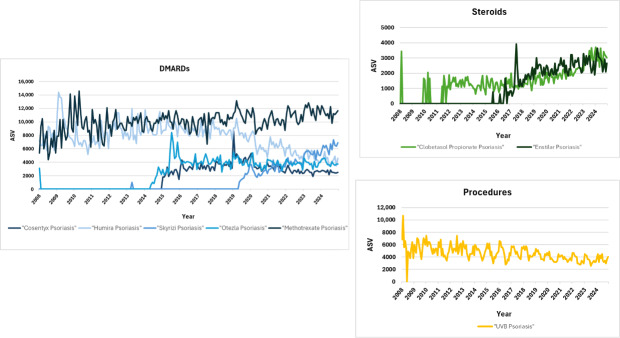 Figure 1
| Treatment | Mentions (N=2260), n (%) |
|---|---|
| Risankizumab | 181 (8) |
| UV-B phototherapy | 129 (5.7) |
| Apremilast | 103 (4.6) |
| Methotrexate | 102 (4.5) |
| Adalimumab | 97 (4.3) |
| Guselkumab | 81 (3.6) |
| Secukinumab | 72 (3.2) |
| Clobetasol propionate | 70 (3.1) |
| Cal/BD | 68 (3) |
| Ixekizumab | 50 (2.2) |
| Remaining 195 treatments | 1307 (57.8) |
Peer Reviews
No public reviews on file for this paper yet. If you reviewed it on a platform where reviews are public (OpenReview, ICLR, NeurIPS, ICML), you can paste yours below so the community can read it here.
Videos
No videos yet. Explain this paper in a talk, walkthrough, or lecture? Add one.
Taxonomy
TopicsMedical Research and Practices · Health Literacy and Information Accessibility · Mental Health and Psychiatry
Introduction
Approximately 8 million individuals in the United States and 125 million individuals worldwide experience psoriasis—a chronic inflammatory skin disease most commonly characterized by scaly erythematous plaques on the extensor surfaces, face, trunk, and scalp. With increased internet accessibility, many patients now turn to web-based platforms to connect with others and seek advice on managing their condition. Over 30% of internet users report using social media to find health-related information, with forums and web-based communities being among the most popular sources [1]. Notably, two widely used resources in the psoriasis community are the “Psoriasis” group on Facebook and “r/Psoriasis” on Reddit, which collectively have over 110,000 users worldwide. We aimed to analyze the most frequently mentioned treatments on these forums while also exploring how interest has evolved over time. By comparing patient discussions with search trends, this research provides valuable insights into treatment preferences and shifts in public awareness.
Methods
Using the web application PullPush API—an indexing service that enables users to retrieve content beyond Reddit’s 1000-entry search limit—all posts on both web-based forums from May 23 to November 23, 2024, were compiled and reviewed to assess their relevance to psoriasis treatment, before tallying the number of mentions each unique treatment received. Non-English posts were excluded from data collection due to their small sample size and practical limitations. The 10 most mentioned treatments across both forums were inputted into Google Trends to assess their popularity over time. These treatments were further categorized into groups—disease-modifying antirheumatic drugs (DMARDs), steroids, and procedures. Google Trends allows users to track the popularity of queries by displaying search interest for queries as relative search volumes (RSVs). RSVs range from 1 to 100, where the number indicates how a topic’s search interest compares to its peak interest level. To convert this value to the total number of searches at any given time, the Google Chrome extension Glimpse was used to convert all RSVs to absolute search volumes.
Results
The gathered posts contained 2260 unique mentions of treatments, which were categorized into 205 unique treatments. Treatments fell under the following categories: biologics, procedures, dietary modifications, home remedies, and topicals. The 10 most mentioned treatments across both forums are shown in Table 1. Of these, 2 did not meet the minimum search queries necessary to generate graphical data through Google Trends. Among the remaining treatments, those with the highest number of searches in any month between 2008 and 2024 were methotrexate, with 13,860 searches in January 2010, and Humira, with 14,396 searches in February 2009 (Figure 1). These results could be explained by shortages in methotrexate and other oncology drugs between 2010 and 2011 and the US Food and Drug Administration’s approval of Humira for plaque psoriasis in 2008, respectively [2]. In recent years however, Humira has experienced declines in popularity due to the availability of cheaper biosimilars [3]. UV-B phototherapy has likewise experienced a similar trend due to the increase in biologics use [4]. Overall, the subcategories that displayed the highest interest based on the daily number of searches were biologic DMARDs (searches: n=768), steroids (searches: n=93), and procedures (searches: n=151).
ASV data from Google Trends for the 10 most discussed psoriasis treatments on Reddit and Facebook (2008‐2024). ASV: absolute search volume; DMARD: disease-modifying antirheumatic drug.
Discussion
Google Trends data reveal that patients prefer injectable medications, especially biologics, for treating psoriasis, with 5 of the top 10 treatments falling into this category. This trend aligns with previous research highlighting patients’ appreciation for the efficiency and convenience of biologics [5]. However, given past research indicating an increased risk of developing cutaneous disorders, inflammatory bowel disease, or interstitial lung disease, patients should be informed about alternative treatment options [6]. This study’s limitations include the exclusion of other social media platforms and potential selection bias, as social media use tends to be more prevalent among younger demographics [7].
Due to the significant disease burden associated with psoriasis, many patients seek additional treatment options, of which some lack strong evidence. Notably, 51% of patients report using complementary and alternative medicine (CAM), including herbal therapy, climatotherapy, and dietary changes, with many forum users recommending dairy-free or gluten-free diets. Common reasons for these choices include preferences for natural approaches, cultural factors, and a perception that conventional medicine is more toxic than CAM treatments [89]. Given their rising popularity, understanding the data surrounding the efficacy of these treatments and their interactions with conventional medicine will better equip dermatologists to serve patients. Interest in psoriasis treatments should center on expanding the evidence base for conventional and alternative treatments and fostering effective collaboration between patients and physicians to optimize outcomes.
The reference list from the paper itself. Each links out to its DOI / PubMed record.
- 1Tulbert BH Snyder CW Brodell RT Readability of patient-oriented online dermatology resources J Clin Aesthet Dermatol Mar 2011432733 Medline 21464884 PMC 3070466 · pubmed ↗
- 2Coghlan J He H Schwendeman AS Overview of Humira® biosimilars: current European landscape and future implications J Pharm Sci Apr 2021110415721582 doi 10.1016/j.xphs.2021.02.003Medline 33556387 PMC 8014989 · doi ↗ · pubmed ↗
- 3Becker DJ Talwar S Levy BP et al Impact of oncology drug shortages on patient therapy: unplanned treatment changes J Oncol Pract 07201394 e 122e 128doi 10.1200/JOP.2012.000799 Medline 23942928 PMC 3710178 · doi ↗ · pubmed ↗
- 4Torres AE Lyons AB Hamzavi IH Lim HW Role of phototherapy in the era of biologics J Am Acad Dermatol Feb 2021842479485 doi 10.1016/j.jaad.2020.04.095Medline 32339702 PMC 7194984 · doi ↗ · pubmed ↗
- 5Florek AG Wang CJ Armstrong AW Treatment preferences and treatment satisfaction among psoriasis patients: a systematic review Arch Dermatol Res 0520183104271319 doi 10.1007/s 00403-018-1808-x Medline 29442137 · doi ↗ · pubmed ↗
- 6Ion A Dorobanțu AM Popa LG Mihai MM Orzan OA Risks of biologic therapy and the importance of multidisciplinary approach for an accurate management of patients with moderate-severe psoriasis and concomitant diseases Biology (Basel)05252022116808 doi 10.3390/biology 11060808 Medline 35741329 PMC 9220356 · doi ↗ · pubmed ↗
- 7Shabir G Iqbal YW Safdar G Demographics’ differences in social networking sites use: what communication motives does it gratify?International Journal of Social Work and Human Services Practice 201425184194 doi 10.13189/ijrh.2014.020503 · doi ↗
- 8Gamret AC Price A Fertig RM Lev-Tov H Nichols AJ Complementary and alternative medicine therapies for psoriasis: a systematic review JAMA Dermatol Nov 120181541113301337 doi 10.1001/jamadermatol.2018.2972 Medline 30193251 · doi ↗ · pubmed ↗