Investigation on possible resistance of Candida auris to irradiation with UVC (254 nm)
Anna-Maria Gierke, Blende Demelezi, Martin Hessling

TL;DR
This study investigates whether Candida auris can develop resistance to UVC radiation after repeated exposure cycles.
Contribution
The study demonstrates that Candida auris may develop resistance to UVC radiation over multiple exposure cycles.
Findings
The log reduction of Candida auris decreased with each UVC irradiation cycle.
Resistance to UVC radiation was observed after 16 consecutive irradiation-recovery cycles.
A constant UVC dose of 18.2 mJ/cm² was used throughout the experiment.
Abstract
Candida auris is a yeast that is increasingly pathogenic due to increased multiresistance to antimycotics. UV (ultraviolet) radiation is still capable of reducing C. auris and offers possible applications in radiation disinfection of surfaces and air. However, it is unknown whether C. auris could also develop a resistance against UV radiation. For this reason, the extent to which C. auris can develop resistance to UVC radiation (254 nm) over several irradiation cycles is being examined. The yeast is irradiated with a UVC dose of 18.2 mJ/cm 2 per cycle, followed by a recovery phase under dark conditions. This irradiation-recovery process was repeated for 16 consecutive cycles, ensuring that the UVC dose of 18.2 mJ/cm 2 remained constant throughout all cycles. It was observed that the log reduction (a log 1 reduction corresponds to a 90% reduction) decreased with increasing number of…
Genes, proteins, chemicals, diseases, species, mutations and cell lines named across the full text — each resolved to its canonical identifier and authoritative record.
Click any figure to enlarge with its caption.
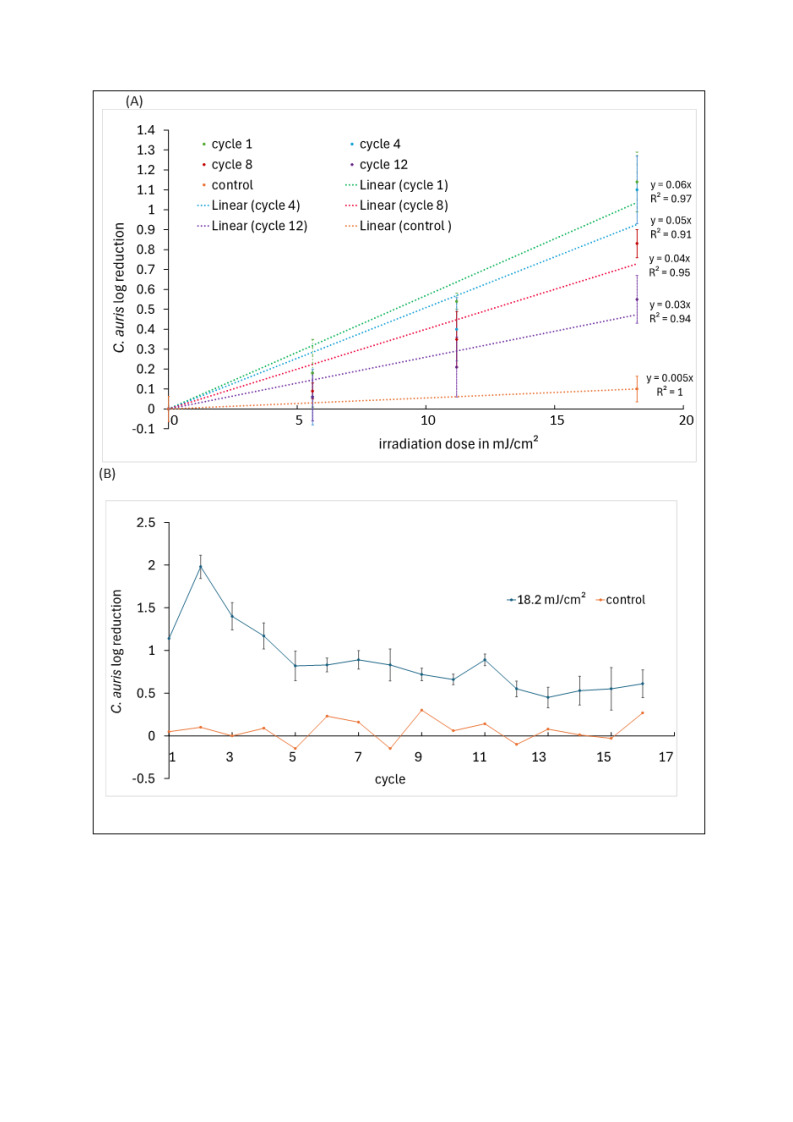 Figure 1
Peer Reviews
No public reviews on file for this paper yet. If you reviewed it on a platform where reviews are public (OpenReview, ICLR, NeurIPS, ICML), you can paste yours below so the community can read it here.
Videos
No videos yet. Explain this paper in a talk, walkthrough, or lecture? Add one.
Taxonomy
TopicsListeria monocytogenes in Food Safety · Radiation Effects and Dosimetry · Antifungal resistance and susceptibility
Description
Candida auris is an emerging yeast that is particularly lethal for immunocompromised patients [1, 2]. It is increasingly being detected in healthcare facilities and hospitals, with cases of antifungal drug-resistant Candida auris on the rise [3–5]. Furthermore, this yeast was listed in the “critical priority group” of the “WHO fungal priority pathogen list” in 2022.
One of the techniques to control C. auris is the application of UVC radiation [6, 7]. Irradiation with UVC (200-280 nm) causes DNA (deoxyribonucleic acid) damage [8]. This results in cyclobutane pyrimidine dimers (CPD) and 6-4 photoproducts in DNA, which can lead to mutagenic effects and even cell death [9, 10]. However, there are various repair mechanisms within the microorganisms that can repair these DNA damages [11, 12].
Escherichia coli has already been shown to develop a certain resistance to UV radiation over several irradiation cycles [13–16]. Further experiments have been carried out on a small number of bacteria, such as Staphylococcus aureus [17–19]. So far, there are no comparable studies on fungi.
Therefore, it is also important to investigate whether a resistance development is possible over time for this yeast. For this reason, this study investigates whether there is any kind of adaptation to an unchanged irradiation dose over 16 cycles of UVC irradiation and recovery.
The suspensions with C. auris were irradiated with a dose of 18.2 mJ/cm ^2^ at an UVC wavelength of 254 nm. Figure 1 demonstrates the results of 16 irradiation cycles. Figure 1A presents semi-logarithmically the C. auris reduction for different irradiation doses after several cycles of irradiation and recovery. A log 1 reduction dose of 16.7 mJ/cm ^2^ was determined after the 1st cycle, 17.9 mJ/cm ^2^ after the 4th cycle, 25 mJ/cm ^2^ after the 8th cycle and 50 mJ/cm ^2^ following the 12th cycle.
In Figure 1B, the observed log reduction or a fixed 254 nm irradiation dose of 18.2 mJ/cm ^2^ after the different cycles is given. After the first irradiation, a log reduction of 1.23 is observed, which increases further in the 2nd cycle to a log reduction of 1.98. In the subsequent cycles, the log reduction decreased to a log reduction of 0.45 following cycle 13. The results describe the sensitivity of C. auris to cyclic irradiation with UVC. It was observed that the log reduction increased in the first irradiation cycles and decreased thereafter. Thus, more fungi survived at the same irradiation dose as the number of cycles increased.
This decrease in log reduction may be attributed to the development of irradiation resistance. As already described by Alcánatara-Díaz et al. and Shibai et al., UV irradiation is a selection pressure exerted on microorganisms [14, 15]. The damage to DNA results in various mutations. UV radiation increases the rate of possible mutations. As a result of selection, only those that are adapted to the new environment can survive and reproduce [15, 12]. Various ideas are compiled as how possible resistance to UV radiation can arise. The concepts describe the activation of individual genes or combined with different genes over several generations, which should result in faster (DNA) repair. Fungi with the best repair mechanisms survive and can multiply [20, 21].
Resistance formation could presumably be observed for C. auris . Over the cycles, a lower sensitivity to UV radiation was observed for the yeast. This was also described in the irradiation curves. The slope of the fit curves decreased with increasing number of cycles.
Methods
C. auris (DSM 21092) was cultivated for liquid cultures in modified YEPG (Yeast Extract Peptone Glucose medium - 200 ml glucose (250 g/l), 20 g peptone from casein, 10 g yeast extract per 1,000 ml (pH 6.5) and for agar plates on potato dextrose agar (M129 - 20 g dextrose, 4 g potato extract, (15 g agar) per 1,000 ml; pH 5.6). Cultivation was carried out at 30 °C. For pre-culture, 5 ml liquid medium was cultivated for 24 hours. To carry out the experimental growth and irradiation cycles, 6 subcultures (5 irradiated cultures and 1 control culture) were prepared with a sample of the preculture (1:150). Each main culture consisted of 4 ml total volume. The cultures were placed in 6-well plates and were shaken with a frequency of 170 Hz. The OD 600nm (optical density at 600 nm) was controlled regularly until it reached a median OD 600nm value of 1.24, just before the stationary phase and the cultures could be removed for the subsequent irradiation.
For irradiation experiments, 2 ml of the cultures were removed and centrifuged at 7,000 rpm for 5 min. After discarding the supernatant, the left pellet was resuspended with phosphate buffered saline (PBS). The washing procedure was repeated. This was followed by a transmission measurement at 254 nm to dilute the washed culture to a transmission of 70-80 % for the 3 mm sample thickness, resulting in a concentration of 1x10 ^7^ colony forming units (CFU)/ml, ensuring uniform irradiation across all layers of the sample. This transmission was measured using a spectrophotometer (SPECORD 250 PLUS double beam spectrophotometer, Analytik Jena GmbH+Co. KG, Jena, Germany) with a 10 mm quartz cuvette.
For irradiation at 254 nm, a low-pressure mercury vapour lamp (TUV 87 15W/G15T8, Philips, Netherlands) was applied as radiation source. An irradiation dose of 18.2 mJ/cm ^2^ (0.7 mW/cm ^2^ ) was chosen after preliminary experiments. After each irradiation, 100 µl samples were taken and, after dilution, plated for subsequent determination of yeast concentration. The irradiation curves were presented semi-logarithmically for different cycles and linear fit curves were added. Using the resulting equation, the log 1 reduction dose for the respective cycles were calculated. In addition, 300 µl from the irradiated sample were taken and mixed with 2,700 µl fresh YEPG medium for the “recovery culturing” of C. auris at 30 °C. The ambient room temperature was maintained at 25 °C. The growth period after the initial four cycles ranged between 29 and 36 hours, after which an average recovery cycle duration of 25.5 hours was observed. This corresponds to the starting point of a new cycle. Both, agar plates and cultures of the new cycle remained covered with aluminum foil to avoid possible photoreactivation.
The reference list from the paper itself. Each links out to its DOI / PubMed record.
- 1Kean R Brown J Gulmez D Ware A Ramage G 2020226 Candida auris: A Decade of Understanding of an Enigmatic Pathogenic Yeast.J Fungi (Basel)6110.3390/jof 601003032110970 PMC 7150997 · doi ↗ · pubmed ↗
- 2Navalkele BD Revankar S Chandrasekar P 2017814 Candida auris: a worrisome, globally emerging pathogen.Expert Rev Anti Infect Ther 1591478-721081982710.1080/14787210.2017.136499228783385 · doi ↗ · pubmed ↗
- 3de Groot T Chowdhary A Meis JF Voss A 2019312 Killing of Candida auris by UV-C: Importance of exposure time and distance.Mycoses 6250933-740740841210.1111/myc.1290330748018 PMC 6850319 · doi ↗ · pubmed ↗
- 4Lockhart SR 2019620 Candida auris and multidrug resistance: Defining the new normal.Fungal Genet Biol 1311087-184510324310324310.1016/j.fgb.2019.10324331228646 PMC 12012538 · doi ↗ · pubmed ↗
- 5Chowdhary A Sharma C Meis JF 2017518 Candida auris: A rapidly emerging cause of hospital-acquired multidrug-resistant fungal infections globally.P Lo S Pathog 1351553-7366 e 1006290 e 100629010.1371/journal.ppat.100629028542486 PMC 5436850 · doi ↗ · pubmed ↗
- 6Gierke AM Vatter P Hessling M 2024822 Fungal photoinactivation doses for UV radiation and visible light-a data collection.AIMS Microbiol 10369472210.3934/microbiol.202403239219750 PMC 11362276 · doi ↗ · pubmed ↗
- 7Hessling M Haag R Sieber N Vatter P 2021216 The impact of far-UVC radiation (200-230 nm) on pathogens, cells, skin, and eyes - a collection and analysis of a hundred years of data.GMS Hyg Infect Control 162196-5226 Doc 07Doc 0710.3205/dgkh 00037833643774 PMC 7894148 · doi ↗ · pubmed ↗
- 8Hung KF Sidorova JM Nghiem P Kawasumi M 2020522 The 6-4 photoproduct is the trigger of UV-induced replication blockage and ATR activation.Proc Natl Acad Sci U S A 117230027-8424128061281610.1073/pnas.191719611732444488 PMC 7293618 · doi ↗ · pubmed ↗