Beauty Standards and Societal Influences on Facelift Surgery Decisions in Saudi Arabia
Sari M Rabah, Hussam F Alkhars, Abdullah Q AlAlwan, Talal A Albalawi, Hana A Alazzmi, Maha AlQahtani, Ali F Alkhars

TL;DR
This study explores why people in Saudi Arabia consider facelift surgery, highlighting the role of beauty standards, social media, and age-related motivations.
Contribution
The study provides new insights into facelift surgery motivations specific to Saudi cultural and societal contexts.
Findings
39% of participants would consider facelift surgery, mainly for self-confidence and societal beauty standards.
Social media and plastic surgeon consultations significantly influence perceptions of facelift surgery.
Older participants were more likely to consider facelifts to feel young again compared to younger participants.
Abstract
Introduction Facelifting, or rhytidectomy, is a surgical procedure to reduce facial wrinkles and create a youthful appearance. This study aims to explore the factors influencing the decision to undergo facelift surgery in Saudi Arabia, focusing on beauty standards and cultural expectations. Methods We conducted a cross-sectional study from January to December 2024, recruiting Saudi individuals 18 years or older. We developed and validated a questionnaire in both English and Arabic, which was distributed via social media platforms and healthcare networks. Data were analyzed using IBM SPSS Statistics for Windows, Version 27.0 (IBM Corp., Armonk, NY), with categorical variables summarized as frequencies and percentages. Associations between demographic variables and attitudes toward facelift surgery were assessed using the Chi-square test, with statistical significance set at p < 0.05.…
Genes, proteins, chemicals, diseases, species, mutations and cell lines named across the full text — each resolved to its canonical identifier and authoritative record.
Click any figure to enlarge with its caption.
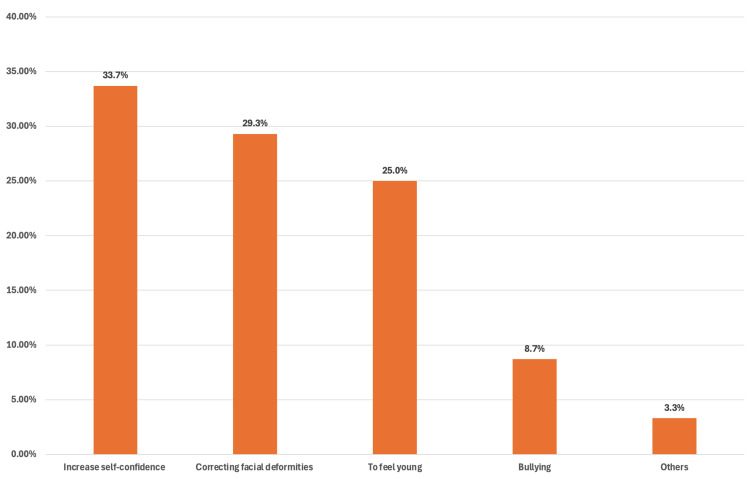 Figure 1
| Biodemographic data | N | Percent | |
| Residence region | Central region | 209 | 28.8 |
| Northern region | 93 | 12.8 | |
| Eastern region | 159 | 21.9 | |
| Western region | 162 | 22.3 | |
| Southern region | 103 | 14.2 | |
| Age in years | 18-25 | 106 | 14.6 |
| 26-35 | 167 | 23.0 | |
| 36-45 | 195 | 26.9 | |
| 46-55 | 173 | 23.8 | |
| > 55 | 85 | 11.7 | |
| Gender | Male | 379 | 52.2 |
| Female | 347 | 47.8 | |
| Educational level | No formal education | 75 | 10.3 |
| General education | 73 | 10.1 | |
| Diploma | 156 | 21.5 | |
| University education | 138 | 19.0 | |
| Post-graduate | 284 | 39.1 | |
| Employment status | Not working | 198 | 27.3 |
| Student | 176 | 24.2 | |
| Employed | 352 | 48.5 | |
| Monthly income | < 5,000 SR | 130 | 17.9 |
| 5,000-10,000 SR | 231 | 31.8 | |
| 10,000-20,000 SR | 251 | 34.6 | |
| > 20,000 SR | 114 | 15.7 | |
| Marital status | Single | 253 | 34.8 |
| Married | 365 | 50.3 | |
| Divorced/widow | 108 | 14.9 | |
| Questions/Statements | Participant responses | |||||||||
| Strongly disagree | Disagree | Neutral | Agree | Strongly agree | ||||||
| N | Percent | N | Percent | N | Percent | N | Percent | N | Percent | |
| What do you think about facelift surgery? | 85 | 11.7 | 194 | 26.7 | 164 | 22.6 | 194 | 26.7 | 89 | 12.3 |
| A person performs facelift surgery to correct facial deformities. | 116 | 16.0 | 183 | 25.2 | 181 | 24.9 | 165 | 22.7 | 81 | 11.2 |
| A person performs a facelift because of bullying from his family and those close to him. | 110 | 15.2 | 172 | 23.7 | 200 | 27.5 | 158 | 21.8 | 86 | 11.8 |
| A person gets a facelift because social media celebrities' influence. | 84 | 11.6 | 178 | 24.5 | 170 | 23.4 | 175 | 24.1 | 119 | 16.4 |
| People's desire to undergo facelift increases when they consult plastic surgeons and obtain approval from them. | 85 | 11.7 | 191 | 26.3 | 155 | 21.3 | 198 | 27.3 | 97 | 13.4 |
| A person performs a facelift because of an aesthetic standard in society. | 84 | 11.6 | 194 | 26.7 | 161 | 22.2 | 200 | 27.5 | 87 | 12.0 |
| A person performs a facelift to increase self-confidence. | 87 | 12.0 | 177 | 24.4 | 179 | 24.7 | 190 | 26.2 | 93 | 12.8 |
| Facelift surgeries are usually performed in elderlies. | 104 | 14.3 | 190 | 26.2 | 182 | 25.1 | 171 | 23.6 | 79 | 10.9 |
| A person performs facelift procedures to feel young again. | 89 | 12.3 | 166 | 22.9 | 184 | 25.3 | 204 | 28.1 | 83 | 11.4 |
| Attitude question/statement | Response choice | Gender | P-value | |||
| Male | Female | |||||
| N | Percent | N | Percent | |||
| What do you think about facelift surgery? | Disagree | 138 | 36.4 | 141 | 40.6 | 0.347a |
| Neutral | 84 | 22.2 | 80 | 23.1 | ||
| Agree | 157 | 41.4 | 126 | 36.3 | ||
| A person performs facelift surgery to correct facial deformities. | Disagree | 157 | 41.4 | 142 | 40.9 | 0.968a |
| Neutral | 93 | 24.5 | 88 | 25.4 | ||
| Agree | 129 | 34.0 | 117 | 33.7 | ||
| A person performs a facelift because of bullying from his family and those close to him. | Disagree | 149 | 39.3 | 133 | 38.3 | 0.266a |
| Neutral | 112 | 29.6 | 88 | 25.4 | ||
| Agree | 118 | 31.1 | 126 | 36.3 | ||
| A person gets a facelift because of social media celebrities’ influence. | Disagree | 137 | 36.1 | 125 | 36.0 | 0.967a |
| Neutral | 90 | 23.7 | 80 | 23.1 | ||
| Agree | 152 | 40.1 | 142 | 40.9 | ||
| People's desire to undergo facelift increases when they consult plastic surgeons and obtain approval from them. | Disagree | 140 | 36.9 | 136 | 39.2 | 0.186b |
| Neutral | 91 | 24.0 | 64 | 18.4 | ||
| Agree | 148 | 39.1 | 147 | 42.4 | ||
| A person performs a facelift because of an aesthetic standard in society. | Disagree | 152 | 40.1 | 126 | 36.3 | 0.574b |
| Neutral | 82 | 21.6 | 79 | 22.8 | ||
| Agree | 145 | 38.3 | 142 | 40.9 | ||
| A person performs a facelift to increase self-confidence. | Disagree | 127 | 33.5 | 137 | 39.5 | 0.236a |
| Neutral | 96 | 25.3 | 83 | 23.9 | ||
| Agree | 156 | 41.2 | 127 | 36.6 | ||
| Facelift surgeries are usually performed in elderlies. | Disagree | 144 | 38.0 | 150 | 43.2 | 0.264a |
| Neutral | 103 | 27.2 | 79 | 22.8 | ||
| Agree | 132 | 34.8 | 118 | 34.0 | ||
| A person performs facelift procedures to feel young again. | Disagree | 135 | 35.6 | 120 | 34.6 | 0.648a |
| Neutral | 100 | 26.4 | 84 | 24.2 | ||
| Agree | 144 | 38.0 | 143 | 41.2 | ||
| Attitude question/statement | Response choice | Age in years | P-Valuea | |||||||||
| 18-25 | 26-35 | 36-45 | 46-55 | > 55 | ||||||||
| N | Percent | N | Percent | N | Percent | N | Percent | N | Percent | |||
| What do you think about facelift surgery? | Disagree | 43 | 40.6 | 66 | 39.5 | 67 | 34.4 | 66 | 38.2 | 37 | 43.5 | 0.827 |
| Neutral | 24 | 22.6 | 39 | 23.4 | 45 | 23.1 | 42 | 24.3 | 14 | 16.5 | ||
| Agree | 39 | 36.8 | 62 | 37.1 | 83 | 42.6 | 65 | 37.6 | 34 | 40.0 | ||
| A person performs facelift surgery to correct facial deformities. | Disagree | 55 | 51.9 | 78 | 46.7 | 67 | 34.4 | 69 | 39.9 | 30 | 35.3 | 0.001* |
| Neutral | 27 | 25.5 | 30 | 18.0 | 67 | 34.4 | 35 | 20.2 | 22 | 25.9 | ||
| Agree | 24 | 22.6 | 59 | 35.3 | 61 | 31.3 | 69 | 39.9 | 33 | 38.8 | ||
| A person performs a facelift because of bullying from his family and those close to him. | Disagree | 38 | 35.8 | 62 | 37.1 | 82 | 42.1 | 67 | 38.7 | 33 | 38.8 | 0.371 |
| Neutral | 27 | 25.5 | 43 | 25.7 | 47 | 24.1 | 52 | 30.1 | 31 | 36.5 | ||
| Agree | 41 | 38.7 | 62 | 37.1 | 66 | 33.8 | 54 | 31.2 | 21 | 24.7 | ||
| A person gets a facelift because of social media celebrities’ influence. | Disagree | 39 | 36.8 | 60 | 35.9 | 73 | 37.4 | 60 | 34.7 | 30 | 35.3 | 0.965 |
| Neutral | 20 | 18.9 | 42 | 25.1 | 48 | 24.6 | 40 | 23.1 | 20 | 23.5 | ||
| Agree | 47 | 44.3 | 65 | 38.9 | 74 | 37.9 | 73 | 42.2 | 35 | 41.2 | ||
| People's desire to undergo facelift increases when they consult plastic surgeons and obtain approval from them. | Disagree | 48 | 45.3 | 69 | 41.3 | 63 | 32.3 | 65 | 37.6 | 31 | 36.5 | 0.271 |
| Neutral | 21 | 19.8 | 32 | 19.2 | 44 | 22.6 | 44 | 25.4 | 14 | 16.5 | ||
| Agree | 37 | 34.9 | 66 | 39.5 | 88 | 45.1 | 64 | 37.0 | 40 | 47.1 | ||
| A person performs a facelift because of an aesthetic standard in society. | Disagree | 42 | 39.6 | 67 | 40.1 | 73 | 37.4 | 57 | 32.9 | 39 | 45.9 | 0.513 |
| Neutral | 27 | 25.5 | 31 | 18.6 | 42 | 21.5 | 45 | 26.0 | 16 | 18.8 | ||
| Agree | 37 | 34.9 | 69 | 41.3 | 80 | 41.0 | 71 | 41.0 | 30 | 35.3 | ||
| A person performs a facelift to increase self-confidence. | Disagree | 41 | 38.7 | 61 | 36.5 | 74 | 37.9 | 53 | 30.6 | 35 | 41.2 | 0.503 |
| Neutral | 23 | 21.7 | 47 | 28.1 | 48 | 24.6 | 40 | 23.1 | 21 | 24.7 | ||
| Agree | 42 | 39.6 | 59 | 35.3 | 73 | 37.4 | 80 | 46.2 | 29 | 34.1 | ||
| Facelift surgeries are usually performed in elderlies. | Disagree | 48 | 45.3 | 62 | 37.1 | 78 | 40.0 | 74 | 42.8 | 32 | 37.6 | 0.926 |
| Neutral | 24 | 22.6 | 44 | 26.3 | 48 | 24.6 | 45 | 26.0 | 21 | 24.7 | ||
| Agree | 34 | 32.1 | 61 | 36.5 | 69 | 35.4 | 54 | 31.2 | 32 | 37.6 | ||
| A person performs facelift procedures to feel young again. | Disagree | 46 | 43.4 | 62 | 37.1 | 73 | 37.4 | 54 | 31.2 | 20 | 23.5 | 0.048* |
| Neutral | 28 | 26.4 | 42 | 25.1 | 44 | 22.6 | 48 | 27.7 | 22 | 25.9 | ||
| Agree | 32 | 30.2 | 63 | 37.7 | 78 | 40.0 | 71 | 41.0 | 43 | 50.6 | ||
Peer Reviews
No public reviews on file for this paper yet. If you reviewed it on a platform where reviews are public (OpenReview, ICLR, NeurIPS, ICML), you can paste yours below so the community can read it here.
Videos
No videos yet. Explain this paper in a talk, walkthrough, or lecture? Add one.
Taxonomy
TopicsFacial Rejuvenation and Surgery Techniques · Body Image and Dysmorphia Studies · Face recognition and analysis
Introduction
Facelifting, or rhytidectomy, is a surgical procedure to reduce facial wrinkles to create a more youthful appearance. Although its history dates back over a century, the procedure has gained increasing popularity in recent decades due to societal emphasis on youthfulness in middle and older age groups [1]. In 1976, Mitz and Peyronie defined the superficial musculoaponeurotic system, a key anatomical structure in facelift surgery [2]. In the late 1980s and early 1990s, Hamra refined Skoog’s technique by introducing deep plane rhytidectomy and the composite facelift to enhance the periorbital and nasolabial regions [3]. Owsley further improved this approach by incorporating malar fat pad dissection and suspension to enhance the nasolabial crease [4]. Ramirez later introduced the subperiosteal rhytidectomy technique to address the cheek, forehead, jowls, lateral canthus, and eyebrows [5].
Patients primarily seek facelift procedures to achieve a younger, more refreshed, and attractive appearance. To enhance outcomes, surgeons have developed various operative modifications and adjunctive procedures [6-9]. Patient-reported outcome studies using validated surveys have demonstrated high satisfaction rates [10]. Similarly, studies evaluating surgeon assessments and public perceptions indicate that facelifting effectively reduces the appearance of aging [11]. Previous research has identified factors influencing the decision to undergo cosmetic procedures, including increased media exposure and low self-esteem [12]. A study in Saudi Arabia reported that 65.7% of individuals visiting cosmetic clinics were motivated by exposure to before-and-after surgery photographs [13]. Given these findings, we conducted this study to explore the factors influencing the decision to undergo facelift surgery in Saudi Arabia, focusing on beauty standards and cultural expectations.
Materials and methods
We conducted this cross-sectional study from January to December 2024 and recruited Saudi individuals from various regions. We included men and women of 18 years or older who resided in Saudi Arabia. We excluded individuals younger than 18 years or those residing outside Saudi Arabia. Throughout the study, we maintained participant privacy and data confidentiality. The Research Ethics Committee of King Faisal University approved the study (reference code: KFU-REC-2025-FEB-ETHICS3070).
We initially developed the study questionnaire in English to ensure clarity in medical terminology. Afterward, we collaborated with a language expert to translate the questionnaire into Arabic, facilitating comprehension among Arabic-speaking respondents. We consulted subject matter experts who reviewed and provided feedback to validate the questionnaire. We assessed content validity using Lawshe’s method and removed items with a content validity ratio below 0.99. We then conducted a pilot study with 102 participants to assess reliability, though we excluded pilot study data from the final analysis.
We used non-probability convenience sampling to recruit participants who met the inclusion criteria. We distributed the Arabic version of the questionnaire via a Google Form Survey on social media platforms and healthcare networks. The questionnaire consisted of three sections: (1) demographic characteristics, (2) general perceptions of facelift surgery and factors influencing the decision to undergo the procedure, and (3) previous facelift experiences and associated influencing factors. We compiled responses in Microsoft Excel (Microsoft Corp., Redmond, WA) for preliminary assessment.
Data analysis
We performed statistical analysis using IBM SPSS Statistics for Windows, Version 27.0 (IBM Corp., Armonk, NY). We summarized participants’ demographic characteristics using descriptive statistics. We reported categorical variables as frequencies and percentages. To assess perceptions and attitudes toward facelift surgery, we used a five-point Likert scale (strongly disagree, disagree, neutral, agree, strongly agree) and analyzed the distribution of responses. We examined the association between gender and attitudes toward facelift surgery using the Chi-square (Pearson X²) test and applied exact probability tests where appropriate. Similarly, we analyzed associations between age groups and attitudes toward facelift surgery using the Chi-square test and exact probability tests to determine significant differences. We set statistical significance at p < 0.05.
Results
Table 1 presents the demographic characteristics of the 726 participants. Most participants resided in the Central region (n=209, 28.8%), followed by the Western (n=162, 22.3%), Eastern (n=159, 21.9%), Southern (n=103, 14.2%), and Northern regions (n=93, 12.8%). The majority were 36 to 45 years (n=195, 26.9%), followed by 46 to 55 years (n=173, 23.8%) and 26 to 35 years (n=167, 23.0%). Men comprised 52.2% of the sample (n=379). Most participants held a postgraduate degree (n=284, 39.1%), while 48.5% were employed (n=352). The most common income range was 10,000-20,000 Saudi Riyals (n=251, 34.6%), and 50.3% were married (n=365).
Table 2 presents participants’ perceptions and attitudes toward facelift surgery. Overall, 39% (n=283) agreed or strongly agreed with undergoing the procedure, with key motivations including self-confidence (n=283, 39%) and societal aesthetic standards (n=287, 39.5%). Plastic surgeon consultations (n=295, 40.7%) and social media influence (n=294, 40.5%) also significantly shaped opinions. Participants cited correcting facial deformities (n=246, 33.9%) and bullying experiences (n=243, 33.6%) as additional motivating factors.
Figure 1 presents the frequency and motives related to facelift. A portion of 92 (12.7%) had undergone facelift surgery. Among those who had undergone the procedure, the most common reasons for seeking facelift included cosmetic or emotional factors, such as increasing their self-confidence (33.7%). Medical issues, such as correcting facial deformities (29.3%). individuals also cited to feel young (25.0%). Additionally, bullying was a factor for another (8.7%) of respondents and (3.3%) responded with other reasons.
Frequency of and motives behind undergoing facelift surgery among the study participantsThe data are represented as (%).
Table 3 compares attitudes toward facelift surgery by gender. While men (n=300, 41.4%) were slightly more likely than women (n=263, 36.3%) to support the procedure, no statistically significant gender differences emerged (p > 0.05). Social media influence, plastic surgeon recommendations, and aesthetic standards affected both genders similarly.
Table 4 examines attitudes by age group. Participants >55 years were significantly more likely to consider facelift surgery to feel young again (n=87, 50.6%) compared to the 18-25 age group (n=32, 30.2%, p = 0.048). Additionally, attitudes toward facelifts for correcting facial deformities varied significantly across age groups (p = 0.001), with the 36-45 age group showing the lowest disagreement (n=67, 34.4%). No other significant age-related differences were observed.
Table 4: Distribution of participants' attitudes toward facelift surgery according to age groupaExact probability test*P < 0.05 (significant)
Discussion
This study examined perceptions and attitudes toward facelift surgery among participants from various regions of Saudi Arabia. The demographic distribution showed that most participants were middle-aged men with varying levels of education, employment, and income. These diverse demographics provide valuable insights into attitudes toward facelift surgery.
The findings indicate that participants generally viewed facelifts positively, particularly for correcting facial deformities and enhancing self-confidence. This aligns with global trends, where cosmetic procedures are recognized for aesthetic improvement and psychological and functional benefits. Studies in the United States highlight that individuals often pursue facelifts to improve their quality of life, especially those with visible facial differences or low self-esteem [14]. Similarly, in South Korea, where cosmetic procedures are widely accepted, facelifts are commonly associated with personal and professional growth [15].
Social media influence emerged as a significant factor shaping perceptions of facelift surgery. A substantial proportion of participants acknowledged the role of social media influencers in promoting cosmetic procedures. This reflects global trends, as platforms like Instagram and TikTok have normalized cosmetic enhancements, particularly among younger audiences. This finding is consistent with previous research indicating that exposure to idealized images on social media can lead to a higher interest in cosmetic surgery [16].
Professional consultations with plastic surgeons also played a crucial role in shaping attitudes. Many participants reported that consultations influenced their perceptions of facelifts, highlighting the importance of professional guidance. A study in Australia emphasizes the role of informed consultations in improving patient satisfaction and setting realistic expectations [17]. These findings suggest that plastic surgeons in Saudi Arabia should prioritize patient education to ensure informed decision-making.
Many participants associated facelifts primarily with older individuals, differing from trends in other countries. In South Korea and the United States, individuals in their 30s and 40s increasingly undergo facelifts as a preventative measure against aging [18,19]. This cultural difference may reflect unique societal attitudes toward aging in Saudi Arabia.
Study limitations
This study stands out as it measures the factors influencing the decision to undergo facelift surgery in Saudi Arabia. However, this study has several limitations. The sample distribution across different regions of Saudi Arabia was uneven. Additionally, reliance on an online survey limited participation to individuals with internet access, potentially affecting the generalizability of the findings. Self-reporting bias may have influenced responses, as participants might have provided socially desirable answers rather than their true opinions. The study also lacks clinical validation, as it focuses on self-reported attitudes rather than actual facelift procedures performed. Furthermore, unmeasured factors, such as satisfactory results, pain and recovery from the procedure, the social recovery, religious beliefs, psychological motivations, and economic considerations, may have influenced participants’ perceptions. The cross-sectional design captures attitudes at a single point in time, making it difficult to assess changes over time or establish causal relationships. Future research should address these limitations by incorporating longitudinal designs, clinical data, and a more diverse sample.
Conclusions
This study highlights multiple factors influencing attitudes toward facelift surgery, including societal beauty standards, media influence, professional consultations, and personal motivations. While the findings align with global trends, the perception of facelifts as procedures primarily for older adults suggests unique cultural influences. These insights are crucial for healthcare providers and policymakers to address the growing demand for cosmetic procedures while ensuring informed decision-making. Future research should explore these attitudes further and assess the long-term impact of cosmetic surgery trends in Saudi Arabia.
The reference list from the paper itself. Each links out to its DOI / PubMed record.
- 1Facelift: Current Concepts, Techniques, and Principles. A Textbook of Advanced Oral and Maxillofacial Surgery Volume 3Facelift: Current Pourdanesh F Esmaeelinejad M Jafari SM Nematollahi Z 653680 London In Tech Open 282016 http://28
- 2The superficial musculo-aponeurotic system (SMAS) in the parotid and cheek area Plast Reconstr Surg Mitz V Peyronie M 808858197693528310.1097/00006534-197607000-00013 · doi ↗ · pubmed ↗
- 3The deep-plane rhytidectomy Plast Reconstr Surg Hamra ST 533861990 https://pubmed.ncbi.nlm.nih.gov/2359803/2359803 · pubmed ↗
- 4Midface lift of the malar fat pad: technical advances Plast Reconstr Surg Owsley JQ Jr Zweifler M 67468511020021214269510.1097/00006534-200208000-00048 · doi ↗ · pubmed ↗
- 5The subperiosteal rhytidectomy: the third-generation face-lift Ann Plast Surg Ramirez OM 218232281992157542310.1097/00000637-199203000-00005 · doi ↗ · pubmed ↗
- 6The lift-and-fill facelift: superficial musculoaponeurotic system manipulation with fat compartment augmentation Clin Plast Surg Rohrich RJ Durand PD Dayan E 5155224620193151480410.1016/j.cps.2019.06.001 · doi ↗ · pubmed ↗
- 7The super-high SMAS facelift technique with tailor tack plication Aesthetic Plast Surg Guyuron B Seyed Forootan NS Katira K 153115394220183023255510.1007/s 00266-018-1223-x · doi ↗ · pubmed ↗
- 8The facial fat compartments revisited: clinical relevance to subcutaneous dissection and facial deflation in face lifting Plast Reconstr Surg Stuzin JM Rohrich RJ Dayan E 1070107814420193168875410.1097/PRS.0000000000006181 · doi ↗ · pubmed ↗