The complete mitochondrial genome of Trichochrysea japana (Motschulsky, 1855) (Coleoptera: Chrysomeloidea) and its phylogenetic analyses
Lulu Huang, Hang Zhang, Ying Chen, Xinquan Li, Jiankai Wu, Songqing Wu

TL;DR
This paper reports the first complete mitochondrial genome of the horticultural pest Trichochrysea japana and its evolutionary relationships with other species.
Contribution
The study provides the first complete mitogenome of Trichochrysea japana and its phylogenetic placement.
Findings
The complete mitogenome of T. japana is 15,681 bp in length and includes 13 protein-coding genes, 22 tRNAs, two rRNAs, and two control regions.
Phylogenetic analysis shows T. japana is closely related to Basilepta melanopus, B. fulvipes, and Colasposoma dauricum.
The mitogenome data offers insights into the genetic evolution of T. japana.
Abstract
Trichochrysea japana (Motschulsky, 1855) (Coleoptera: Chrysomelidae) is a horticultural pest with a widespread distribution. However, the complete mitochondrial genome (mitogenome) of this species has not been available . In this study, we sequenced and analyzed the first complete mitogenome of T. japana. The mitogenome is 15,681 bp in length (GenBank accession number: OR387477) and includes 13 typicalPCGs, 22 tRNAs, two rRNAs, and two control regions. Furthermore, phylogenetic analysis indicated that T. japana is closely related to Basilepta melanopus, B. fulvipes, and Colasposoma dauricum. The T. japana mitogenome data provides valuable insights into the genetic evolution of this species .
Genes, proteins, chemicals, diseases, species, mutations and cell lines named across the full text — each resolved to its canonical identifier and authoritative record.
Click any figure to enlarge with its caption.
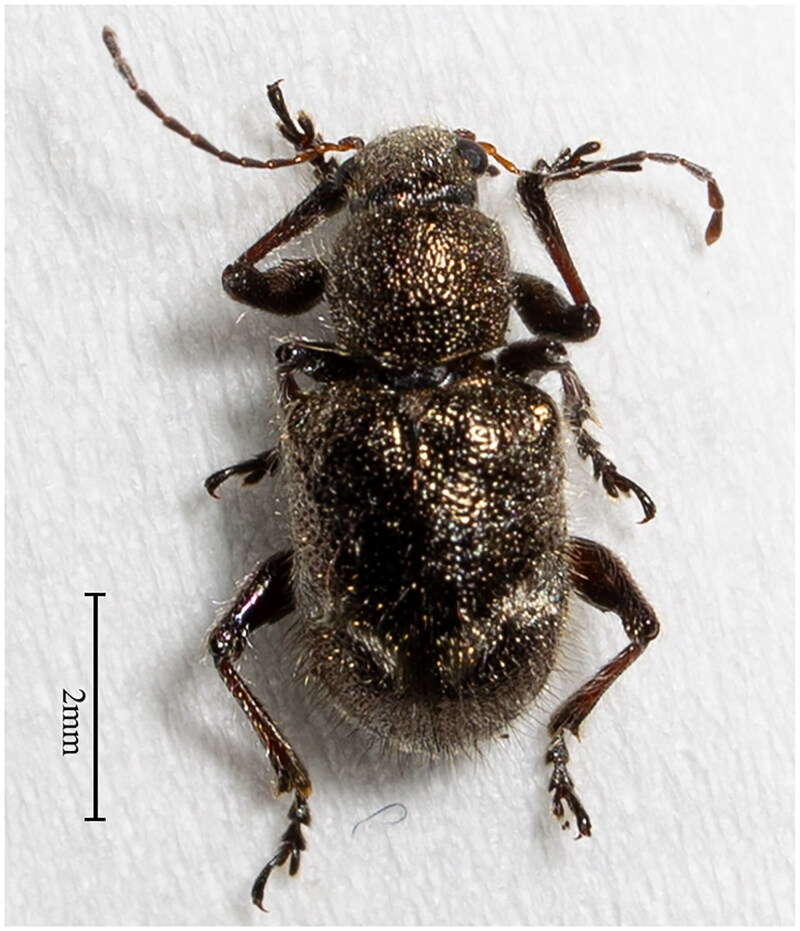 Figure 1
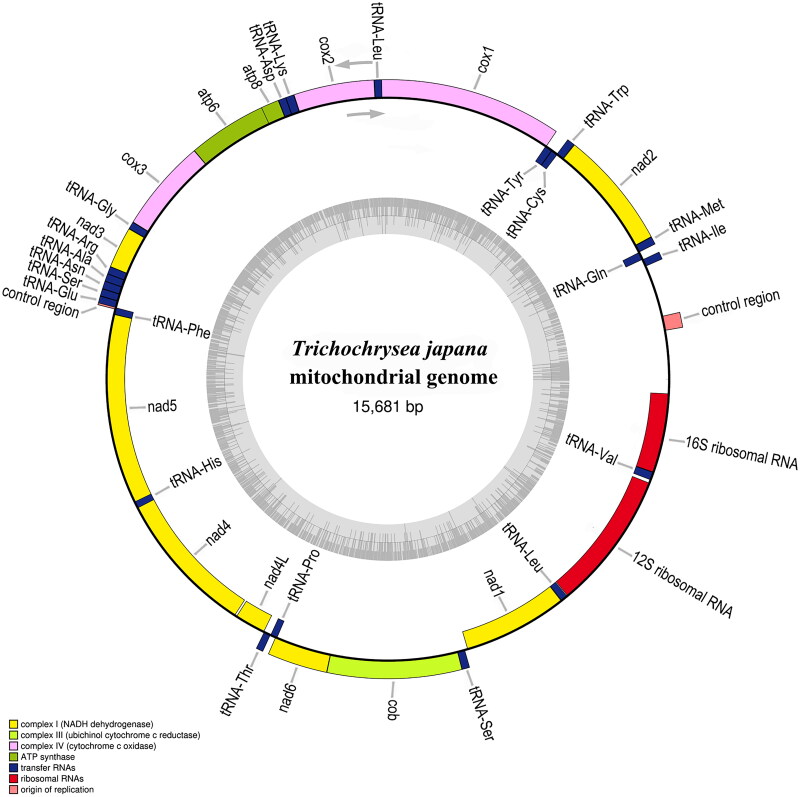 Figure 2
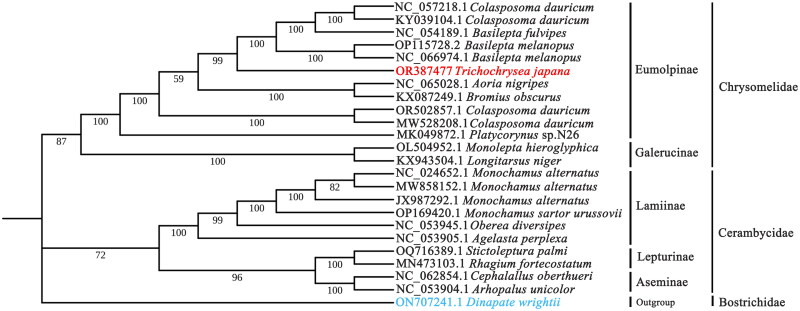 Figure 3
| Family | Subfamily | Species | GenBank no. | References |
|---|---|---|---|---|
| Chrysomelidae | Eumolpinae |
| This study | |
|
| Unpublished | |||
|
| (Song et al. | |||
|
| (Liu et al. | |||
|
| Unpublished | |||
|
| Unpublished | |||
|
| Unpublished | |||
|
| Unpublished | |||
|
| Unpublished | |||
|
| Unpublished | |||
| (Nie et al. | ||||
| Galerucinae |
| Unpublished | ||
|
| (Gómez‐Rodríguez et al. | |||
| Cerambycidae | Lamiinae |
| (Li et al. | |
|
| (Zhang et al. | |||
|
| (Wang et al. | |||
|
| (Shi et al. | |||
|
| Unpublished | |||
|
| Unpublished | |||
| Lepturinae |
| Unpublished | ||
|
| (Nie et al. | |||
| Aseminae |
| Unpublished | ||
|
| Unpublished | |||
| Bostrichidae | Bostrichinae |
| Unpublished |
- —Forestry Innovation Class Talent Training Model Project
- —Natural Science Foundation of Fujian Province10.13039/501100003392
Peer Reviews
No public reviews on file for this paper yet. If you reviewed it on a platform where reviews are public (OpenReview, ICLR, NeurIPS, ICML), you can paste yours below so the community can read it here.
Videos
No videos yet. Explain this paper in a talk, walkthrough, or lecture? Add one.
Taxonomy
TopicsColeoptera Taxonomy and Distribution · Insect Resistance and Genetics · Insect and Arachnid Ecology and Behavior
Introduction
Trichochrysea japana (Motschulsky, 1855), a member of the Chrysomelidae family within the Coleoptera order, has a wide geographical distribution, spanning China, Japan, and Korea (Komiya 1985). Notably, it is commonly found across several provinces in China, including Fujian, Hunan, Anhui, Guangxi, and Taiwan, where it poses a significant threat to tea trees (Zhang 1999). Hunan, renowned for its copious oil tea tree resources, is particularly vulnerable to the harmful effects of T. japana on tea tree growth (Li et al. 2013). The superfamily Chrysomeloidea, which encompasses seven distinct families, further highlights the ecological importance and potential challenges posed by this diverse insect group (Mckenna et al. 2015). Once the adults emerge from the soil, they feed on leaves and buds, weakening the host plant and making it more susceptible to various diseases (He et al. 2010). The body of T. japana is oval-shaped, brown, and about eight millimeters long. It has green spots on its wings, black hairs on its body, elongated antennae, and distinct internodes (Figure 1).
Morphological photograph of Trichochrysea japana (photographed by Lulu Huang at Fujian Agriculture and Forestry University, Fuzhou City, China).
Recent advances in molecular biology have greatly improved insect classification systems and comprehensive mitogenome analysis has provided valuable insights into the genetics and developmental patterns of species (Zhang 2006). This study analyzed the mitogenome characteristics and phylogenetic placement of T. japana, offering essential insights into its genetic and evolutionary relationships.
Materials
T. japana was discovered in Lianjiang County, Fuzhou City, Fujian Province, China (119°23′38′′E, 26°3′7′′N). The specimen voucher, designated as YJ-202301, is securely stored in the laboratory of the College of Forestry at Fujian Agriculture and Forestry University (Songqing Wu, [email protected]).
Methods
Genomic DNA extraction and sequencing
3.1.
The leg of an adult T. japana was used as the sample, and total genomic DNA was extracted using the TruSeq DNA sample preparation kit (Vazyme, Fuzhou, China) and purified with the QIAquick Gel Extraction kit (Qiagen, Hilden, Germany). The concentration and purity of the extracted DNA were accurately assessed using a Nanodrop 2000 spectrophotometer (Thermo Fisher Scientific, Massachusetts, USA). The samples were sequenced on the Illumina HiSeq 2500 platform, employing a paired-end sequencing strategy with 2 × 150 bp reads.
Mitogenome assembly and annotation
3.2.
Low-quality reads and artifacts were removed from the original dataset, which contained a total of 49,598,828 reads, resulting in 887,692 clean reads. These clean reads were assembled using MitoZ (Meng et al. 2019) and metaSPAdes software (Nurk et al. 2017). Genome annotation was performed using mitoMaker software (Prosdocimi and Schomaker-Bastos 2018). To ensure accuracy, the complete mitogenome sequence of T. japana was corrected regarding Platycorynus sp. N26 (GenBank accession number: MK049872.1) (Nie et al. 2020b).
Phylogenetic analysis
3.3.
To analyze the taxonomic status of T. japana more comprehensively, we constructed a phylogenetic tree using the mitogenome of T. japana and other 22 Chrysomeloidea species as the ingroup, with Dinapate wrightii (Coleoptera: Bostrichoidea; GenBank accession number: ON707241.1) was used as outgroup (Table 1). The complete mitogenome sequences of all species were aligned using MEGA7 software (Katoh and Standley 2013). The phylogenetic tree was then generated using the maximum-likelihood (ML) method within the IQ-TREE software, with 1000 bootstrap replicates (Nguyen et al. 2015). Finally, the phylogenetic tree was visualized using iTol v6 (https://itol.embl.de/).
Results
The mitogenome of T. japana was constructed using high-coverage sequencing data, with a coverage rate exceeding 5000 × (Figure S1). The total length of the T. japana mitogenome is 15,681 bp (GenBank accession number: OR387477), with a GC content of 35.2%, consisting of 41.6% adenine (A), 8.6% guanine (G), 14% cytosine (C), and 35.8% thymine (T). The complete mitogenome contains 13 protein-coding genes (PCGs), 22 transfer RNAs (tRNAs), two ribosomal RNAs (rRNAs), and two control regions (Figure 2). Fourteen genes are transcribed from the minority strand (N-strand), including eight tRNAs, four PCGs, and two rRNAs, while the remaining fourteen tRNAs and nine PCGs are transcribed from the majority strand (J-strand). The lengths of the 12S and 16S rRNAs are 1251 bp and 714 bp, respectively. The 22 tRNAs molecules in this genome assembly ranged from 61 bp (tRNA-Cys) to 73 bp (tRNA-Val). The total length of the 13 PCGs is 11,111 bp, encoding 3710 amino acids. Most PCGs begin with standard start codons ATD (ATT, ATG, ATA), with the exceptions of nad4 and nad5, which use TAT; nad4L, which starts with CAT; and nad1, which begins with CAA. The termination codons for the PCGs include TAA, GCT, TAG, ATT, and an incomplete codon (T).
Mitochondrial genome map of the Trichochrysea japana (GenBank: OR387477) the gene’s GC content is shown by gray inner circles, different gene functions are represented by colored outside circles, and transcriptional direction is represented by arrows.
Phylogenetic analysis showed that the analyzed species were clustered into three main branches. The first branch, located at the root of the tree, consists of D. wrightii, which belongs to the Bostrichoidea superfamily within Coleoptera. The second branch includes 10 species from the Lamiinae, Lepturinae, and Aseminae subfamilies of the Cerambycidae family. The third branch contains 13 species, including T. japana, which belongs to the Chrysomelidae of Coleoptera. Within this branch, T. japana is closely related to B. melanopus, B. fulvipes, and C. dauricum and is classified within the subfamily Eumolpinae (Figure 3).
Maximum-likelihood analysis of Trichochrysea japana and 23 related species insects based on genome sequence with 1000 bootstraps. Bootstrap support values are labeled near the branch. The species analyzed in this study are represented by red fonts, and the outgroup is represented by blue fonts. The sequences from the following species were used: Trichochrysea japana OR387477 (This study), Colasposoma dauricum NC_057218.1, Colasposoma dauricum KY039104.1 (Song et al. 2018), Basilepta fulvipes NC_054189.1 (Liu et al. 2020), Basilepta melanopus NC_066974.1, Basilepta melanopus OP115728.2, Aoria nigripes NC_065028.1, Bromius obscurus KX087249.1, Colasposoma dauricum OR502857.1, Colasposoma dauricum MW528208.1, Platycorynus sp. N26 MK049872.1 (Nie et al. 2020b) Monolepta hieroglyphica OL504952.1, Aoria nigripes KX943504.1 (Gómez‐Rodríguez et al. 2015), Monochamus alternatus NC_024652.1 (Li et al. 2016), Monochamus alternatus MW858152.1 (Zhang et al. 2021), Monochamus alternatus JX987292.1 (Wang et al. 2013), Monochamus sartor urussovii OP169420.1 (Shi et al. 2023), Oberea diversipes NC_053945.1, Agelasta perplexa NC_053905.1, Stictoleptura palmi OQ716389.1, Rhagium fortecostatum MN473103.1 (Nie et al. 2020a), Cephalallus oberthueri NC_062854.1, Arhopalus unicolor NC_053904.1, Dinapate wrightii ON707241.1.
Discussion and conclusion
In this study, the mitogenome of T. japana was successfully sequenced and annotated, revealing a comprehensive mitogenome containing 37 genes, similar to the organization observed in the hypothetical ancestral insects (Clary and Wolstenholme 1985). The presence of multiple control regions in the mitogenome of T. japana and other select insects is likely due to evolutionary gene mutations (Wei and Chen 2011). T. japana displays a characteristic bias toward high A + T content (A + T = 77.4%, G + C = 22.6%), with the combined proportions of A and C being higher than those of T and G (A + C = 55.6%, T + G = 44.4%), consistent with patterns observed in other insects (Raupach et al. 2022). Furthermore, the phylogenetic analysis provides essential insights into the evolutionary dynamics of the mitogenome in this species and offers an indispensable foundation for future genetic research. Additionally, acquiring T. japana mitogenome data will significantly aid the development of new biological control strategies for managing this pest.
Supplementary Material
Supplementary Material.docx
The reference list from the paper itself. Each links out to its DOI / PubMed record.
- 1Clary DO, Wolstenholme DR. 1985. The mitochondrial DNA molecular of Drosophila yakuba: nucleotide sequence, gene organization, and genetic code. J Mol Evol. 22(3):252–271. doi:10.1007/BF 02099755.3001325 · doi ↗ · pubmed ↗
- 2Gómez‐Rodríguez C, Crampton‐Platt A, Timmermans MJTN, Baselga A, Vogler AP, Gilbert M. 2015. Validating the power of mitochondrial metagenomics for community ecology and phylogenetics of complex assemblages. Methods Ecol Evol. 6(8):883–894. doi:10.1111/2041-210X.12376. · doi ↗
- 3He XY, Xiong Y, Cai SP, Han GY, Zhan ZR, Chen DL, Zhong JH. 2010. A pest insects and mites list of Camellia oleifera from. China. Journal of Wuyi Science. 26(001):11–30.
- 4Katoh K, Standley DM. 2013. MAFFT multiple sequence alignment software version 7: improvements in performance and usability. Mol Biol Evol. 30(4):772–780.23329690 10.1093/molbev/mst 010PMC 3603318 · doi ↗ · pubmed ↗
- 5Komiya Y. 1985. Studies on the Trichochrysea-species of Japan, Ryukyu Archipelago, Taiwan and Korea (Coleoptera, Chrysomelidae, Eumolpinae). Elytra. 12(02):11–25.
- 6Liu L-N, Zheng S-J, Guo Z-X, Li X-D, Li J-B, Zeng L., 2020. Complete mitochondrial genome of banana new pest Basilepta fulvipes (Coleoptera: Eumolpinae) and phylogenetic analysis. Mitochondrial DNA Part B. 5(3):2996–2997. doi:10.1080/23802359.2020.1797572.33458031 PMC 7782735 · doi ↗ · pubmed ↗
- 7Li F, Zhang H, Wang W, Weng H, Meng Z. 2016. Complete mitochondrial genome of the Japanese pine sawyer, Monochamus alternatus (Coleoptera: cerambycidae). Mitochondrial DNA A DNA Mapp Seq Anal. 27(2):1144–1145. doi:10.3109/19401736.2014.936321.24989053 · doi ↗ · pubmed ↗
- 8Li M, Zhou G, Li H, He Z, Liao Z, Xia Y, Yu J, Yan X. 2013. The list and fauna characteristics of Oil-tea pest in Hunan. Hunan Forestry Sci Technol. 40(04):60–64.