Intralesional Treatment of Non-American Cutaneous Leishmaniasis with Multiple Lesions
Clarissa Pieri, Stephen L. Walker

Abstract
Genes, proteins, chemicals, diseases, species, mutations and cell lines named across the full text — each resolved to its canonical identifier and authoritative record.
Click any figure to enlarge with its caption.
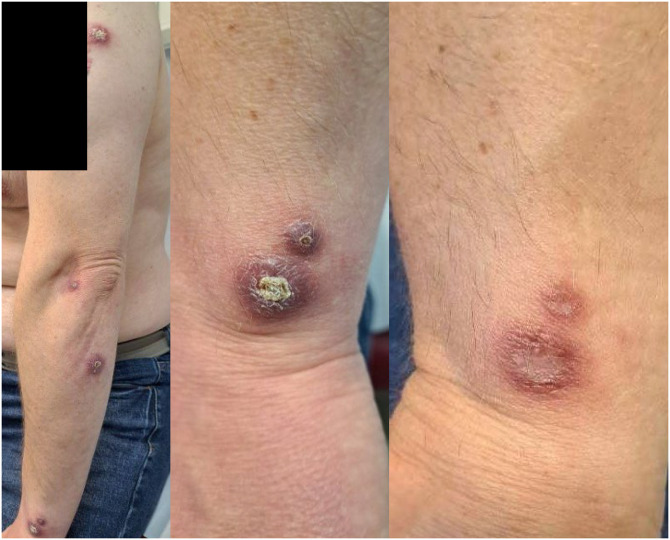 Figure 1
Peer Reviews
No public reviews on file for this paper yet. If you reviewed it on a platform where reviews are public (OpenReview, ICLR, NeurIPS, ICML), you can paste yours below so the community can read it here.
Videos
No videos yet. Explain this paper in a talk, walkthrough, or lecture? Add one.
Taxonomy
TopicsResearch on Leishmaniasis Studies
A 44-year-old male developed five ulcerated plaques on the left upper limb (Figure 1) while in Sicily, Italy. The size of lesions varied between 1 and 2.5 cm 1 year before presentation at the Hospital for Tropical Diseases, London. There was no lymphadenopathy, lymphangitis, or subcutaneous induration. He was HIV uninfected. The ulcerated lesions had not responded to separate courses of oral clarithromycin, doxycycline, or cotrimoxazole. A skin biopsy showed granulomatous inflammation, and Leishmania donovani complex DNA was detected, confirming the diagnosis of cutaneous leishmaniasis (CL).
The treatment options for CL were discussed, including conservative management, intralesional (IL) treatment with meglumine antimoniate (MA), miltefosine, intravenous MA, or liposomal Amphotericin B. The number of CL lesions on our patient raised an interesting issue with respect to three published CL treatment guidance documents, which advise systemic therapy for individuals with “complex” CL.1
Our patient met the criteria for “simple” rather than “complex” CL; he was immunocompetent, and the causative Leishmania species was unlikely to be associated with mucosal disease and the location of the lesions. However, all three publications categorized our patient as “complex” because he had five CL lesions. Two recommend systemic therapy if there are four or more CL lesions, and the other publication recommends systemic therapy if there are more than four of “substantial size,” defined as greater than 1 cm.1?^–^3 The other two guidance documents use different lesion sizes (3 and 4 cm) for categorizing CL as complex (independent of the number of lesions).2^,^3
The patient wished to have active treatment given the prolonged duration of the skin lesions and continued inflammation. He expressed a preference for local treatment rather than systemic treatment because of the reduced risk of adverse effects.4
Weekly IL MA (300 mg/mL) was administered intradermally to all lesions on five occasions initially and was well tolerated. The volume of MA required for infiltration decreased at each administration. Six milliliters were initially required, and 1.5 mL were required for two lesions at the final treatment session. All lesions flattened and re-epithelialized with scarring when reviewed at day 90.
The three guidance documents are extremely useful for physicians managing individuals with CL, particularly those who may be unfamiliar with the disease. Choosing the best CL therapy requires affected individuals to be supported to make informed decisions about their care. This may mean deviating from expert recommendations, particularly where the evidence for such recommendations is lacking.
The reference list from the paper itself. Each links out to its DOI / PubMed record.
- 1Aronson N Herwaldt BL Libman M Pearson R Lopez-Velez R Weina P Carvalho EM Ephros M Jeronimo S Magill A, 2016. Diagnosis and treatment of leishmaniasis: Clinical practice guidelines by the Infectious Diseases Society of America (IDSA) and the American Society of Tropical Medicine and Hygiene (ASTMH). Clin Infect Dis 63: 1539–1557.27941143 10.1093/cid/ciw 742 · doi ↗ · pubmed ↗
- 2Blum J , 2014. Leish Man recommendations for treatment of cutaneous and mucosal leishmaniasis in travelers, 2014. J Travel Med 21: 116–129.24745041 10.1111/jtm.12089 · doi ↗ · pubmed ↗
- 3World Health Organization, 2014. Manual for Case Management of Cutaneous Leishmaniasis in the WHO Eastern Mediterranean Region. Available at: https://iris.who.int/handle/10665/120002. Accessed August 27, 2024.
- 4Lyra MR , 2023. A randomized, controlled, noninferiority, multicenter trial of systemic vs intralesional treatment with meglumine antimoniate for cutaneous leishmaniasis in Brazil. Clin Infect Dis 77: 574–582.37100061 10.1093/cid/ciad 253 · doi ↗ · pubmed ↗