Acute Toxoplasmosis in Two Immunocompetent Colombian Soldiers after Ingestion of Undercooked Squirrel Meat
Daniel Celis-Giraldo, Leidy J. Medina-Lozano, Álvaro A. Faccini-Martínez

Abstract
Genes, proteins, chemicals, diseases, species, mutations and cell lines named across the full text — each resolved to its canonical identifier and authoritative record.
Click any figure to enlarge with its caption.
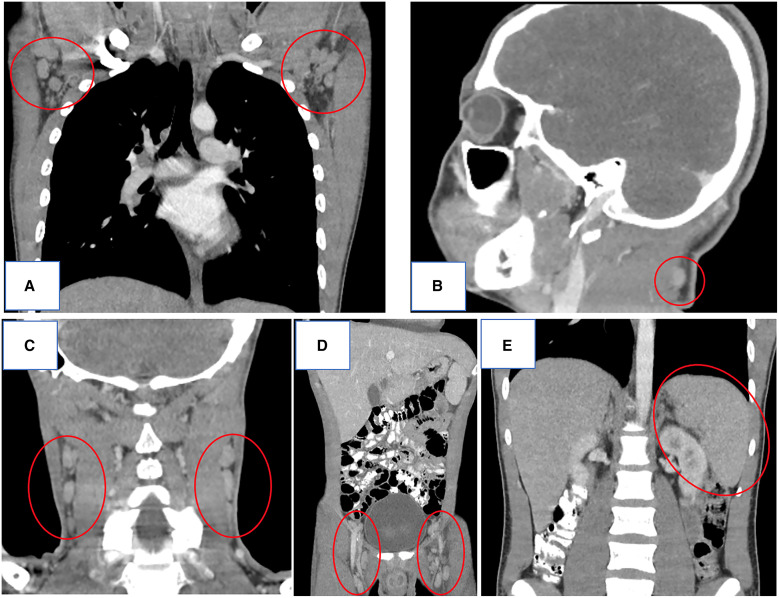 Figure 1
Peer Reviews
No public reviews on file for this paper yet. If you reviewed it on a platform where reviews are public (OpenReview, ICLR, NeurIPS, ICML), you can paste yours below so the community can read it here.
Videos
No videos yet. Explain this paper in a talk, walkthrough, or lecture? Add one.
Taxonomy
TopicsToxoplasma gondii Research Studies · Travel-related health issues · Rabies epidemiology and control
On December 5 and 15, 2023, two young, previously healthy soldiers stationed in the jungle of Vichada department (Amazon-Orinoco Colombian region) were transferred to our institution, Hospital Militar Central, for prolonged febrile illness. The first patient had 12 days of fever, generalized lymphadenopathy, asthenia, night sweats, and retinochoroiditis of the right eye with a whitish feathery edged lesion of 0.5 in diameter disk (dd) with perilesional vasculitis. The second patient had 22 days of fever, generalized lymphadenopathy, weight loss, diarrhea, and retinochoroiditis of the left eye with a whitish lesion on the upper temporal arcuate with undefined borders of 0.5 in dd. The patients reported eating undercooked squirrel meat and drinking untreated water during jungle patrols. In both patients, IgM and IgG antibodies to Toxoplasma gondii were positive, and there were low IgG avidity indices. Serological results were negative for acute HIV, Chagas, syphilis, Cytomegalovirus and Epstein-Barr virus infections. Computed tomography revealed generalized lymphadenopathy and splenomegaly in both patients (Figure 1). They received treatment with trimethoprim/sulfamethoxazole for 4 weeks and exhibited significant clinical improvement.
In a recent systematic review that described acute toxoplasmosis in immunocompetent hosts, classic manifestations included fever (86%), lymphadenopathy (74%), malaise (68%), and ocular findings (34%). The most common risk factors were eating undercooked meat (47%) and drinking untreated water (37%), similar to our cases.1 Outbreaks among Colombian military personnel have been reported.2 Toxoplasmosis in South America exhibits different clinical behavior, and treatment should be initiated in the context of acute infection.3
The reference list from the paper itself. Each links out to its DOI / PubMed record.
- 1Layton J Theiopoulou D-C Rutenberg D Elshereye A Zhang Y Sinnott J Kim K Montoya JG Contopoulos-Ioannidis DG, 2023. Clinical spectrum, radiological findings, and outcomes of severe toxoplasmosis in immunocompetent hosts: A systematic review. Pathogens 12: 543.37111429 10.3390/pathogens 12040543 PMC 10145896 · doi ↗ · pubmed ↗
- 2Pino LE Salinas JELópez MC, 2009. Descripción de un brote epidémico de toxoplasmosis aguda en pacientes inmunocompetentes miembros de las fuerzas militares de Colombia durante operaciones de selva. Infectio 13: 83–91.
- 3Gómez Marín JE Zuluaga JD Pechené Campo EJ Triviño Jde-la-Torre A, 2018. Polymerase chain reaction (PCR) in ocular and ganglionar toxoplasmosis and the effect of therapeutics for prevention of ocular involvement in South American setting. Acta Trop 184: 83–87.29409823 10.1016/j.actatropica.2018.01.013 · doi ↗ · pubmed ↗