Type I Hypersensitivity due to Basic Blue 99 in a Hair Colour Conditioning Agent
Takafumi Numata, Kazuki Fujimori, Kana Kato, Tomonobu Ito, Kazutoshi Harada, Yukari Okubo

Abstract
Genes, proteins, chemicals, diseases, species, mutations and cell lines named across the full text — each resolved to its canonical identifier and authoritative record.
Click any figure to enlarge with its caption.
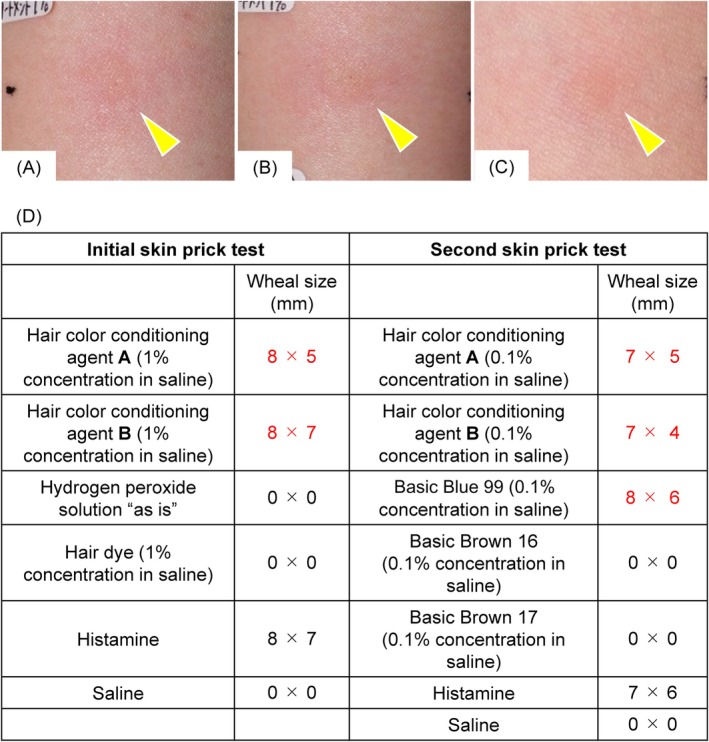 FIGURE 1
| Author | Year | Age | Sex | Past medical history | Symptoms | Diagnosis | Positive concentration of BB99 in the SPT |
|---|---|---|---|---|---|---|---|
| Washio et al. [ | 2017 | 56 | F | Asthma | Wheals, nausea, dyspnea, impaired consciousness | Contact anaphylaxis | 0.1% aqua |
| Vanden Broecke et al. [ | 2014 | 57 | F | CD to PPD, nickel, chromium, cobalt, colophonium | Itching, ‘bad taste’ in the mouth | Contact urticaria syndrome | 1% aqua |
| Jagtman [ | 1996 | 71 | F | ND | Severe itching, urticaria | Contact urticaria | ND |
| Wigger‐Alberti, Elsner, and Wüthrich [ | 1996 | 67 | M | ND | Rhinoconjunctivitis, coughing, swelling of eyelid | Immediate‐type allergy | ND |
| Our case | 54 | F | Atopic dermatitis, cold urticaria | Pruritic facial rash, irritated throat, sneeze, stomach pain, vomiting | Type I hypersensitivity | 0.1% saline |
Peer Reviews
No public reviews on file for this paper yet. If you reviewed it on a platform where reviews are public (OpenReview, ICLR, NeurIPS, ICML), you can paste yours below so the community can read it here.
Videos
No videos yet. Explain this paper in a talk, walkthrough, or lecture? Add one.
Taxonomy
TopicsContact Dermatitis and Allergies · Skin Protection and Aging · Mast cells and histamine
Basic Blue 99 (BB99) is used as a direct, nonoxidative hair colourant in hair dyes [1]. Type I hypersensitivity to BB99 has rarely been reported [2, 3, 4, 5]. We herein present a case of Type I hypersensitivity caused by BB99 and review four, previously reported cases.
Case Report
1
A 54‐year‐old, female, Japanese patient visited our dermatology department following a recent episode of Type I hypersensitivity. She had a history of atopic dermatitis, cold urticaria, and contact dermatitis caused by *p‐*phenylenediamine (PPD)‐containing hair dye. Moreover, 4 years previously, following the self‐application of a hair colour conditioning agent without PPD, she experienced a pruritic facial rash, which subsided overnight.
One month prior to her current presentation, she experienced a pruritic facial rash, throat irritation, sneezing, stomach pain, and vomiting 20 min after a non‐PPD hair dye, a hair colour conditioning agent, and a hydrogen peroxide solution had been applied to her hair in a hair salon. She visited an emergency centre at a nearby hospital where Type I hypersensitivity reaction triggered by the hair dye or hair colour conditioning agent was diagnosed. A skin prick test carried out with the same hair colour conditioning agent which she used 4 years ago (Hair colour conditioning agent A) and the hair colour conditioning agent used most recently at the hair salon (Hair colour conditioning agent B), both at a 1% dilution in saline, as well as hair dye at a 1% dilution in saline and the hydrogen peroxide solution ‘as is’, was positive for both hair colour conditioning agents but was negative for the hair dye and hydrogen peroxide solution within 15 min after application (Figure 1A,B,D). A skin prick test later performed using the ingredients of the hair colour conditioning agents and the two hair colour conditioning agents was positive for BB99 and the two hair colour conditioning agents, but was negative for Basic Brown 16 and Basic Brown 17 within 15 min after application (Figure 1C,D). Both hair colour conditioning agents contained BB99, leading to the diagnosis of Type I hypersensitivity induced by BB99.
The results of the skin prick tests were positive. (A) Hair colour conditioning agent A at a 1% dilution in saline (arrowheads; wheal size: 8 mm × 5 mm; ++, = histamine). (B) Hair colour conditioning agent B at a 1% dilution in saline (arrowheads; wheal size: 8 mm × 7 mm; +++, = histamine). (C) Basic Blue 99 at a 0.1% dilution in saline (arrowhead; wheal size: 8 mm × 6 mm; +++, > histamine). (D) Summary of the skin prick test results.
Discussion
2
BB99 (3‐[(4‐amino‐6‐bromo‐5,8‐dihydro‐1‐hydroxy‐8‐imino‐5‐oxo‐2‐naphthalenyl) amino]‐N,N,N‐trimethyl benzenaminium chloride [Arianor Steel Blue; CAS no. 68123‐13‐7]) can cause Type I hypersensitivity, including contact urticaria and contact anaphylaxis. Besides the present case, only four other cases of Type I hypersensitivity caused by BB99 have been reported to date (Table 1). Interestingly, all the patients were older than 50 years, and most were female. Two patients had a history of an atopic disorder. The positive concentration used for the skin prick tests ranged from 0.1% to 1%.
In conclusion, hair dyes containing BB99 are commonly used worldwide, but BB99 itself has rarely been reported as a contact sensitizer. The skin prick test is a useful method of identifying the allergenic substances, such as BB99. The present study found that a 0.1% dilution was sufficient for a prick test with BB99 and BB99‐containig hair colour conditioning agent.
Author Contributions
Takafumi Numata: writing – original draft, methodology. Kazuki Fujimori: investigation. Kana Kato: investigation. Tomonobu Ito: investigation. Kazutoshi Harada: writing – review and editing. Yukari Okubo: writing – review and editing, supervision.
Consent
Informed written consent for the publication of the details of this case and the accompanying images was obtained from the patient.
Conflicts of Interest
The authors declare no conflicts of interest.
The reference list from the paper itself. Each links out to its DOI / PubMed record.
- 1Cosmetic Ingredient Review Expert Panel , “Final Report on the Safety Assessment of Basic Blue 99,” International Journal of Toxicology 26, no. S 2 (2007): 51–63, 10.1080/10915810701351202.17613131 · doi ↗ · pubmed ↗
- 2K. Washio , K. Ijuin , A. Fukunaga , H. Nagai , and C. Nishigori , “Contact Anaphylaxis Caused by Basic Blue 99 in Hair Dye,” Contact Dermatitis 77, no. 2 (2017): 122–123, 10.1111/cod.12740.28703343 · doi ↗ · pubmed ↗
- 3K. Vanden Broecke , M. Bruze , L. Persson , H. Deroo , and A. Goossens , “Contact Urticaria Syndrome Caused by Direct Hair Dyes in a Hairdresser,” Contact Dermatitis 71, no. 2 (2014): 124–126, 10.1111/cod.12211.25040717 · doi ↗ · pubmed ↗
- 4B. A. Jagtman , “Urticaria and Contact Urticaria due to Basic Blue 99 in a Hair Dye,” Contact Dermatitis 35, no. 1 (1996): 52, 10.1111/j.1600-0536.1996.tb 02273.x.8896962 · doi ↗ · pubmed ↗
- 5W. Wigger‐Alberti , P. Elsner , and B. Wüthrich , “Immediate‐Type Allergy to the Hair Dye Basic Blue 99 in a Hairdresser,” Allergy 51, no. 1 (1996): 64–65, 10.1111/j.1398-9995.1996.tb 04555.x.8721534 · doi ↗ · pubmed ↗