Pattern and Forensic Significance of Defense Injuries in Homicide Cases: A Cross-Sectional Study
Nani Gopal Das, Nirmalendu Das, Abhik Sil

TL;DR
This study examines defense injuries in homicide cases to understand their patterns and forensic importance in determining weapon types and assault details.
Contribution
The study provides empirical evidence on the correlation between weapon types and specific defense injury patterns in homicides.
Findings
Defense injuries were most common on hands, forearms, and fingers.
Incised wounds were typical in knife attacks, while blunt force trauma caused contusions and fractures.
Gunshot victims had fewer defense injuries, mostly abrasions or contusions.
Abstract
Introduction Defense injuries play a crucial role in forensic investigations by providing insights into the nature of an assault, the type of weapon used, and the manner of death. This study aims to analyze the prevalence, patterns, and forensic significance of defense injuries in homicide cases. Methods A retrospective observational study was conducted on 60 homicide cases with documented defense injuries. Data was collected from autopsy reports, crime scene records, and inquest papers over a five-year period at a tertiary care hospital and compared. The injuries were categorized based on type, anatomical distribution, and the weapon involved. Statistical analysis was performed to assess the relationship between defense injuries and weapon type. Results Defense injuries were most commonly observed on the hands 48 (80%), forearms 39 (65%), and fingers 24 (40%). Incised wounds were…
Genes, proteins, chemicals, diseases, species, mutations and cell lines named across the full text — each resolved to its canonical identifier and authoritative record.
Click any figure to enlarge with its caption.
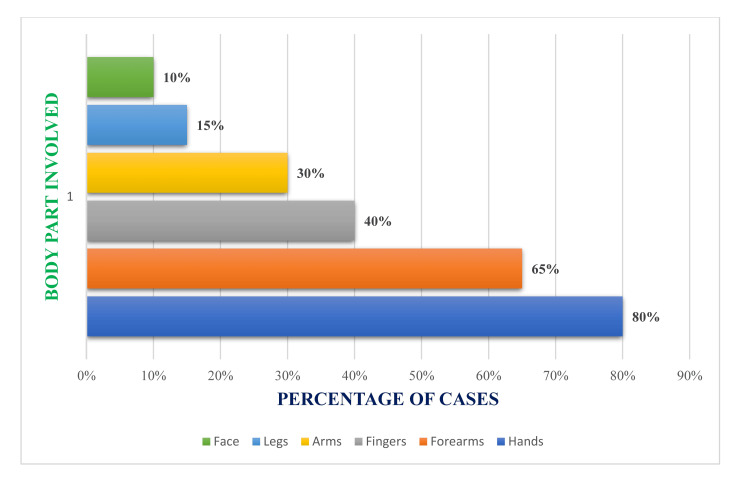 Figure 1
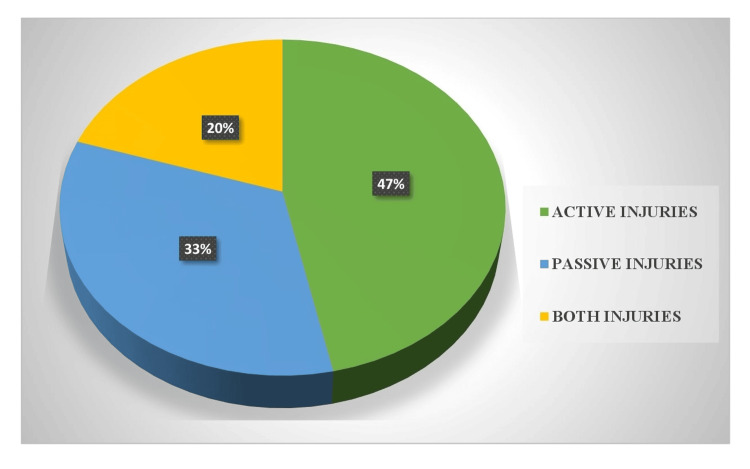 Figure 2
| Categorical variables | Frequency | Percentage | p-value |
| Age group (in years) | 0.08 | ||
| 0-20 | 06 | 20 | |
| 20-50 | 42 | 70 | |
| >50 | 12 | 10 | |
| Gender | 0.01 | ||
| Male | 42 | 70 | |
| Female | 18 | 30 | |
| Religion | 0.01 | ||
| Hindu | 35 | 58 | |
| Muslim | 21 | 35 | |
| Christian | 3 | 5 | |
| Buddhist | 1 | 2 | |
| Educational status | 0.02 | ||
| Illiterate | 31 | 52 | |
| Primary | 16 | 27 | |
| 10th | 09 | 15 | |
| 12th | 03 | 05 | |
| Graduation | 01 | 01 | |
| Occupation | 0.01 | ||
| Unskilled | 40 | 67 | |
| Skilled | 14 | 23 | |
| Semi-skilled | 4 | 06 | |
| Semi-professional | 2 | 04 | |
| Marital status | 0.03 | ||
| Married | 35 | 58 | |
| Unmarried | 19 | 31 | |
| Divorced | 4 | 7 | |
| Widower | 2 | 4 | |
| Place of residence | 0.04 | ||
| Rural | 41 | 68 | |
| Urban | 19 | 32 | |
| Type of injury | Common weapon used | Frequency | Percentage | p-value | Chi-square value |
| Incised wounds | Knife, blade | 36 | 60% | 0.01 | 2.71 |
| Contusions | Blunt objects | 33 | 55% | 0.02 | 1.85 |
| Lacerations | Heavy blunt force | 27 | 45% | 0.04 | 0.16 |
| Fractures | Metal rods, clubs | 21 | 35% | 0.03 | 1.19 |
| Gunshot injury | Firearms | 12 | 20% | 0.06 | 5.89 |
Peer Reviews
No public reviews on file for this paper yet. If you reviewed it on a platform where reviews are public (OpenReview, ICLR, NeurIPS, ICML), you can paste yours below so the community can read it here.
Videos
No videos yet. Explain this paper in a talk, walkthrough, or lecture? Add one.
Taxonomy
TopicsGun Ownership and Violence Research · Homicide, Infanticide, and Child Abuse · Psychopathy, Forensic Psychiatry, Sexual Offending
Introduction
Defense injuries, also known as defensive wounds, occur when a victim attempts to shield themselves from an attacker. It results from the immediate and instinctive reaction of the victim to ward off an attack in order to ensure survival [1]. These injuries are crucial in forensic medicine practice in homicide investigations throughout the world, providing insights into the mode of assault, the weapon used, and the comparative power of the assailant and victim [2].
Understanding the pattern and distribution of these injuries helps differentiate homicide from suicide and accidental injuries, thereby influencing legal interpretations. Forensic experts consider defense injuries an essential element in reconstructing the sequence of events leading to death. The anatomical location, type, and severity of such injuries play a crucial role in understanding the circumstances of the crime [3].
As of data till December 2022, the National Crime Records Bureau (NCRB) displayed that a total of 28,522 murder cases were registered across India, averaging approximately 78 incidents per day. Uttar Pradesh reported the highest number of murder cases at 3,491, while Sikkim had the fewest with just nine cases [4].
In many homicide cases, the presence of defense injuries indicates victim resistance, while their absence might suggest restraint, incapacitation, or a surprise attack. Studies have shown that in 79% of cases of homicide, upper limbs, particularly the hands and forearms, are the most common sites of defense wounds. Analyzing these injuries in detail enhances the ability of forensic pathologists to infer the victim’s actions during the assault [5].
This study investigates the patterns and forensic significance of defense injuries in homicide cases to enhance the understanding of forensic experts and law enforcement agencies.
Materials and methods
Study design and setting
This study was a retrospective cross-sectional study with a descriptive observational design. It was conducted in the Department of Forensic Medicine and Toxicology, Tripura Medical College and Dr. Dr. Bhimrao Ramji Ambedkar Memorial Teaching Hospital, Hapania, Agartala, West Tripura, India. The study period spanned five years, from January 2019 to December 2024.
Study materials and data sources
Data were obtained from medico-legal autopsy reports in the Forensic Medicine and Toxicology department's records, with prior administrative approval, crime scene records from the investigating police officer, and medico-legal documents at the casualty.
Sample size and selection criteria
A total of 60 confirmed homicide cases were included in the study. The required sample size was calculated using the following formula: n=Z^2^×p×(1−p)/d^2^,where Z=1.96 (Z-score for a 95% CI), p=0.5 (expected prevalence based on previous studies), and d=0.13 (acceptable margin of error). The calculated sample size is approximately 57 cases. Since sample sizes are usually rounded up for feasibility, a sample size of 60 cases is justified. This ensures adequate statistical power while maintaining practical constraints (limited cases) in forensic medicine studies. Cases were selected based on specific inclusion and exclusion criteria to ensure forensic relevance. Only confirmed homicide cases with documented defense injuries and detailed autopsy reports were included. Cases with complete medico-legal records were prioritized to ensure data accuracy and reliability. Exclusions included unidentified bodies with incomplete records, decomposed bodies where injury assessment was compromised, and cases where the manner of death was undetermined.
Sampling method
A purposive sampling method was employed. Given the relatively lower number of homicide cases, this method was used to specifically include cases that met the study’s forensic requirements. Only those cases with clear documentation of injury patterns were selected to ensure a focused and reliable analysis.
Study tools and data collection procedure
Data were collected using a semi-structured questionnaire to document key forensic variables. Victim demographics, including age, sex, and occupation, were recorded. The cause and manner of death were categorized by homicide method, such as stabbing, blunt force trauma, firearm injury, or strangulation. Defense injuries were classified based on type (incised wounds, lacerations, contusions, and fractures) and anatomical distribution (hands, forearms, fingers, arms, legs, and face). Weapon characteristics (knife, blunt object, firearm, ligature) and injury severity (single vs. multiple wounds) were also analyzed. Data were extracted from autopsy reports, crime scene records, and medico-legal documents, ensuring accuracy. Only comprehensive cases were included, providing a detailed forensic analysis of injury patterns in homicide cases.
Statistical analysis
The available data were entered into MS Excel 2007 (Microsoft Corp., Redmond, WA, US), and then in the software Statistical Package for Social Sciences (SPSS), version 21 (SPSS, Inc., Chicago, IL). The qualitative data were expressed in terms of percentage, and quantitative data were expressed in terms of frequency, mean, and standard deviations. We conducted a chi-square test to determine the association of victims’ demographic details with independent variables like sex, age, religion, educational status, occupation, marital status, and place of residence and to check a statistically significant correlation between weapon type and injury patterns. A p-value of less than 0.05 at a 95% CI is considered statistically significant, leading to the rejection of the null hypothesis in favor of the alternative hypothesis.
Ethical considerations
This study was conducted following ethical principles and guidelines for research involving human subjects. Ethical approval was obtained from the Ethics Committee of Tripura Medical College and Dr. Bhimrao Ramji Ambedkar Memorial Teaching Hospital (12/24), and the study adhered to the principles outlined in the Declaration of Helsinki (2013). The Institutional Ethics Committee consists of a legal representative including all other members. Since this was a retrospective forensic study, informed consent from participants was not required, as no direct interaction with individuals occurred, and only de-identified autopsy records were analyzed. Strict confidentiality measures were maintained, ensuring that all personal identifiers were removed from forensic reports, and the data were used solely for research purposes.
Results
A significant proportion (42 (70%)) of the cases occurred in individuals aged 20-50 years, suggesting that this age group is at higher risk for such incidents. Male predominance (42 (70%)) was observed among the victims, with females comprising 18 (30%) of the cases. A higher incidence of defense wound cases was observed among Hindus (35, 58%), followed by Muslims (21, 35%), based on the data analysis in the study. A total of 31 (52%) of the victims had no formal education, suggesting a possible correlation between literacy levels and vulnerability. Individuals from unskilled occupational backgrounds comprised 40 (67%) of the victims, indicating higher vulnerability. Married individuals constituted 35 (58%) of the victims, suggesting possible socio-demographic influences on vulnerability. Rural residents accounted for 41 (68%) of the victims, suggesting higher vulnerability in these areas, as shown in Table 1.
The data presented in Figure 1 support the notion that defense injuries predominantly occur on the upper limbs in 48 (80%) cases (forearms, hands, and arms), as these are instinctively used for protection. Involvement of the lower limbs and face is relatively lower, accounting for six to nine (10 to 15%) cases, which may indicate that attackers generally target upper body regions or that victims prioritize shielding their heads and torsos.
Anatomical distribution of defense injuries
Sharp-edged weapons (knives and blades) were the most frequently used, resulting in a high incidence of incised wounds (36, 60%). Blunt force trauma contributed significantly to the injuries, with contusions (33, 55%), lacerations (27, 45%), and fractures (21, 35%). Firearm-related injuries were the least common (12, 20%), indicating that gun-related violence occurs but is less prevalent than other forms of assault, as depicted in Table 2.
Active defense wounds were the most common (28, 47%), indicating that many victims fight back during an attack. Passive defense wounds (20, 33%) are also significant, reflecting defensive gestures such as shielding the body. A combination of both types (12, 20%) suggests variability in defensive responses based on the nature of the attack, as detailed in Figure 2.
Type of defense wounds (n=60)
Discussion
The findings of this study align with previous forensic research that suggests defense injuries are most prevalent in cases involving sharp-force trauma. Studies by Chattopadhyay et al. [5] and Shah et al. [6] confirm that incised wounds on the hands and forearms are strong indicators of an attempt to fend off an attacker. Additionally, research by Herman K et al. highlights that parry fractures of the ulna are frequently seen in blunt force trauma in child abuse cases [7].
A study by Kemal et al. found defensive injuries occurred in 31% of homicides and hand wounds were common in homicides in accordance with our analysis. Their work also highlighted that victims with prior self-defense training exhibited a higher incidence of forearm fractures, indicating a more prolonged attempt to resist [8].
Gunshot wounds demonstrated fewer defense injuries in our study, which is consistent with observations by Beardslee et al., who found that firearm-related homicides often involve surprise attacks, leaving victims with little time to react defensively [9]. Similarly, an extensive review by Pardini et al. and Irshad et al. noted that firearm-related defense wounds were often limited to minor abrasions, except in cases of close-range encounters where victims attempted to seize the weapon [10,11].
Our results also correlate with findings by Glass et al., who reported that the absence of defense wounds in strangulation homicides is a strong forensic indicator of restraint before death. This is crucial in differentiating homicide from autoerotic asphyxiation or accidental strangulation [12].
Limitations of the study
This study has several limitations, including a small sample size (60 cases). As a single-center, retrospective study, it relies on existing forensic records, which may contain missing or inconsistent data. The absence of a control group (e.g., suicides and accidents) limits comparative analysis. Additionally, perpetrator characteristics and attack dynamics were not analyzed.
Recommendations
Recommendations include standardized documentation of defense injuries in autopsy reports, forensic medicine training for medical professionals to enhance medico-legal reporting, and further prospective studies incorporating biomechanical analysis of defense wounds.
Conclusions
This study highlights the forensic significance of defense injuries in homicide cases. The presence, type, and distribution of these injuries assist in crime reconstruction and legal investigations. Proper documentation and interpretation of such injuries are essential for determining the nature of the assault, the weapon used, and the victim's resistance.
The reference list from the paper itself. Each links out to its DOI / PubMed record.
- 1Simpson’s Forensic Medicine Simpson’s Forensic Medicine. 13th ed. London: Hodder Arnold Payne-James J Jones RM London, UKCRC Press 2013
- 2Di Maio's Forensic Pathology Di Maio VJ Molina DK Boca Raton CRC Press 2020
- 3The Essentials of Forensic Medicine and Toxicology Forensic Medicine and Toxicology. 34th ed. Jaypee Brothers Reddy KSN New Delhi Jaypee Medical Publishers 2017
- 4National Crime Records Bureau. Crime in India 2023 2 2025 2022 https://www.ncrb.gov.in/uploads/nationalcrimerecordsbureau/custom/1701607577 Crimein India 2022 Book 1.pdf
- 5Pattern of defense injuries among homicidal victims Egypt J Forensic Sci Chattopadhyay S Sukul B 818432013
- 6Profile of defense injuries in homicidal deaths: a prospective study Indian J Forensic Med Pathol Shah JP Mangal HM Vora DH Chotaliya DB Chauhan VN Doshi SM 11511952012 https://rfppl.co.in/subscription/upload_pdf/Art.2_833.pdf
- 7Is a parry fracture-an isolated fracture of the ulnar shaft-associated with the probability of abuse in children between 2 and 16 years old?Children (Basel) Hermans K Fransz D Walbeehm-Hol L Hustinx P Staal H 650820213443854110.3390/children 8080650 PMC 8394848 · doi ↗ · pubmed ↗
- 8Deaths due to sharp force injuries in Bexar County, Texas, with respect to manner of death Am J Forensic Med Pathol Kemal CJ Patterson T Molina DK 2532593420132362940510.1097/PAF.0b 013e 31828 ced 68 · doi ↗ · pubmed ↗