Edematous changes and nail ulcers in hand transplant after SARS‐COV‐2 infection: Unraveling infection or rejection?
Lee‐Moay Lim, Yue‐Chiu Su, Yur‐Ren Kuo

Abstract
Genes, proteins, chemicals, diseases, species, mutations and cell lines named across the full text — each resolved to its canonical identifier and authoritative record.
Click any figure to enlarge with its caption.
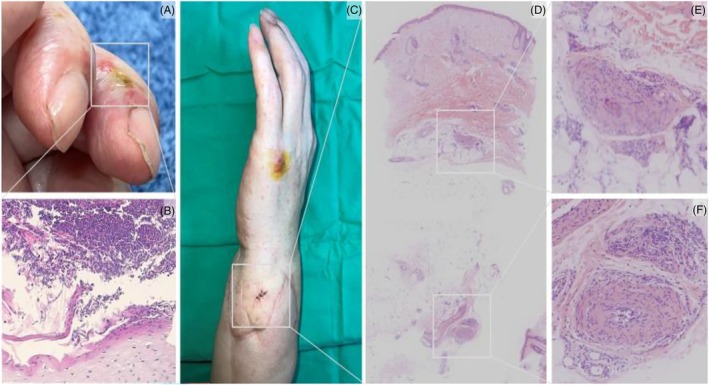 Figure 1
- —Ministry of Science and Technology, Taiwan 10.13039/100020595
- —Kaohsiung Medical University Hospital, Taiwan 10.13039/501100011645
Peer Reviews
No public reviews on file for this paper yet. If you reviewed it on a platform where reviews are public (OpenReview, ICLR, NeurIPS, ICML), you can paste yours below so the community can read it here.
Videos
No videos yet. Explain this paper in a talk, walkthrough, or lecture? Add one.
Taxonomy
TopicsOrgan and Tissue Transplantation Research · Polyomavirus and related diseases · Nonmelanoma Skin Cancer Studies
A vascularized composite allotransplantation (VCA) of the upper extremity is a proven treatment option for selected patients who have acquired upper limb loss. After transplantation, transplant recipients are at high risk of contracting infections because of immunosuppressive therapies. As a result, maintaining the health status of VCA patients is challenging, since organ rejection is triggered by T‐cell recognition of antigens, either because of infection or immune activation.1 In VCA allografts, acute rejection is usually detected directly from the graft, which partly explains the high diagnosis rate. As there are no assays for graft rejection for monitoring purposes, infection of the allograft could make diagnosis more difficult.2 The present report describes a hand transplant recipient who developed erythematous plaques and nail ulcers after the SARS‐CoV‐2 infection, and eventually whose transplanted hand had to be removed.
These 53‐year‐old males who suffered from crushed injury of his left upper limb received below‐elbow allograft hand transplantation in 2014. Following his allotransplantation, he took oral immunosuppressive agents including mychophenolate mofetil, tacrolimus, and prednisolone, as well as topical immunosuppressive ointment. He presented with edematous change over his allotransplanted hand in 2022 (Figure 1A). Upon inspection, erythematous plaques were found over his proximal nail fold of left fingers, with necrotic change and pus like discharge over his third and fourth finger (Figure 1B). Prior to the appearance of the plaques, he was infected with SARS‐CoV‐2, so his immunosuppressive agents were reduced to aid his recovery. Based on the pathological findings of the fourth finger skin biopsy, the plaques were identified as sub‐corneal pustules free of fungal elements (Figure 1A,B). Chronic rejection exhibiting intimal proliferation in vessels was noted in the subcutaneous fat in the forearm skin biopsy (Figure 1C–F). During the follow‐up, pale skin, graft edema, and rash were found (Figure 1C), with acute and chronic rejection proven from biopsy. The titration of immunosuppressive agents did not yield satisfactory results to reverse the rejection. Due to the patient's immunocompromised status and the uncontrolled rejection, the transplanted hand was amputated.
The use of immunosuppressants increases the risk of contracting SARS‐CoV‐2 in transplant recipients. SARS‐CoV‐2 recovery may be improved with the reduction of immunosuppressants, but damage to transplanted hand resulting from inflammatory responses is significantly more detrimental. Skin rejection typically manifests as a maculopapular erythematous rash on the upper forearm and dorsum of the hands, sparing the palm and nails.3 Atypical rejection characterized by nail changes and palmar involvement were rare, as described by Schneeberger et al. in their study.3 An immune dysregulation induced by SARS‐CoV‐2 can lead to fatal immune responses.4 The high rejection rate among renal and pancreatic transplant recipients with COVID‐19 suggests widespread immune reactivation despite immunosuppressive therapy.5
Our patient's immunocompromised status makes him particularly susceptible to coinfections. A prompt graft skin biopsy may be able to provide the most accurate early diagnosis. Consequently, the allotransplanted hand was removed because of uncontrolled rejection and infection, and the patients recovered uneventfully. In our experience, closely monitoring VCA patients with SARS‐CoV‐2 infection can result in an earlier rejection detection, which may lead to the patient surviving their allotransplant.
CONFLICT OF INTEREST STATEMENT
The authors declare no conflict of interest.
The reference list from the paper itself. Each links out to its DOI / PubMed record.
- 1Alhumaid S , Rabaan AA , Dhama K , Yong SJ , Nainu F , Hajissa K , et al. Solid organ rejection following SARS‐Co V‐2 vaccination or COVID‐19 infection: a systematic review and meta‐analysis. Vaccines (Basel). 2022;10(8):1289.36016180 10.3390/vaccines 10081289 PMC 9412452 · doi ↗ · pubmed ↗
- 2Kaufman CL , Marvin MR , Chilton PM , Hoying JB , Williams SK , Tien H , et al. Immunobiology in VCA. Transpl Int. 2016;29(6):644–654.26924305 10.1111/tri.12764 · doi ↗ · pubmed ↗
- 3Schneeberger S , Gorantla VS , van Riet RP , Lanzetta M , Vereecken P , van Holder C , et al. Atypical acute rejection after hand transplantation. Am J Transplant. 2008;8(3):688–696.18261182 10.1111/j.1600-6143.2007.02105.x · doi ↗ · pubmed ↗
- 4Giamarellos‐Bourboulis EJ , Netea MG , Rovina N , Akinosoglou K , Antoniadou A , Antonakos N , et al. Complex immune dysregulation in COVID‐19 patients with severe respiratory failure. Cell Host Microbe. 2020;27(6):992–1000.e 3.32320677 10.1016/j.chom.2020.04.009PMC 7172841 · doi ↗ · pubmed ↗
- 5Aziz F , Muth B , Parajuli S , Garg N , Mohamed M , Mandelbrot D , et al. Unusually high rates of acute rejection during the COVID‐19 pandemic: cause for concern? Kidney Int. 2020;98(2):513–514.32569652 10.1016/j.kint.2020.05.038PMC 7305724 · doi ↗ · pubmed ↗