Emergence of a novel high-level tigecycline resistance gene tet(X6) variant coexisting with tet(X2) and two tet(X) copies in a Sphingobacterium sp
Qiu Xu, Jie Hou, Stefan Schwarz, Jiyun Chai, Longhua Lin, Caiping Ma, Yao Zhu, Wanjiang Zhang

Abstract
Genes, proteins, chemicals, diseases, species, mutations and cell lines named across the full text — each resolved to its canonical identifier and authoritative record.
Click any figure to enlarge with its caption.
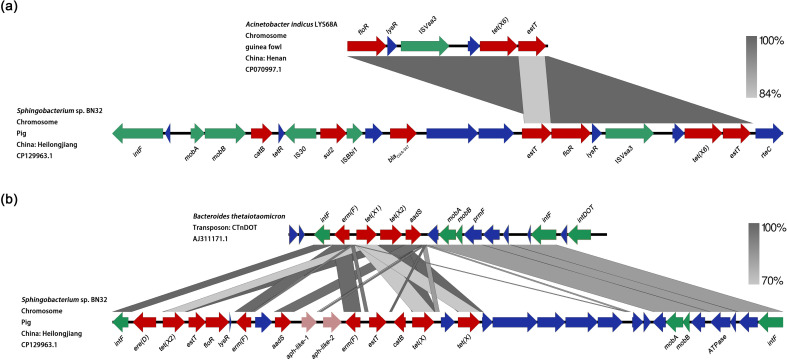 Fig 1
Fig 1- —National Science Foundation of Heilongjiang Province of China
- —Central Public-interest Scientific Institution Basal Research Fund
Peer Reviews
No public reviews on file for this paper yet. If you reviewed it on a platform where reviews are public (OpenReview, ICLR, NeurIPS, ICML), you can paste yours below so the community can read it here.
Videos
No videos yet. Explain this paper in a talk, walkthrough, or lecture? Add one.
Taxonomy
TopicsAntibiotic Resistance in Bacteria · Pharmaceutical and Antibiotic Environmental Impacts · Bacteriophages and microbial interactions
LETTER
Tigecycline represents one of the last-resort drugs for the treatment of life-threatening infections caused by multi-drug-resistant (MDR) Gram-negative bacteria, especially carbapenem- and colistin-resistant Enterobacteriaceae. In 2019, the occurrence of mobile high-level tigecycline resistance genes, tet(X3) and tet(X4), in isolates from animals, humans, and the environment poses a significant threat to public health (1, 2). Subsequently, some other tet(X) variants, tet(X5)–tet(X22), were also identified in various species of bacteria (3). Among them, the genes tet(X4) and tet(X6) were reported to occur commonly (4). The tet(X6) gene was first identified on SXT/R391 integrative and conjugative element (ICE) ICEPgs6Chn1 in a tigecycline-resistant Proteus genomospecies from retail pork in China (5). Similar to genes tet(X3) and tet(X4), the tet(X6) gene was able to confer high-level resistance to tigecycline, as well as the newly approved eravacycline and omadacycline. Until now, the tet(X6) gene has been identified in Proteus, Acinetobacter, and Escherichia (6). The genus Sphingobacterium, a member of Bacteroidota, was first described by Yabuuchi et al. in 1983 based on the presence of large amounts of sphingophospholipids in their cell membranes (7). Currently, the Sphingobacterium is regarded as an opportunistic pathogen associated with some human infections, such as bacteremia and peritonitis (8). In this study, we identified a novel chromosome-borne tet(X6) variant and its co-occurrence with tet(X2) and two tet(X) copies in a Sphingobacterium sp. BN32.
In October 2021, strain BN32 was isolated from the feces sample in Heilongjiang province, China, using a Columbia CNA blood agar plate containing tigecycline (2 mg/L). Species identification was conducted using 16S rRNA sequencing, and the result showed that strain BN32 was identified as Sphingobacterium sp. The genomic DNA of strain BN32 was extracted and subjected to whole genome sequencing (WGS) utilizing combined Illumina Hiseq (short reads) and Oxford Nanopore MinION (long reads) platforms. The de novo hybrid assembly was carried out using Unicycler v. 0.4.3, followed by genome annotation using both the RAST server (http://rast.nmpdr.org/) and BLAST (https://blast.ncbi.nlm.nih.gov/Blast.cgi). WGS revealed that strain BN32 harbored only a circular chromosome (4,373,748 bp). The whole genome sequences of strain BN32 have been deposited into the GenBank database under accession number CP129963. ResFinder analysis combining BLAST analysis indicated that strain BN32 carried multiple acquired antimicrobial resistance genes (ARGs), including aadS, ere(D), estT (four copies), sul2, blaOXA-347, erm(F) (two copies), floR (two copies), catB (two copies), tet(X) (two copies), tet(X2), and tet(X6). Phylogenetic analysis among tet(X) variants revealed that this tet(X6) gene was a novel variant (Fig. S1), which exhibited 97.63% nucleotide identity to the original tet(X6) (GenBank accession no. MN507533). To verify the function of the tet(X6) variant, the intact ORF of the tet(X6) variant, together with the predicted promoter, was amplified and ligated into the vector pUC19. The recombinant vector was then transferred chemically to Escherichia coli DH5α, followed by antimicrobial susceptibility testing. A 16- to 64-fold increase in the MICs of all tested tetracyclines was observed for the E. coli transformant. Among them, the MIC for tigecycline was a 32-fold increase compared with E. coli DH5α carrying the empty vector (from 0.125 to 4 mg/L), and this indicated that the novel tet(X6) variant was active against tetracyclines, including tigecycline. To the best of our knowledge, this is the first report of the tet(X6) gene in Sphingobacterium. In order to investigate the transferability of the tet(X6) variant, a conjugative transfer assay was performed using rifampin-resistant E. coli C600 as the recipient. Despite repeated attempts, transconjugants were not obtained. Genetic context analysis revealed that this tet(X6) variant was located in an MDR region. A ca. 6-kb core fragment harboring the tet(X6) variant exhibited >99% identity (99% coverage) to the corresponding regions of chromosomes or plasmids in various Acinetobacter isolates (Fig. 1a). This observation suggested that the tet(X6) variant possibly originated from Acinetobacter sp. In addition, two identical tet(X) genes exhibited 99.91% nucleotide identity to the prototype tet(X) gene (GenBank accession no. M37699), with one transversional point mutation (C-T) at position 1,077. Sequence analysis showed that similar to the tet(X6) variant, two tet(X) genes together with the tet(X2) gene were also located in a large MDR region. Sequence comparison suggested that this MDR region was located in a CTnDOT-like structure, which shared similarity with a conjugative transposon CTnDOT (GenBank accession no. AJ311171) previously described in Bacteroides (9) (Fig. 1b). However, the intDOT gene, which coded for a tyrosine recombinase that was responsible for catalyzing the integration and excision of CTnDOT (10), was absent in the BN32 strain. Of note, two putative aminoglycoside resistance genes, which we named aph-like-1 and aph-like-2, respectively, were also found in the MDR region (Fig. 1b). Gene annotation and comparisons revealed that both of them encoded aminoglycoside phosphotransferases, which implied that they may be two novel aminoglycoside resistance genes and their functions need further investigation.
(a) Genetic environment of the tet(X6) variant in Sphingobacterium sp. BN32. (b) Genetic environment of two tet(X) and tet(X2) in Sphingobacterium sp. BN32. Arrows indicate the directions of transcription of the genes, and different genes are shown in different colors. Genes are color-coded as follows: green, mobilization; red, antimicrobial resistance; light red, putative antimicrobial resistance; blue, other proteins. Regions of homology are denoted by blue shading.
To conclude, we identified the emergence of a novel tet(X6) variant, together with tet(X2) and two tet(X) genes, mapped on the chromosome by different MDR regions in a Sphingobacterium sp. As a reservoir of ARGs, it is necessary to continue monitoring Sphingobacterium sp. of different origins.
The reference list from the paper itself. Each links out to its DOI / PubMed record.
- 1He T, Wang R, Liu D, Walsh TR, Zhang R, Lv Y, Ke Y, Ji Q, Wei R, Liu Z, et al.. 2019. Emergence of plasmid-mediated high-level tigecycline resistance genes in animals and humans. Nat Microbiol 4:1450–1456. doi:10.1038/s 41564-019-0445-231133751 · doi ↗ · pubmed ↗
- 2Sun J, Chen C, Cui CY, Zhang Y, Liu X, Cui ZH, Ma XY, Feng YJ, Fang LX, Lian XL, Zhang RM, Tang YZ, Zhang KX, Liu HM, Zhuang ZH, Zhou SD, Lv JN, Du H, Huang B, Yu FY, Mathema B, Kreiswirth BN, Liao XP, Chen L, Liu YH. 2019. Plasmid-encoded tet(X) genes that confer high-level tigecycline resistance in Escherichia coli. Nat Microbiol 4:1457–1464. doi:10.1038/s 41564-019-0496-431235960 PMC 6707864 · doi ↗ · pubmed ↗
- 3Lu XY, Zhang LF, Peng K, Wang QJ, Liu RQ, Wang ZQ, Li RC. 2023. Characterisation of a novel tigecycline resistance gene tet(X 22) and its coexistence with bla NDM-1 in a Pseudomonas caeni isolate. Int J Antimicrob Agents 62:106961. doi:10.1016/j.ijantimicag.2023.10696137666436 · doi ↗ · pubmed ↗
- 4Zheng XR, Zhu JH, Zhang J, Cai P, Sun YH, Chang MX, Fang LX, Sun J, Jiang HX. 2020. A novel plasmid-borne tet(X 6) variant co-existing with bla NDM-1 and bla OXA-58 in a chicken Acinetobacter baumannii isolate. J Antimicrob Chemother 75:3397–3399. doi:10.1093/jac/dkaa 34232766775 · doi ↗ · pubmed ↗
- 5He DD, Wang LL, Zhao S, Liu L, Liu JH, Hu GZ, Pan YS. 2020. A novel tigecycline resistance gene, tet(X 6), on an SXT/R 391 integrative and conjugative element in a Proteus genomospecies 6 isolate of retail meat origin. J Antimicrob Chemother 75:1159–1164. doi:10.1093/jac/dkaa 01232016288 · doi ↗ · pubmed ↗
- 6Usui M, Fukuda A, Suzuki Y, Nakajima C, Tamura Y. 2022. Broad-host-range Inc W plasmid harbouring tet(X) in Escherichia coli isolated from pigs in Japan. J Glob Antimicrob Resist 28:97–101. doi:10.1016/j.jgar.2021.12.01234936926 · doi ↗ · pubmed ↗
- 7Yabuuchi E, Kaneko T, Yano I, Moss CW, Miyoshi N. 1983. Sphingobacterium gen. nov., Sphingobacterium spiritivorum comb. nov., Sphingobacterium multivorum comb. nov., Sphingobacterium mizutae sp. nov., and Flavobacterium indologenes sp. nov.: glucose-nonfermenting gram-negative rods in CDC groups IIK-2 and I Ib. Int J Syst Bacteriol 33:580–598. doi:10.1099/00207713-33-3-580 · doi ↗
- 8Zhang R, Dong N, Shen ZQ, Zeng Y, Lu JY, Liu CC, Zhou HW, Hu YY, Sun QL, Cheng QP, Shu LB, Cai JC, Chan EWC, Chen GX, Chen S. 2020. Epidemiological and phylogenetic analysis reveals Flavobacteriaceae as potential ancestral source of tigecycline resistance gene tet(X). Nat Commun 11:4648. doi:10.1038/s 41467-020-18475-932938927 PMC 7494873 · doi ↗ · pubmed ↗