Deep Sedation in High-risk Patients Undergoing Emergency Upper GI Endoscopy: A Retrospective Study Assessing Safety and Effectiveness
Martina Mariani, Romolo Villani, Anna De Simone, Simona Cotena, Rossella Pirolli, Manuela Nugnes, Silvio Canciello, Paolino Manganiello, Elena Santoriello, Francesca Schettino, Vincenzo Schettini, Giorgia Bruno, Raffaele Annunziata

TL;DR
This study examines the safety and effectiveness of deep sedation during emergency upper GI endoscopy in high-risk patients.
Contribution
The study provides new insights into the safety of deep sedation in high-risk emergency GI endoscopy settings.
Findings
No significant difference in complications between moderate and deep sedation.
Adverse outcomes during deep sedation were rare.
Deep sedation is safe for high-risk emergency GI procedures.
Abstract
Emergency upper gastrointestinal (GI) endoscopy is often prolonged and complex, performed during high-risk conditions. These procedures can be affected by an increased risk for airway compromise. Scarce literature can be found providing guidance on anesthesiological conduct during upper GI endoscopy in Emergency. This was a monocentric retrospective study conducted on 96 patients treated in the Emergency Gastroenterology Unit at AORN Cardarelli, between June and October 2023. Key features of moderate and deep sedation procedures were investigated. There was no statistically significant difference in the incidence of complications and respiratory depression between the patients receiving moderate sedation versus those treated with deep sedation. Adverse outcomes of sedation and analgesia during endoscopic procedures are rare, even during a deep state of sedation.
Genes, proteins, chemicals, diseases, species, mutations and cell lines named across the full text — each resolved to its canonical identifier and authoritative record.
Click any figure to enlarge with its caption.
 Figure 1
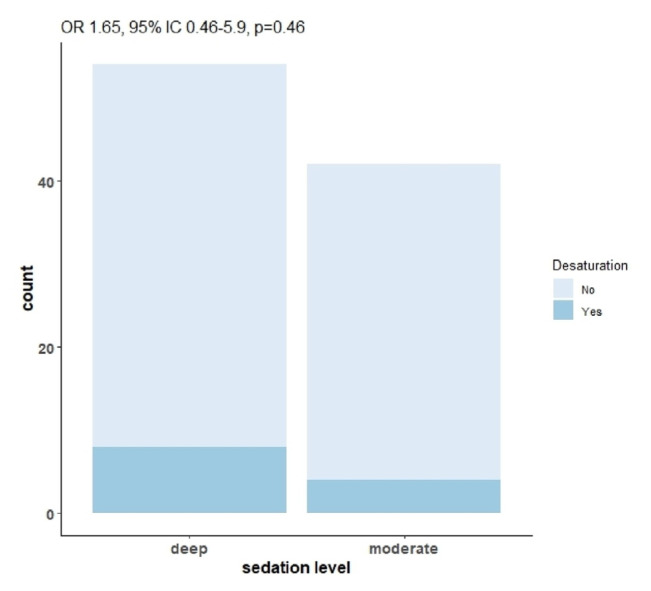 Figure 2
Peer Reviews
No public reviews on file for this paper yet. If you reviewed it on a platform where reviews are public (OpenReview, ICLR, NeurIPS, ICML), you can paste yours below so the community can read it here.
Videos
No videos yet. Explain this paper in a talk, walkthrough, or lecture? Add one.
Taxonomy
TopicsAnesthesia and Sedative Agents · Nausea and vomiting management · Airway Management and Intubation Techniques