CAG-targeted brain-permeable therapy tested in biallelic humanized polyQ mouse models
Magdalena Surdyka, Żaneta Kalinowska-Pośka, Anna Niewiadomska-Cimicka, Ewelina Jesion, Agnieszka Fiszer, Elisabeth Singer-Mikosch, Lorraine Fievet, Lukasz Przybyl, Nicholas S. Caron, Michael R. Hayden, Huu Phuc Nguyen, Yvon Trottier, Maciej Figiel

TL;DR
This study tests a brain-targeted therapy for polyglutamine diseases using shRNAs delivered through the blood, showing reduced toxic protein with minimal side effects in mice.
Contribution
The study demonstrates a non-invasive, brain-permeable CAG-targeted therapy with improved silencing and reduced toxicity in biallelic polyQ disease models.
Findings
CAG-targeted shRNAs reduced mutant huntingtin and ataxin-3 proteins and aggregates in mouse brains.
AAV-PHP.eB delivery achieved brain transduction with minimal toxicity compared to other shRNAs.
The approach shows potential for targeting somatic expansion and accelerating drug development for polyQ diseases.
Abstract
In polyglutamine (polyQ) diseases, including Huntington disease (HD) and spinocerebellar ataxia type 3 (SCA3), targeting the mutant CAG tract in mRNA could be a therapeutic strategy for lowering pathogenic protein. We explored the viability of this therapeutic strategy in vivo at the level of the reagent design, toxicity, systemic delivery, brain regions transduction, silencing efficiency, and allele preference. We designed a series of CAG-directed short hairpin RNAs (shRNAs) based on a previous A2 reagent, allele selective in vitro. Humanized HD (Hu128Q/21Q) and SCA3 (Ki150Q/21Q) mice with mutant ∼100 CAGs and normal 21 CAGs alleles were used to simulate biallelic conditions occurring in patients. We administered AAV-PHP.eB shRNAs-encoding vectors into the blood as an equivalent of non-invasive CAG-directed brain-targeted therapy crossing the blood-brain barrier. We demonstrate that…
Genes, proteins, chemicals, diseases, species, mutations and cell lines named across the full text — each resolved to its canonical identifier and authoritative record.
Click any figure to enlarge with its caption.
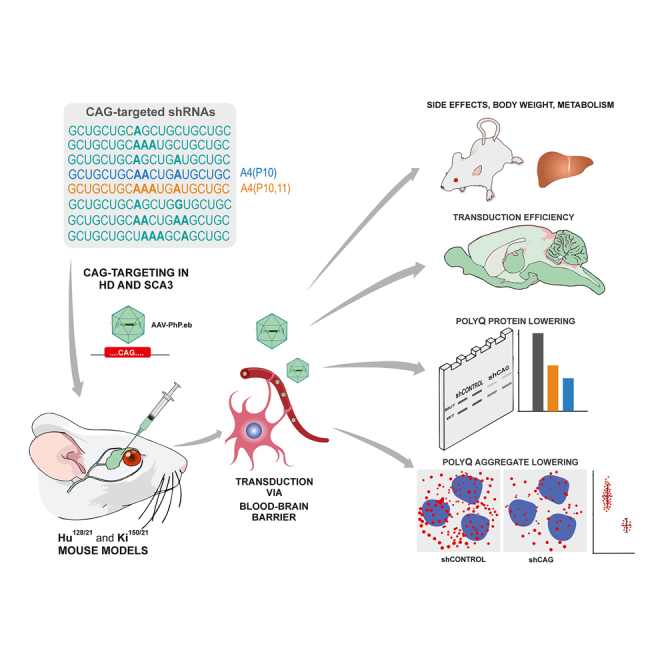 Figure 1
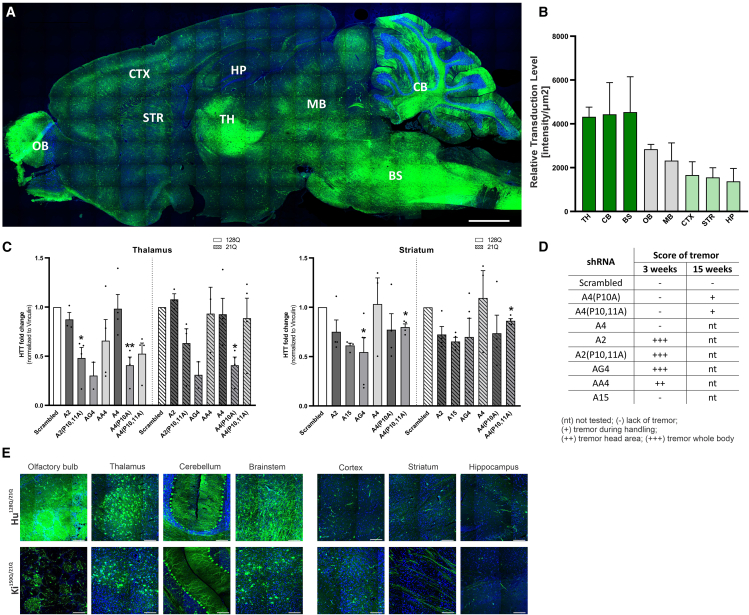 Figure 2
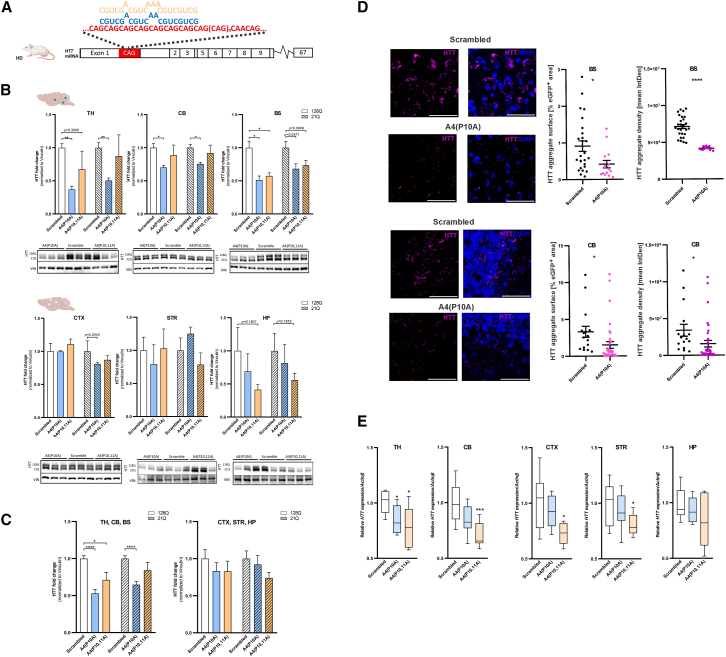 Figure 3
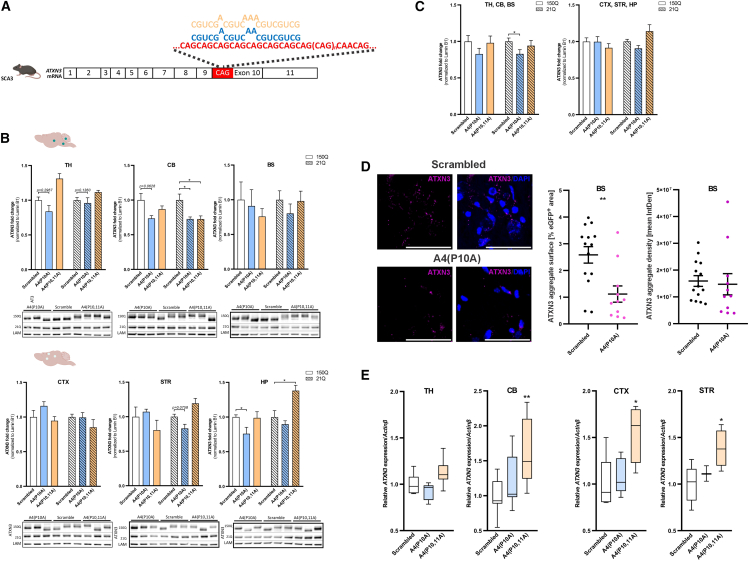 Figure 4
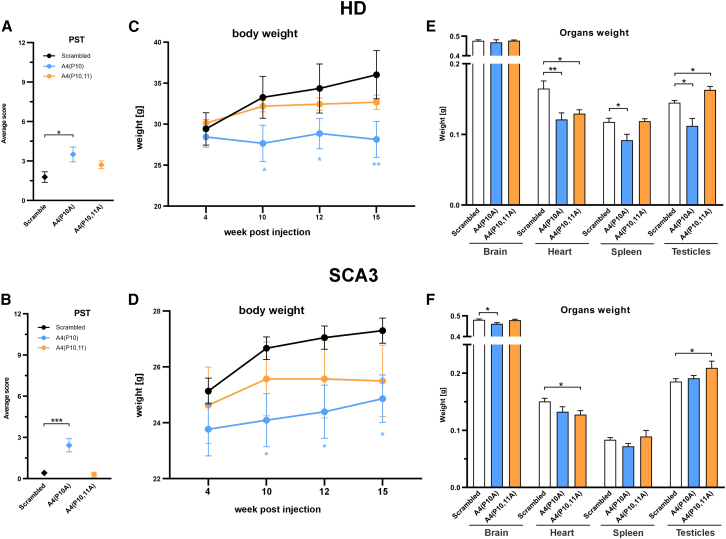 Figure 5
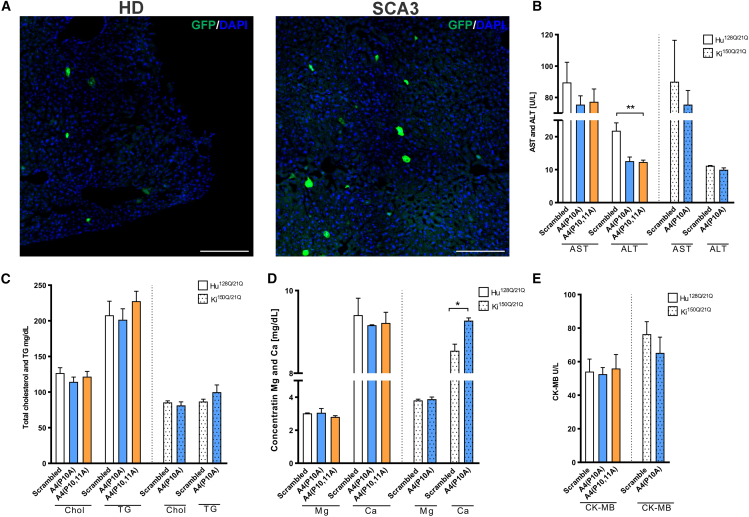 Figure 6
Peer Reviews
No public reviews on file for this paper yet. If you reviewed it on a platform where reviews are public (OpenReview, ICLR, NeurIPS, ICML), you can paste yours below so the community can read it here.
Videos
No videos yet. Explain this paper in a talk, walkthrough, or lecture? Add one.
Taxonomy
TopicsGenetic Neurodegenerative Diseases · Neuroscience and Neuropharmacology Research · Neurological disorders and treatments