“Catch me if you can” - locating the “Black Sheep” neurons after early-life seizures
Yingying Tang, Xiongfeng Guo, Mengqi Yan, Cenglin Xu

TL;DR
This study identifies specific neurons affected by early-life seizures, offering new insights into preventing long-term brain damage.
Contribution
The study pinpoints activated pyramidal neurons and altered AMPARs in the hippocampus after early-life seizures.
Findings
Activated pyramidal neuron subpopulations were located in the hippocampus after early-life seizures.
Altered functions of AMPARs were demonstrated in these neurons.
Findings may guide future preventive strategies for seizure-related neurological disorders.
Abstract
Unprovoked seizures in early life are one of the most severe conditions in pediatric neurology, and are often associated with long-lasting cognitive and behavioral deficits, as well as pharmacoresistant epilepsy in adulthood in some conditions. Unillustrated mechanisms greatly restrict the development of preventive strategies for early-life seizures (ELSs) related neuronal impairments. The recent groundbreaking study published in The Journal of Clinical Investigation represents a giant leap forward in understanding the complex pathogenesis mechanism and developing targeted therapies for ELS related neuronal impairments. The authors conducted elegant experiments to locate the activated pyramidal neuron subpopulation in the hippocampus and demonstrated the altered functions of (α-amino-3-hydroxy-5-methyl-4-isoxazole propionic acid)-type glutamate receptors (AMPARs). And we believe that…
Genes, proteins, chemicals, diseases, species, mutations and cell lines named across the full text — each resolved to its canonical identifier and authoritative record.
Click any figure to enlarge with its caption.
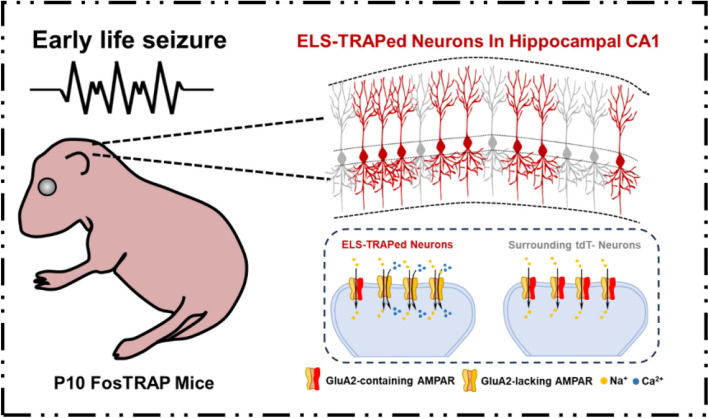 Figure 1
Peer Reviews
No public reviews on file for this paper yet. If you reviewed it on a platform where reviews are public (OpenReview, ICLR, NeurIPS, ICML), you can paste yours below so the community can read it here.
Videos
No videos yet. Explain this paper in a talk, walkthrough, or lecture? Add one.
Taxonomy
TopicsNeuroscience and Neuropharmacology Research · Epilepsy research and treatment · Lipid Membrane Structure and Behavior