A NiCo oxide/NiCo sulfate hollow nanowire-coated separator: a versatile strategy for polysulfide trapping and catalytic conversion in high-performance lithium-sulfur batteries
Jiarui Liu, Xinhai Wang, Tinghong Gao, Wensheng Yang, Qinyan Jian, Bingxian Li, Lishan He, Yunjun Ruan

TL;DR
This paper introduces a new separator material for lithium-sulfur batteries that traps and converts harmful polysulfides, significantly improving battery performance and cycle life.
Contribution
A novel hollow nanowire-coated separator using NiCo oxide/sulfate is proposed for efficient polysulfide management in lithium-sulfur batteries.
Findings
The modified separator achieves an initial capacity of 1260 mA h g−1 at 0.2C.
After 100 cycles, 75.9% of the initial capacity is retained.
The battery maintains 695 mA h g−1 after 500 cycles at 1C.
Abstract
Lithium-sulfur batteries (LSBs) are highly anticipated due to their remarkable theoretical specific energy and energy density. Nevertheless, the polysulfide shuttle effect severely curtails their cycle life, posing a significant obstacle to commercialization. Herein, we introduce nickel-cobalt oxide/nickel-cobalt sulfate hollow nanowires (NCO/NCSO-HNWs) as a separator modification material. The ingeniously designed hollow nanostructure of NCO/NCSO-HNWs endows it with a profusion of adsorption and catalytic active sites. This unique feature enables it to not only physically adsorb lithium polysulfides (LiPSs) but also catalytically convert them, thereby remarkably enhancing the anchoring and conversion efficiency of LiPSs. The LSBs equipped with NCO/NCSO-HNWs-modified separators exhibit an outstanding initial capacity of 1260 mA h g−1 at 0.2C. Even after 100 cycles, a high capacity of…
Genes, proteins, chemicals, diseases, species, mutations and cell lines named across the full text — each resolved to its canonical identifier and authoritative record.
Click any figure to enlarge with its caption.
 Figure 1
 Figure 2
 Figure 3
 Figure 4
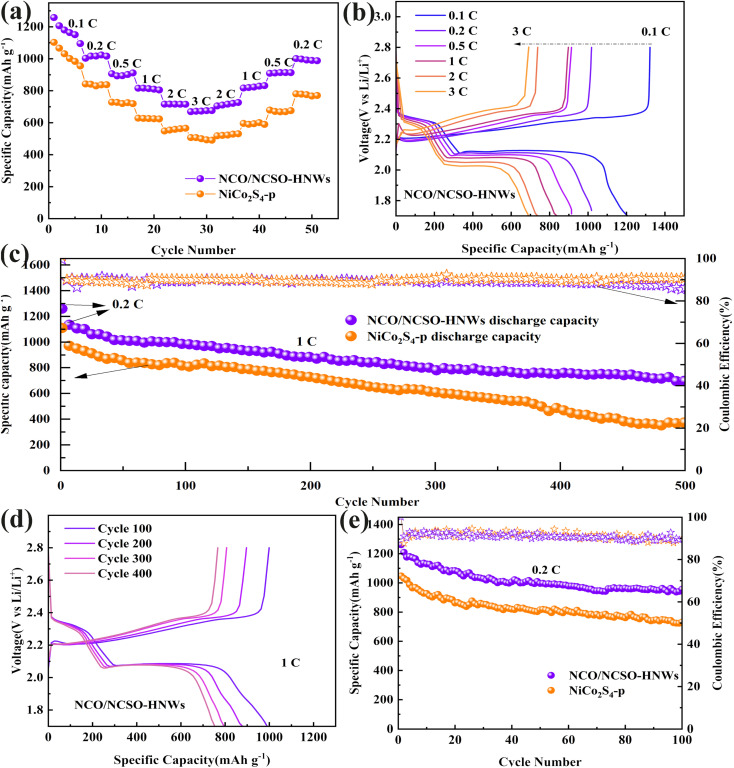 Figure 5
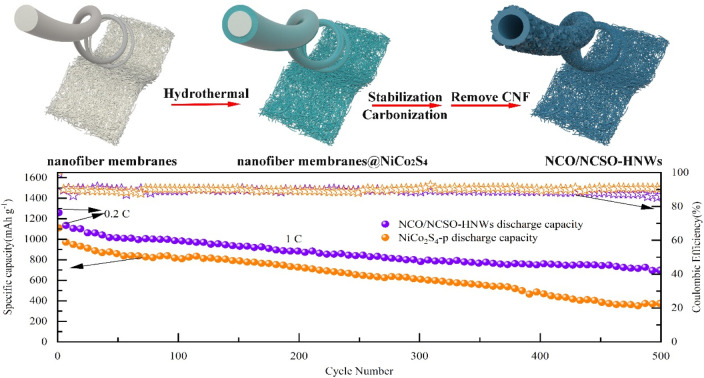 Figure 6
Peer Reviews
No public reviews on file for this paper yet. If you reviewed it on a platform where reviews are public (OpenReview, ICLR, NeurIPS, ICML), you can paste yours below so the community can read it here.
Videos
No videos yet. Explain this paper in a talk, walkthrough, or lecture? Add one.
Taxonomy
TopicsAdvanced Battery Materials and Technologies · Advancements in Battery Materials · Advanced battery technologies research